Do solar panels need heat or light to generate electricity?
Solar PV panels generate electricity from light, not heat. Here is why bright cooler days can often outperform very hot days.
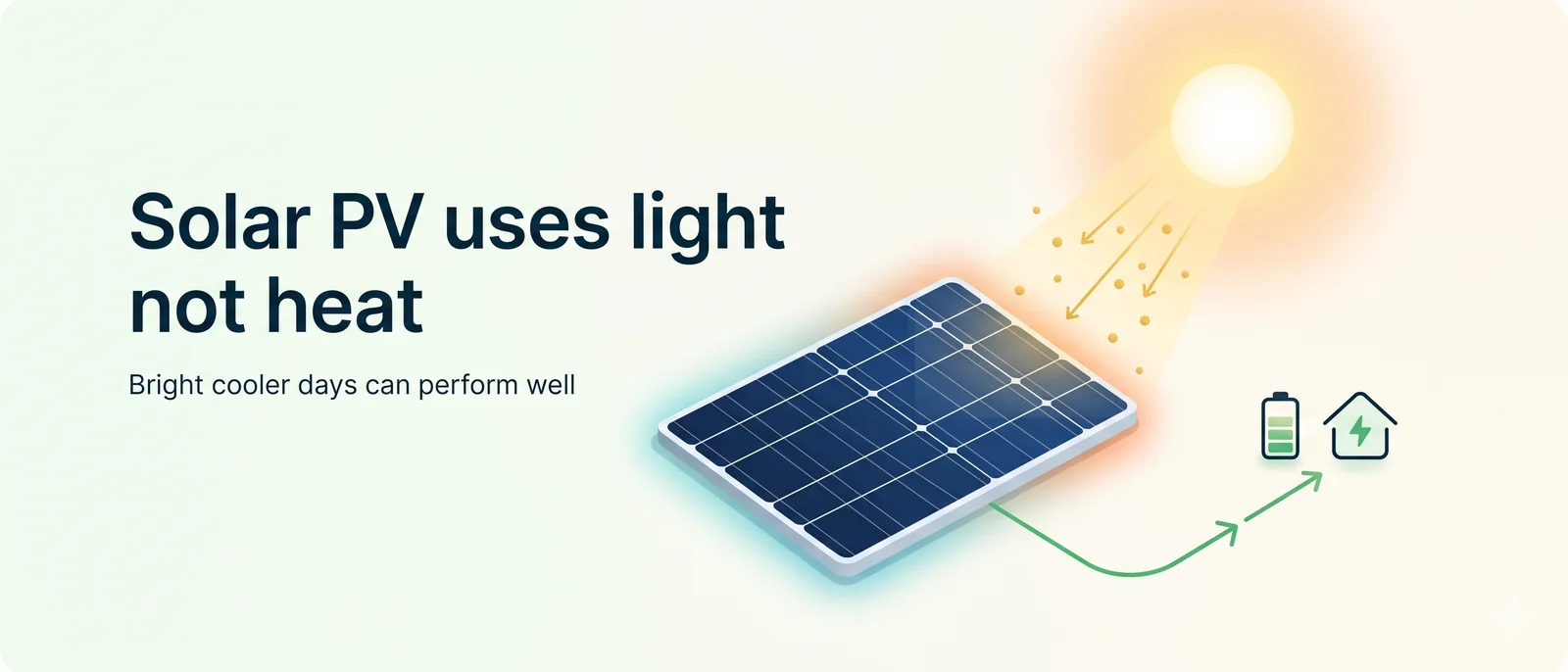
Many homeowners naturally assume solar panels work best when the weather is hot.
It feels logical. Sunshine, summer and heat all arrive together often enough that they get treated as the same thing. So when a customer sees a very warm day but the solar generation is not the highest number they have ever seen, it can feel as if something is wrong.
Usually, nothing is wrong.
Solar panels do not generate electricity from heat. They generate electricity from light.
That small difference explains why a bright, cool day can sometimes perform better than a very hot day, and why solar generation should be read beside light conditions rather than air temperature alone.
The quick version: solar PV uses light, not heat
Solar panels are often called Solar PV panels.
PV stands for photovoltaic:
- photo means light;
- voltaic relates to electricity.
So photovoltaic means turning light into electricity.
The panel is not using warmth as fuel. It is reacting to light energy from the sun. That is why solar PV is different from solar thermal, which uses the sun's heat to warm water or another fluid.
What happens inside a solar panel
A solar panel is made from layers of semiconductor material, usually silicon.
When sunlight reaches the panel, tiny packets of light energy, called photons, hit the material. Some of that light energy frees electrons inside the panel. When those electrons move through an electrical circuit, they create an electric current.
That process is the photovoltaic effect.
For a homeowner, the practical version is this:
Light hits the panel. The panel turns part of that light into electricity. The inverter then converts it into usable electricity for the home, battery or grid export.
The stronger and cleaner the light reaching the panel, the more opportunity the panel has to generate. Cloud, shade, haze, panel angle and time of day all affect that light.
Why hot weather does not always mean higher solar generation
Heat and sunlight often arrive together, but they do different things to a solar panel.
Sunlight is the input that creates electricity. Heat is more like an operating condition.
As a solar panel gets hotter, its electrical performance can drop slightly. This is normal for solar PV. The panel can still generate well on a hot day, especially when the sunlight is strong and the day is long, but the heat itself is not helping the panel produce more electricity.
That is why the highest generation day is not always the hottest day.
A very hot afternoon can bring strong sun, but it can also bring high panel temperature, haze or a less favourable sun angle. A cooler clear day can give the panel plenty of light while keeping it closer to a better working temperature.
Why bright cooler days can look so strong
Imagine two days.
The first is very hot, still and hazy. The air feels warm, but the light reaching the panels is softened by haze, and the panels are running hot.
The second is cooler, clear and bright. The sunlight is direct, the sky is clean and the panels stay cooler.
The second day can sometimes produce a stronger solar curve, especially around the middle of the day. The panels are getting the light they need without as much heat-related efficiency loss.
This is why spring can surprise people. A crisp sunny day in March, April or May can produce excellent solar generation, even if it does not feel like peak summer weather.
Common misconception: warm weather means solar should be high
Warm weather alone does not tell you what your solar should produce.
Solar generation depends on several things:
- how bright the sunlight is;
- how much cloud or haze is present;
- the time of day;
- the season and sun height;
- panel direction and angle;
- shade from trees, chimneys or nearby buildings;
- panel temperature;
- inverter limits, battery state and export behaviour.
Temperature is only one part of the picture, and it is not the source of the electricity.
If the weather is warm but cloudy, generation may be modest. If the weather is cool but the sky is clear and bright, generation can be very strong.
Common misconception: solar panels need direct summer sun to work
Direct sunlight usually gives the strongest output, but solar panels can still generate on cloudy days.
Clouds reduce the amount of light reaching the panels, so output is usually lower. But daylight still contains useful light energy, and PV panels can convert some of that into electricity.
This is why a solar dashboard often shows a softer, lower curve on overcast days rather than a flat zero. The system is still working. It simply has less light available.
Common misconception: a low day means the system has a fault
One low generation day is not usually a fault.
Solar output naturally changes with weather, shade, season and household energy behaviour. A passing cloud can change live solar power quickly. A dull winter day can generate far less than a clear spring day. A battery reaching full charge can change whether spare solar is used locally or exported.
The useful question is not "Was today's number lower than yesterday?"
It is:
Does the generation pattern make sense for the light conditions and the system setup?
If bright clear days are consistently much lower than expected, or a previously normal system suddenly changes behaviour, that is worth checking. But daily movement by itself is normal.
What your solar app is really showing you
Most solar apps show a mixture of live power and daily energy.
Live solar power is usually shown in kW. It tells you the rate of generation right now.
Daily solar generation is usually shown in kWh. It tells you how much energy the panels have produced over the day.
Those two numbers answer different questions. A cloud passing over the panels can reduce live kW immediately, while the day's kWh total will keep building as more energy is generated.
If your dashboard has solar, battery, grid and EV views, it also matters where the solar went. It may have supplied the home, charged the battery, supported EV charging or exported to the grid.
For that reason, a good home energy dashboard should explain both production and destination, not only show one solar number.
If solar, battery, grid and EV numbers feel inconsistent, why your solar dashboard numbers do not add up explains how to separate live power, daily energy, import, export and battery movement.
What homeowners should watch over time
For most homes, the best check is a simple pattern check.
Look at a few bright days rather than one moment. Ask:
- does generation rise smoothly through the morning and fall later in the day?
- do cloudy periods show as dips rather than total failure?
- does the system perform better on clear days than dull days?
- do seasonal changes make sense?
- has shade changed, for example from a growing tree or new obstruction?
- did anything change in the inverter, battery or export settings?
This gives a calmer and more useful view than comparing every warm day against the highest day you have ever seen.
What installers should explain during handover
This is a small explanation that can prevent a lot of customer confusion.
Customers often monitor a new solar system closely in the first few weeks. If they believe solar panels are powered by heat, a very hot day with ordinary generation can create unnecessary concern.
A simple handover message helps:
Solar PV uses light, not heat. Bright days matter most. Very hot panel temperatures can slightly reduce efficiency, so a cooler sunny day can sometimes perform especially well.
That explanation gives the customer a better way to read the app after installation. It also helps them understand why generation varies naturally without assuming the equipment is failing.
For a wider customer handover checklist, what to ask before solar and battery installation covers the practical questions that help customers understand system behaviour after installation.
How 1app.energy helps
Customers often have strong renewable hardware but still need one clear place to understand what the home is doing.
1app.energy gives supported homes live visibility across solar, battery, EV charging and tariff behaviour in one app. For Solis hybrid inverter and Solis inverter homes, it helps close the customer software gap by making energy flow easier to follow.
Where supported and customer-enabled, 1app.energy can also help with tariff-aware battery behaviour, EV charging context and clearer cost visibility.
The goal is not only to show that solar generated today. It is to help the customer understand what happened across the home: what solar produced, where it went, when the battery moved, whether the EV affected demand and how tariff timing changed the cost picture.
That same source-of-truth principle is covered in home energy dashboard source of truth: what to check. For Solis homes specifically, the Solis software gap explains why customers often need a clearer software layer above the inverter app.
Related reading for solar generation checks
- How to read your inverter data to spot energy waste
- Is solar still worth it if export rates drop?
- Why 1app.energy exists for UK solar battery homes
Common questions about solar panels, heat and light
Do solar panels need heat to work?
No. Solar PV panels generate electricity from light, not heat. Heat is not the fuel source.
Do solar panels work better when it is hot?
Not necessarily. Solar panels can perform well on hot sunny days because there is often plenty of sunlight, but very high panel temperature can slightly reduce efficiency. Bright cooler days can sometimes perform especially well.
Do solar panels work on cloudy days?
Yes, but usually at a lower output. Clouds reduce the amount of light reaching the panels, although daylight can still generate electricity.
Is Solar PV the same as solar thermal?
No. Solar PV generates electricity from light. Solar thermal uses heat from the sun to warm water or another fluid.
Why did my solar generate more on a cool day than a hot day?
The cooler day may have had clearer, stronger light reaching the panels, while the hot day may have had higher panel temperatures, haze, cloud or a less favourable generation pattern.
Final thought
Solar panels are powered by light, not heat.
Hot weather can arrive with strong sunshine, but heat itself is not what creates the electricity. The best solar days are often the ones with clear, strong light and panels that are not running too hot.
If you want one clearer place to understand solar, battery, EV charging and tariff behaviour in a supported home, visit 1app.energy to start early-access onboarding.
Does this sound like your home?
Your setup might already qualify.
Tell us which devices and tariff you are on. We review every request and invite in order of fit, not sign-up date.