Why 1app.energy exists for UK solar battery homes
Why UK solar battery homes need one clearer app for solar, battery, EV charging and tariff behaviour as export tariffs and grid limits change.
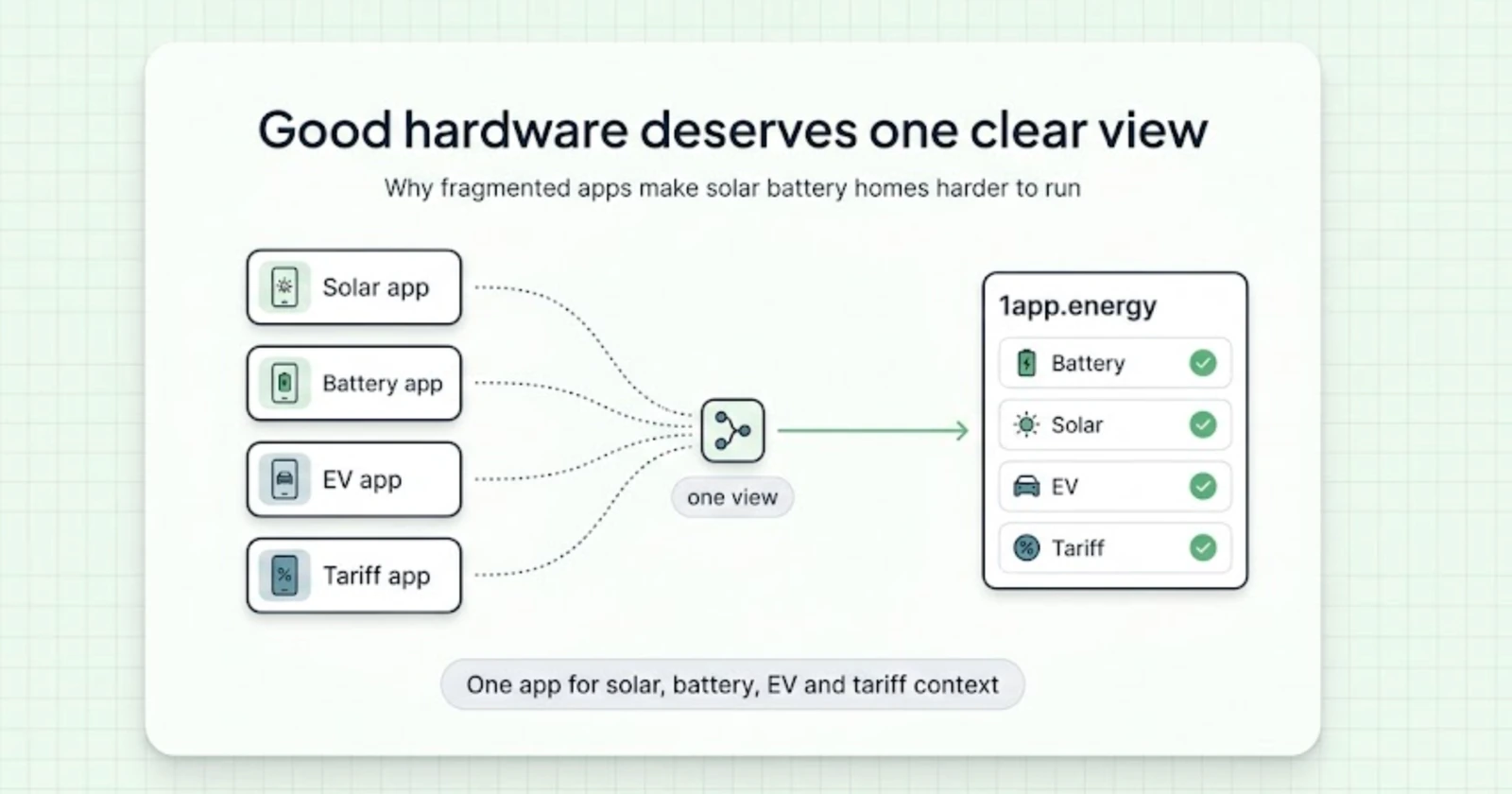
1app.energy exists because UK renewable homes have become more capable than the software experience around them.
A customer can have a strong solar and battery installation, a hybrid inverter, an EV charger, an export tariff, a time-of-use import tariff and future heat-pump plans. Each part may work on its own. The problem is that the customer still has to understand how those parts affect each other.
That is not a small inconvenience. It changes whether the home actually gets the value the customer expected.
The next phase of UK solar is not only about more panels or bigger batteries. It is about better coordination.
The quick version: why 1app.energy exists
1app.energy is a customer-facing software layer for supported renewable homes.
The core message is:
One app for solar, battery, EV and tariff.
For supported homes, 1app.energy helps customers understand live energy flow, solar generation, battery charge and discharge, grid import and export, EV charging context and tariff behaviour in one clearer place.
Where supported, verified and customer-enabled, it can also help with tariff-aware battery behaviour. That includes charging during useful off-peak periods, protecting reserve, avoiding poor EV-battery interactions and treating export as a checked decision.
It is not a promise that every device can be controlled. It is a response to a real customer software gap.
The market problem: good hardware, fragmented software
The UK solar and battery market has improved quickly.
Customers have more hardware choice. More installers are active. Solar, batteries, EV chargers and heat pumps are more familiar than they were a few years ago. Government support such as VAT relief for qualifying energy-saving materials and heat-pump grants has helped many customers think seriously about electrification.
But the customer experience after installation is still fragmented.
A typical renewable home may have:
- an inverter app;
- a battery screen;
- an EV charger app;
- a supplier app;
- a smart meter view;
- tariff documents;
- export tariff terms;
- DNO approval paperwork;
- installer handover notes.
Those sources may all be correct in isolation. The customer problem is that they do not automatically explain the home as one system.
Why export tariff changes make the software gap more important
When export rates are high and simple, customers can be tempted to think the strategy is just "export surplus".
As export rates change, that becomes too shallow.
A solar battery home needs to know whether energy is better used now, stored for later, exported, held for reserve or used for EV charging. That decision depends on import tariff, export tariff, battery state, EV demand, DNO export limit and future refill opportunity.
The customer should not have to work that out manually across several apps.
This is why falling or changing export rates strengthen the case for better software. The customer needs context, not only a battery percentage and a tariff number.
The practical export decision is covered in home battery export checks before selling stored energy, where tariff source, reserve, EV demand and export limits all have to line up before stored energy is sold.
Why DNO export limits expose the same issue
DNO export limits are another example.
An export-limited system can still be a good system. It can use solar locally, charge the battery, reduce import and support flexible loads. But the customer needs to understand what happens when solar is high, the battery is full and export is capped.
Without a whole-home view, the customer may only notice that the expected export income is lower or that solar generation appears to be clipped.
The paperwork may be correct. The inverter may be correctly configured. The customer may still not understand daily behaviour.
That is a software gap.
For the connection background, G98, G99 and G100 forms: UK solar and battery DNO guide explains why export approval and export limitation matter before daily optimisation starts.
EV charging is where many customers feel the pain
EV charging is one of the clearest reasons 1app.energy exists.
An EV charger can create a large load. The home battery may see that load and discharge into it. If the EV is charging during a cheap supplier-controlled window, that may be the wrong outcome. The customer expected cheap grid energy to charge the car and stored battery energy to protect the home later.
From one device's point of view, nothing necessarily failed.
The charger charged the car. The battery supported the home. The supplier tariff provided a charging window.
The missing part is coordination.
This is why the product is not just another inverter chart. The customer needs to know how EV charging, battery behaviour and tariff timing interact.
The issue is explained in detail in why your home battery can drain when Octopus charges your EV.
Why Solis homes are a strong starting point
Solis hybrid inverter and Solis inverter homes are a strong example of the gap.
The hardware can be a good foundation for solar and battery storage. SolisCloud can show useful inverter data. But a customer with a Solis inverter, an EV charger, a battery and a smart tariff may still need a richer whole-home software layer.
That is where 1app.energy is especially useful today.
For supported Solis-based homes, 1app.energy helps close the customer software gap by bringing solar, battery, EV charging and tariff behaviour into one clearer experience.
That does not mean replacing every manufacturer app. It means giving the customer a layer above individual devices, focused on the home outcome.
For more context, see the Solis software gap: why UK homes need a smarter energy app.
Visibility first, automation carefully
1app.energy's positioning should be cautious because energy control is a customer-trust surface.
Visibility and control are different.
Visibility means the customer can see useful data: solar generation, battery state, grid import and export, tariff periods, EV charging context where supported, and daily cost behaviour.
Control means the system can write commands to supported equipment, such as battery charging or discharging behaviour.
Those should not be treated as the same thing.
Automation should only happen where:
- the device is supported;
- the installation is verified;
- the control path is safe enough to use;
- tariff context is present;
- the customer has enabled the behaviour;
- reserve, EV and export-limit guardrails are respected.
Some homes may start with visibility only. That is still useful. It is better to be honest than to expose a control option that does not truly work end to end.
What 1app.energy is not
It is important to keep the public promise clean.
1app.energy is not:
- a replacement for a qualified installer;
- a DNO approval tool;
- a guarantee of savings;
- a promise to control every inverter or charger;
- a public claim of unsupported heat-pump control;
- an installer portal;
- a shortcut around export limits or tariff rules.
The product is stronger when the boundary is clear.
It is a customer-facing app layer for supported renewable homes, starting with the real problem customers already feel: too many disconnected energy apps and not enough whole-home understanding.
What better looks like for the customer
A better renewable-home experience should answer the questions customers actually ask:
- Where is my solar going right now?
- Why did the battery discharge?
- Did the EV charge from battery, grid or solar?
- Did I import during the expensive period?
- Did my battery charge during the cheap window?
- Was export actually useful today?
- Is my tariff setup correct?
- Is anything missing, stale or pending?
The answer should not require the customer to compare three apps and a bill.
That is what 1app.energy is aiming to provide for supported homes.
What this means for installers and partners
Installers increasingly need a post-install software story.
Customers do not only judge an installation by whether the panels generate. They judge it by whether the whole home makes sense afterwards.
If a customer has a Solis inverter, battery, EV charger and tariff, the installer can hand over a stronger message:
The hardware is installed correctly. 1app.energy gives you one clearer place to understand solar, battery, EV charging and tariff behaviour where your setup is supported.
That helps the customer feel supported after installation without promising an installer portal or unsupported control.
Why this matters now
The timing matters because the market is changing.
Export tariffs are no longer a simple upward story. DNO export limits are becoming more visible. EV charging and heat pumps are increasing household electricity demand. Smart tariffs are making timing more important. Customers are trying to protect themselves from energy-price volatility.
All of those trends point in the same direction:
The customer needs a whole-home energy layer.
That is why 1app.energy exists.
Common questions about 1app.energy
Who is 1app.energy for?
1app.energy is for UK renewable homes where solar, battery, EV charging and tariff behaviour need to be understood together. It is especially relevant for supported Solis-based homes.
Does 1app.energy control every battery?
No. Control depends on supported hardware, verified installation state, customer settings and safe backend control paths. Some homes may use visibility before automation.
Does 1app.energy support heat pumps?
Heat pumps are part of the wider electrification story customers should plan around. Any control feature should only be described for homes and integrations where it is approved and supported.
Is 1app.energy only for Solis homes?
Solis hybrid inverter and Solis inverter homes are the strongest current focus because the customer software gap is clear. 1app.energy should still be described as a supported-device platform, with LuxpowerTek treated as beta onboarding and other integrations only described when approved.
How is 1app.energy different from an inverter app?
An inverter app usually focuses on inverter and battery data. 1app.energy is designed to show the wider home context: solar, battery, EV charging and tariff behaviour together. The Solis software gap explains why that matters for UK solar battery customers.
Final thought on why 1app.energy exists
The next phase of UK home energy will not be won by hardware alone.
Customers need software that explains how solar, battery, EV charging and tariff behaviour work together inside real network, device and tariff limits.
That is the problem 1app.energy is built to solve.
Visit 1app.energy/signup to check your inverter and start signup.
Sources checked on 17 June 2026
Does this sound like your home?
Your setup might already qualify.
Tell us which devices and tariff you are on. We review every request and invite in order of fit, not sign-up date.