Octopus Streams: what EV and battery owners need to know
Octopus Streams turns daily EV plug-ins into a streak. Learn how it works, what the fish mean, and what solar battery homes should check.
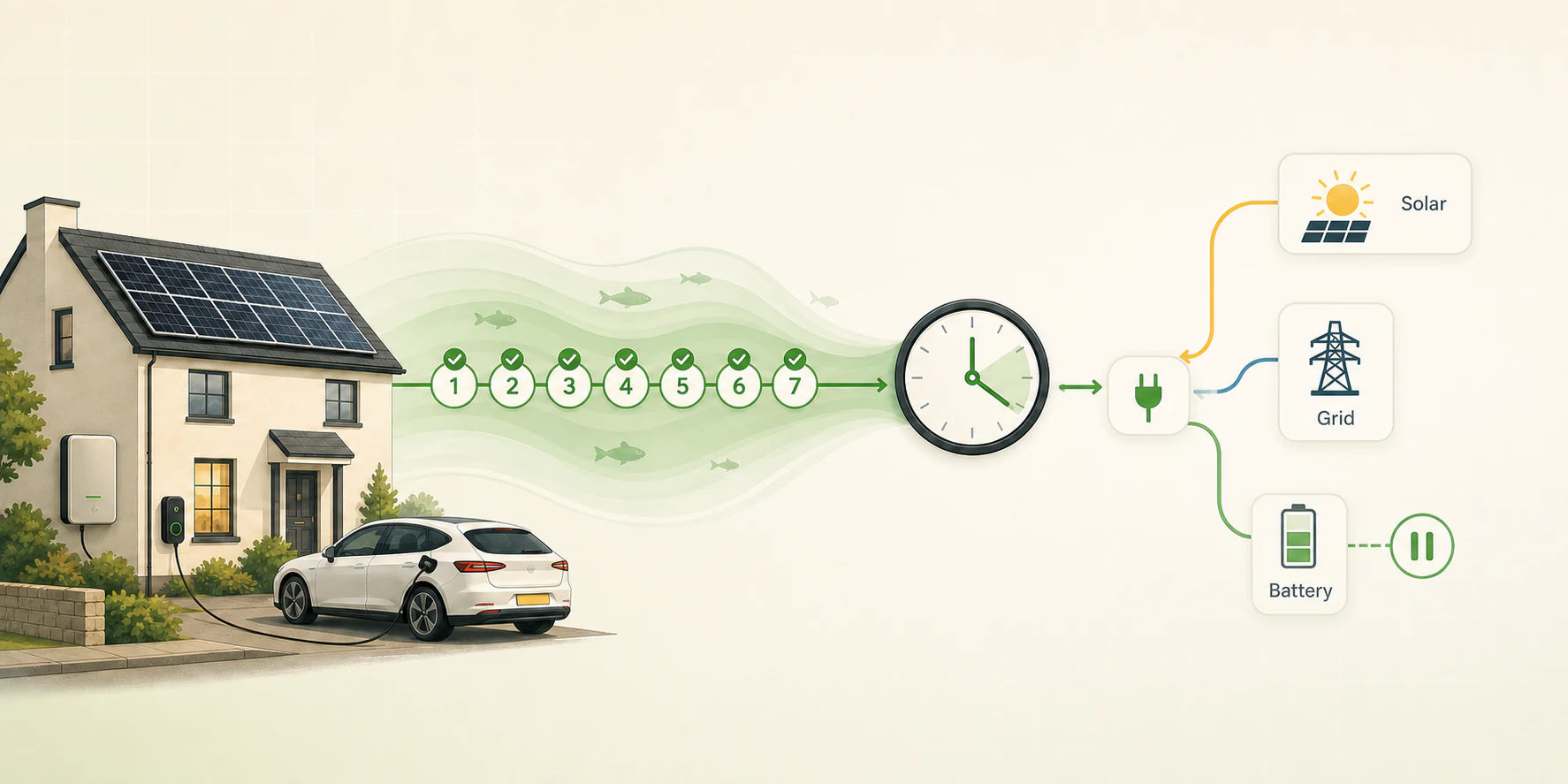
Octopus Energy launched Streams on 22 July 2026, giving Intelligent Octopus Go customers a new reason to plug in their EV whenever it is parked at home.
The feature turns daily plug-ins into a streak, with digital fish to collect and automatic safeguards for the occasional missed day.
It is a simple idea, but the name can create confusion. Streams is not a new electricity tariff, it does not mean the car must charge every day, and it does not replace the need to understand what a smart charging session does to a home battery.
This guide explains what Octopus Streams is, how the streak works, and what homes with solar, batteries and EV charging should check.
The quick version: Octopus Streams in 2026
- Streams is a feature, not a tariff. It sits inside the Octopus app for Intelligent Octopus Go customers.
- The habit is to connect the car at home each day. Octopus says a full charge is not required; making the connection is enough to keep the streak moving.
- Each day becomes a Stream, Freeze or Miss. A Freeze can protect the streak when a day is missed.
- The rewards described at launch are digital fish. Octopus says there are currently 21 to collect, with more planned.
- Being plugged in is not the same as charging. The connection gives Octopus more flexibility to choose when an eligible smart charge should happen.
- Streams does not coordinate a home battery. A solar battery home still needs to check whether an EV session used grid energy, solar or stored battery energy.
Streams rewards availability. The practical energy result still depends on when the EV charges and how the rest of the home responds.
What is Octopus Streams?
Streams is a gamified charging streak inside the Octopus Energy app.
Octopus Streams launch artwork. Source: Octopus Energy.
Octopus wants Intelligent Octopus Go customers to plug in whenever their car is at home, rather than waiting until the battery is nearly empty or trying to predict the cheapest charging period themselves.
That longer connection window gives Octopus more opportunities to schedule charging when electricity is expected to be cheaper or greener. The customer sets the charging preferences, leaves the compatible car or charger connected, and lets the smart charging system choose suitable slots.
Streams makes that routine visible. Instead of only seeing a charging schedule, the customer can build a daily streak and unlock digital fish at milestones.
You can find Streams in the Devices area of the Octopus app, on the main device control page below the charging preferences.
How do Stream, Freeze and Miss work?
Octopus checks whether the car was plugged in and gives the day one of three results:
- Stream: the car was connected and the streak continues;
- Freeze: a saved Freeze is applied automatically to protect the streak;
- Miss: the day was missed without a Freeze available, so the streak can reset.
Octopus says customers start with one Freeze and earn more as the Stream becomes longer. The launch version includes 21 digital fish, with different fish unlocked as the customer reaches new milestones.
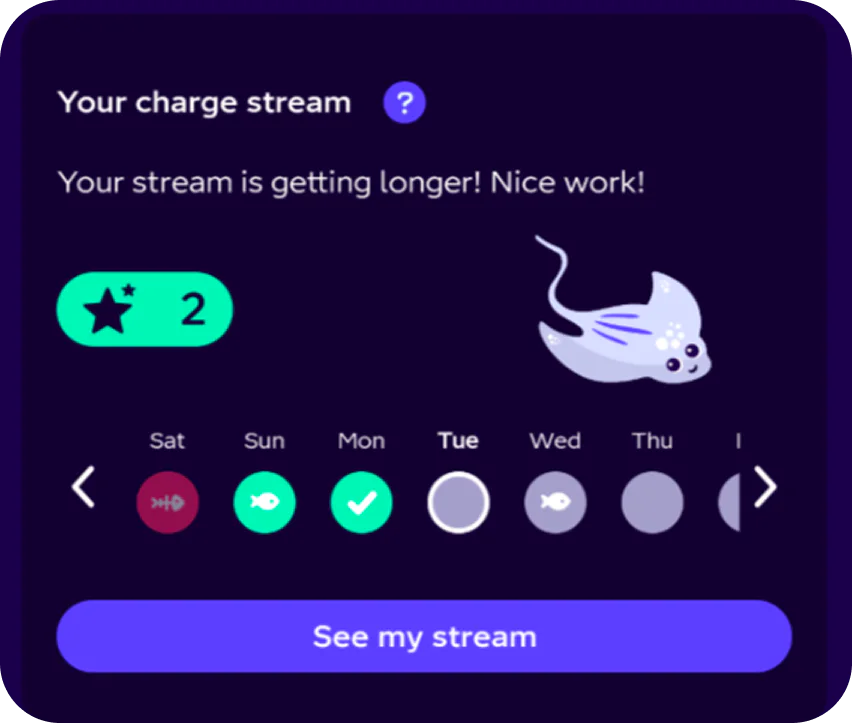
The charge Stream card in the Octopus Energy app. Source: Octopus Energy.
The important detail is that Octopus does not require a full charging session to count the day. The purpose is to build the connection habit, not to encourage customers to add energy their car does not need.
That distinction matters. Plugging in gives the smart charging system options; it does not mean the charger must immediately draw power.
Why does Octopus want EVs plugged in every day?
An EV is a large but flexible electrical load.
A petrol or diesel car must be refuelled when the driver visits a filling station. A home-charged EV can spend many hours parked and connected, while only needing a smaller number of hours to receive the required energy.
That gap gives a smart charging service room to move the demand.
If thousands of cars all start charging during the evening peak, the grid must serve a sudden rise in demand. If those cars remain connected for longer, their charging can be spread across quieter periods or moved towards times with more renewable electricity available.
Octopus uses summer daytime solar as one example. When there is abundant solar generation across the electricity system, a connected EV may be able to use a daytime smart slot rather than adding all its demand overnight.
This is about renewable availability on the wider grid. It is separate from whether a particular home has rooftop solar, and separate again from whether that home's battery is charging or discharging.
Does plugging in every day use more electricity?
Not by itself.
Octopus's current smart charging guidance says the six-hour daily allowance is based on time the car is actually smart charged, not time spent plugged in. A car can therefore remain connected without every connected hour counting as charging.
The car still needs a target and ready time that match the driver's real needs. Streams should not be a reason to request unnecessary energy, inflate the target or charge a car that is already sufficiently full.
A sensible routine is:
- plug in when the car is parked at home;
- keep the target realistic for the next journey;
- check the ready time;
- leave Octopus to schedule eligible smart charging;
- use a manual or bump charge only when the car genuinely needs energy immediately.
If a customer regularly needs a large catch-up charge, the separate six-hour charging limit also matters. Our guide to Intelligent Octopus Go Charge Cap and home batteries explains how the allowance and peak-rate overrun can work.
Does Octopus Streams change the electricity price?
Streams itself does not introduce a new unit rate.
It is a feature built around Intelligent Octopus Go. The underlying tariff still owns the import rates, guaranteed overnight window, smart charging treatment and any account-specific terms.
Octopus currently describes Intelligent Octopus Go as providing:
- a six-hour off-peak period for the whole home from 23:30 to 05:30;
- up to six hours of eligible EV smart charging at the off-peak rate each day;
- the off-peak rate for the whole home when Octopus schedules an eligible car charge outside the overnight home window;
- the peak rate for car charging beyond the daily allowance.
Rates and tariff versions can change, so customers should check the live quote and terms for their own region and account rather than copy a price from an article.
Streams may help Octopus gain more scheduling flexibility, but collecting a fish is not a separate billing event.
Do Octopus Streams fish have a cash value?
Octopus's launch announcement describes the fish as digital collectibles and a way to mark progress.
It does not describe cash rewards, bill credits or Octopoints for reaching a Stream milestone. Customers should therefore treat the fish as a fun record of the habit unless Octopus publishes a separate reward or changes the feature.
That does not make the idea pointless. A better connection habit can make smart charging more flexible and reduce last-minute catch-up charging.
But the practical value comes from giving the charging system more choice, not from assuming the streak itself pays money.
What Octopus Streams means for solar homes
For a home with solar panels, a daytime smart slot can create several possible energy flows.
The EV might receive:
- surplus solar that would otherwise have been exported;
- electricity imported from the grid at an eligible smart rate;
- energy discharged from the home battery;
- a changing mixture of all three.
Those outcomes are not interchangeable.
Using genuine surplus solar can be sensible. Importing in a confirmed discounted slot can also be sensible. Emptying the home battery into the car may be less useful if the customer wanted that stored energy for the evening.
The Streams streak does not show which of those outcomes occurred. It records the connection habit, while the tariff, smart meter, charger, inverter and battery each describe a different part of the result.
That is why solar homes should review the whole energy flow, not only whether the Stream increased.
What Octopus Streams means for home batteries
Streams does not directly control a separate home battery.
When Octopus starts a smart EV session, many inverters simply see a large new household load. If the battery is allowed to discharge, it may supply some of the EV charging even when grid electricity is available at a discounted rate.
Nothing has necessarily failed:
- Octopus scheduled the compatible EV or charger;
- the charger requested power;
- the inverter responded to household demand;
- the battery followed its configured discharge rules.
The missing piece is coordination between those systems.
This is the same issue covered in what Intelligent Octopus Go does to a home battery and why Octopus EV charging can drain stored battery energy.
A long Stream can show that the car was consistently available for smart charging. It cannot prove that the battery was protected, the right source supplied the car, or the whole home achieved the lowest cost.
What should EV and battery owners check?
Before changing schedules simply to build a longer Stream, check the following:
- Is the target realistic? Ask for the energy needed for the next journey, rather than defaulting to a large daily top-up.
- Is smart charging active? A connection alone does not prove that Octopus scheduled or completed a charging session.
- Did charging stay within the allowance? Review any warning or Charge Cap setting available on the account.
- What happened to the home battery? Compare battery state of charge before, during and after a daytime EV slot.
- Was solar genuinely surplus? Solar supplied to the car may reduce export or battery charging elsewhere in the home.
- Do the charger and inverter measure the same boundary? CT placement and topology affect whether the battery responds to EV load. The Solis, zappi and Octopus setup checklist explains the common checks.
- Did the bill and physical flow tell the same story? A discounted half-hour can still coincide with unexpected battery discharge.
A successful streak is evidence that the EV was available. It is not proof that every device in the home worked together.
How 1app.energy helps make the whole home clearer
Octopus should remain the source of truth for its tariff, smart charging schedule and bill.
1app.energy adds the customer-facing software layer for supported renewable homes, bringing solar, battery, EV and tariff context into one clearer view.
For supported and verified setups, this can help a customer see:
- when the EV was drawing power;
- whether the battery was charging, holding or discharging;
- what crossed the grid meter;
- how solar was being used;
- what the tariff context was at the same time;
- whether the battery remained ready for later home demand.
Where supported and customer-enabled, tariff-aware battery behaviour can also help the battery respond to relevant EV and tariff context instead of treating every charging session as ordinary household demand.
1app.energy does not award Streams fish, alter the Octopus streak or replace Octopus billing. Its job is to help explain and coordinate the rest of the supported home around that smart charging activity.
If you are comparing fixed and intelligent charging before changing tariff, read Octopus Go vs Intelligent Octopus Go for battery homes.
Common questions about Octopus Streams
Is Octopus Streams a new tariff?
No. Streams is a streak feature in the Octopus app for Intelligent Octopus Go customers. Intelligent Octopus Go remains the electricity tariff.
Do I need to charge my EV every day to keep the Stream?
Octopus says you only need to plug in at home; a full charge is not required. Keep the target based on the energy you actually need.
Where can I find Streams in the Octopus app?
Octopus says it appears in the Devices area, on the main device control page below the charging preferences.
What is a Freeze in Octopus Streams?
A Freeze is an earned safety net that Octopus can apply automatically when a day is missed, protecting the current streak. Customers start with one and can earn more as the Stream grows.
How many Octopus Streams fish are there?
Octopus said there were 21 digital fish to collect when Streams launched on 22 July 2026, with more planned.
Can Octopus Streams stop my home battery charging the EV?
No. Streams tracks whether the car was connected. Battery behaviour depends on the installation, inverter settings, topology and any supported coordination controls.
Does being plugged in use the six-hour charging allowance?
Octopus says only actual smart charging time counts towards the six-hour limit, not time spent connected without charging.
Final thought on Octopus Streams
Octopus Streams turns a useful smart charging habit into a visible game: plug in regularly, give the system more flexibility and collect fish as the streak grows.
For an EV-only home, that may be all the encouragement needed.
For a home with solar and a battery, the next question is more important: when the car did charge, where did the energy come from and what happened to the rest of the home?
Visit 1app.energy to start early-access onboarding and see whether your supported solar, battery, EV and tariff setup can be brought into one clearer view.
Sources checked on 23 July 2026
- Octopus Energy: Meet Streams, for the launch date, Stream, Freeze and Miss rules, digital fish, feature location and daily plug-in explanation.
- Intelligent Octopus Go, for the current smart charging structure and live tariff framing.
- Octopus smart charging and Charge Cap, for the six-hour allowance, connected-versus-charging distinction and charging guidance.
- Octopus smart tariff terms, for the current Intelligent Octopus Go tariff conditions.
Does this sound like your home?
Your setup might already qualify.
Choose your inverter to start. Supported homes create an account straight away; other setups join the compatibility list.