Octopus Go vs Intelligent Octopus Go: which suits battery homes?
Octopus Go vs Intelligent Octopus Go for homes with a battery: 2026 windows and rates, how EV dispatch affects stored solar, and which tariff fits your home.
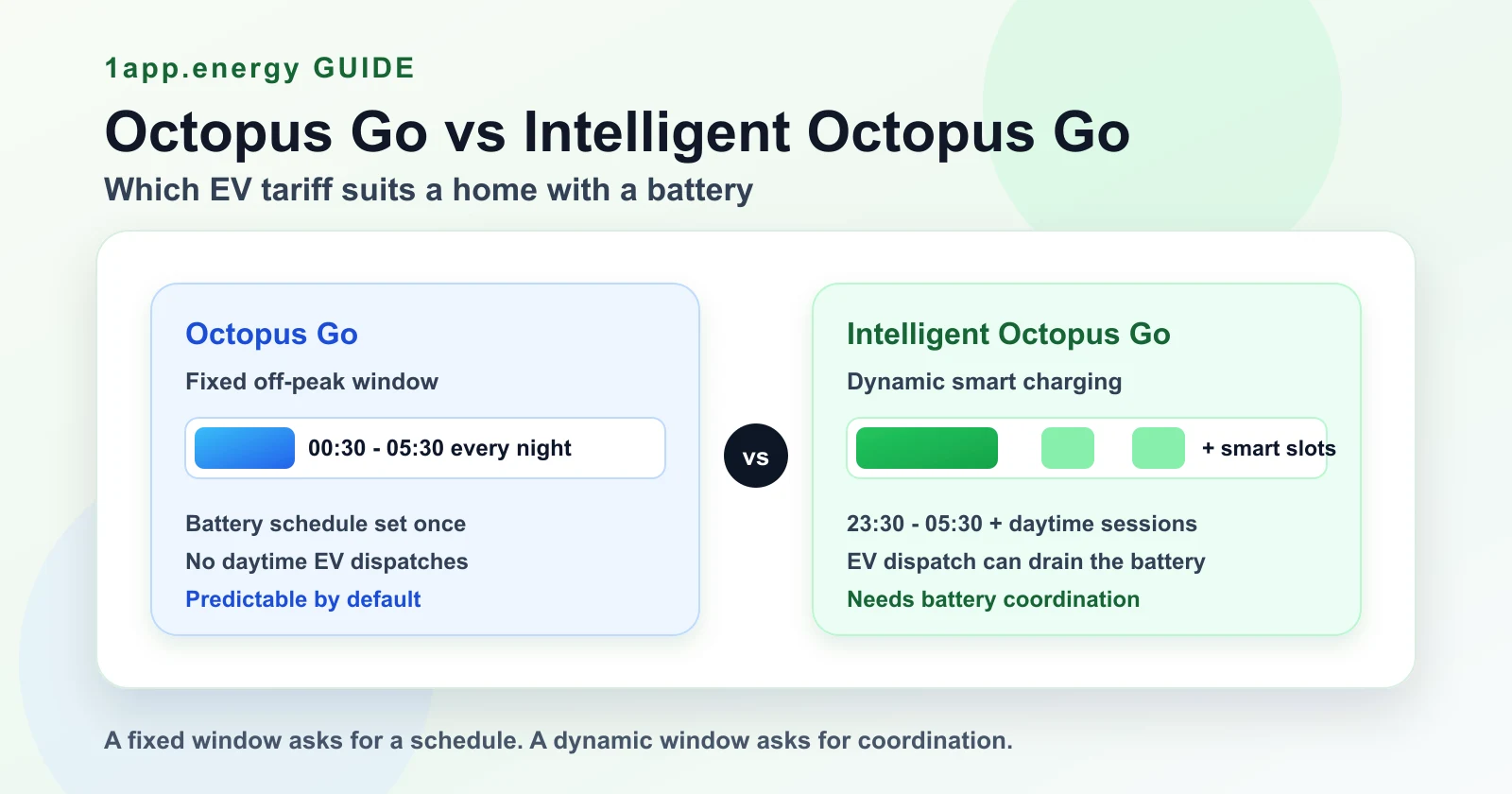
Octopus Go and Intelligent Octopus Go are both built to make EV charging cheap. At a headline level they look similar: a low overnight rate, a standard daytime rate, and eligibility tied to owning an EV.
For an EV-only household, the choice is mostly about convenience. For a home with solar and a battery, the choice changes how the whole house behaves, and picking the wrong one can quietly cost more than the tariff saves.
This guide compares the two as they stand in June 2026, with the battery-owner's view front and centre.
The short answer: Octopus Go is predictable and battery-friendly by default. Intelligent Octopus Go has the higher ceiling, but only when something coordinates the battery with its dynamic charging windows.
The quick version: Octopus Go vs Intelligent Octopus Go in 2026
- Octopus Go gives a fixed five-hour off-peak window, currently 00:30 to 05:30 every night per Octopus's Go page, at an off-peak rate that is typically higher than Intelligent Octopus Go's. Rates vary by region; check the live quote.
- Intelligent Octopus Go gives a six-hour home off-peak window, 23:30 to 05:30, at a typically lower off-peak rate, plus Octopus-scheduled smart charging for the car of up to six hours a day, which can land outside the night window.
- Go works with any EV charged at home and a compatible smart meter. Intelligent Octopus Go needs an eligible vehicle or an eligible charger. Either route qualifies, and for many homes the car itself is the connection.
- A battery can be scheduled confidently around Go's fixed window. Intelligent Octopus Go's daytime dispatches can pull stored solar out of an uncoordinated battery.
- Intelligent Octopus Go added a Charge Cap and a clearer rate structure in 2026; that changes the billing maths for battery homes.
- On paper, Intelligent Octopus Go is the more economical option for eligible homes: six cheap hours instead of five, at a lower rate. Whether it wins in practice depends on one question: will anything coordinate your battery with the tariff, or is the battery on its own?
What Octopus Go offers a battery home in 2026
Octopus Go is the simple one. As of 17 June 2026, Octopus's Go page describes a 00:30 to 05:30 off-peak window every night, five hours at a fixed time, with regional pricing shown in your quote. Its off-peak rate is typically a little higher than Intelligent Octopus Go's: you are paying for predictability rather than the lowest possible rate.
The window repeats at the same time for the tariff period. That predictability is worth a lot to a battery home: your inverter's charge schedule, your EV charging timer and your battery hold window can all be set once and reviewed occasionally, rather than managed nightly. Recheck them if Octopus changes its terms, your tariff renews, or your hardware setup changes.
Eligibility is also looser: you need an EV you charge at home and a compatible smart meter, but not a specific charger brand.
The trade-off is that Go never gets smarter than its window. There are no extra cheap hours on windy nights and no scheduling done for you.
What Intelligent Octopus Go changes
Intelligent Octopus Go is the automated one. As of 17 June 2026, Octopus's Intelligent Go page shows a 23:30 to 05:30 home off-peak window, six hours and an hour longer than Go's, plus Octopus-scheduled smart EV charging for eligible setups. The off-peak rate is typically lower than Octopus Go's, which is why eligible homes looking for the most economical option usually start here.
The key mechanic: Octopus connects directly to the car or to the charger. An eligible vehicle is enough on its own, because many EV brands link through the Octopus app. An eligible charger covers homes whose car cannot connect. Either route qualifies. Octopus then schedules the car's charging itself: some sessions land overnight, some land in the afternoon when the grid is cheap and green.
When Octopus schedules the car outside the night window, the eligible charging is billed at the smart rate. Do not assume other household or battery imports during a smart slot are discounted unless Octopus confirms it for your account. The 2026 four-rate structure and the six-hour allowance are unpacked in detail in the Intelligent Octopus Go Charge Cap guide.
For an EV-only home, all of this is upside. For a battery home, it introduces the coordination problem.
Why a fixed window is friendlier to a home battery
A battery management system needs to know when to charge, when to hold and when to discharge. With Go, those instructions can be written once: charge in the 00:30 to 05:30 window, hold through it, discharge for the home afterwards.
With Intelligent Octopus Go, the EV's charging window moves every day. A battery hold schedule set for the night window offers no protection during a 14:00 dispatch on a sunny Wednesday.
What happens instead: the EV starts drawing power, the inverter sees a large home load, and the battery does exactly what it was configured to do: it discharges into that load. The solar energy you stored all morning ends up in the car at battery round-trip losses, while the car would have been billed at the smart rate anyway.
Some inverter brands offer partial help, such as a solar divert mode, tariff-aware scheduling or export controls, but a typical home battery still does not receive Octopus's live EV dispatch signal. Check your exact inverter and charger combination before assuming the battery will hold back during a smart session.
That failure mode is invisible on the bill and very visible in the evening, when the battery is flat at 18:00. It is the single most common complaint pattern from battery homes on smart EV tariffs, and it is covered step by step in why a home battery drains when Octopus charges the EV.
Preventing exactly this is one of the jobs 1app.energy was built for: where supported, verified and customer-enabled, Smart Control watches the tariff windows and EV charging and holds the battery back, so stored solar is not lost to a dispatch the battery never knew about.
A worked example: 10kWh battery and 4kW solar on each tariff
For a home with a 10kWh battery and 4kW of solar, here is an illustrative comparison rather than a universal result.
On Octopus Go:
- Battery charges in the fixed 00:30 to 05:30 window where the inverter schedule supports it.
- No unexpected daytime discharge into EV sessions.
- Stored solar usually reaches the evening peak.
- What you configured is what you get.
On Intelligent Octopus Go, uncoordinated:
- Battery charges overnight as scheduled.
- Two to four daytime smart sessions a week each pull several kWh of stored solar into the car.
- The battery hits the evening lower than expected on those days, and the home imports at peak rates instead.
- The lost stored-solar value can quietly offset much of the tariff's advantage. The mechanics are unpacked in what really happens to your home battery on Intelligent Go.
On Intelligent Octopus Go, with whole-home coordination:
- The battery holds back during detected smart sessions, where inverter control is supported and verified.
- The EV charges from scheduled grid supply at the smart rate; stored solar stays for the evening.
- Net result: the higher ceiling of Intelligent Octopus Go is actually reached.
Which Octopus tariff should a battery home choose?
Choose Octopus Go if:
- You do not have a battery, or nothing in your setup will coordinate the battery with dynamic charging windows.
- Your EV charging is predictable and overnight-only.
- You value simplicity and a schedule you set once.
Choose Intelligent Octopus Go if:
- You have an eligible vehicle or an eligible charger and meet the current eligibility rules.
- You want the more economical setup: a lower off-peak rate and six cheap hours instead of five.
- You want carbon-aware scheduling in addition to price-aware scheduling.
- Something coordinates your battery with the dispatch windows: inverter-native features where they exist, or a supported coordination layer such as 1app.energy Smart Control, where supported, verified and customer-enabled. Choosing between its modes is covered in which 1app.energy Smart Control mode you should use.
- You want the extra smart sessions and are set up so they charge the car, not drain the battery.
The honest answer is that Intelligent Octopus Go is the higher-ceiling tariff, but the ceiling only exists for homes where the EV, the tariff data and the battery are actually coordinated. Without that, Go's fixed window usually produces the better whole-home outcome, not because its rate is better, but because nothing fights the battery.
What about Octopus Flux and Agile for a battery home?
Go and Intelligent Octopus Go are import-focused: they assume the win is cheap charging. Homes with larger solar arrays sometimes do better on an export-led tariff instead.
That route now runs through Intelligent Octopus Flux, where Octopus itself controls a compatible battery and exports into the 16:00 to 19:00 peak. The brand list and conditions are worth reading first, and we cover them in Intelligent Octopus Flux: what battery owners should check.
Octopus Agile prices every half hour against the wholesale market. It can beat Go on cheap days, but it only works for a battery home when something reads tomorrow's prices and schedules charging into the cheapest slots. The trade-offs are compared in Octopus Agile vs Go for home batteries.
Common questions about Octopus Go vs Intelligent Octopus Go
Is Intelligent Octopus Go cheaper than Octopus Go?
On the rates, typically yes: Intelligent Octopus Go's off-peak rate is usually lower than Go's, and the cheap window is six hours against Go's five, so it is the more economical option for eligible homes. For the whole home, it depends on whether daytime dispatches drain your battery. An uncoordinated battery can give back the difference. Check the live regional rates on Octopus's pages; they change.
Does Intelligent Octopus Go drain a home battery?
It can, indirectly. Octopus dispatches the EV; your battery sees a big home load and discharges into it unless it has been told not to. Coordination is what prevents it, and that is what 1app.energy Smart Control is designed to help with for supported Solis, zappi and Octopus homes, where verified and customer-enabled.
What is the Intelligent Octopus Go charge cap?
A 2026 feature: the car gets up to six hours of off-peak smart charging per day, measured midday to midday, with a cap designed to stop expensive overrun. Battery homes should read the billing details before assuming every smart slot is cheap for the whole house.
Can I get Intelligent Octopus Go without a compatible EV or charger?
No. The direct connection to the car or the charger is the product. An eligible vehicle is enough on its own, so you do not need a specific charger brand if the car connects, and an eligible charger covers homes whose car cannot. If both are unsupported, Octopus Go is the available option of the two.
Do I need to change battery settings when switching between these tariffs?
Yes. At minimum, review the charge window (00:30 to 05:30 on Go, 23:30 to 05:30 on Intelligent Octopus Go) and any hold or reserve schedules. Moving to Intelligent Octopus Go without revisiting battery behaviour is how most stored-solar losses start.
Sources checked on 17 June 2026
- Octopus Go tariff page, for the fixed off-peak window, eligibility wording and regional quote flow.
- Intelligent Octopus Go tariff page, for the home off-peak window, smart charging eligibility and current product wording.
- Octopus Intelligent Go Charge Cap explainer, for Octopus's own explanation of smart charging and the 2026 Charge Cap structure.
Final thought on Octopus Go vs Intelligent Octopus Go
The tariff names suggest the choice is about intelligence. For a battery home it is really about coordination.
A fixed window asks nothing of your battery except a schedule. A dynamic window asks your battery to know things it cannot know on its own. Pick the tariff that matches the coordination your home actually has, or add the coordination and take the higher ceiling.
Visit 1app.energy/signup to check whether your Solis, zappi and Octopus setup is supported and start signup.
Relevant smart controls
These mode pages are the closest product-side follow-on from the issue explained in this article.
Home First
A simpler home-first mode. It runs the home from your own solar and battery first and avoids automatic battery export.
Autopilot
The best starting mode for most homes. Autopilot charges when power is cheap, keeps battery back for the home, and can export spare battery power when prices are high.
Time-based Control
A simple schedule-based mode. Time-based Control charges the battery during your cheaper tariff periods until it reaches the battery target you set.
Does this sound like your home?
Your setup might already qualify.
Choose your inverter to start. Supported homes create an account straight away; other setups join the compatibility list.