Fogstar batteries with Solis or LuxpowerTek: what customers need
Fogstar batteries can pair with Solis and LuxpowerTek systems. Here is why customers still need one clear app for battery, EV charging and tariff behaviour.
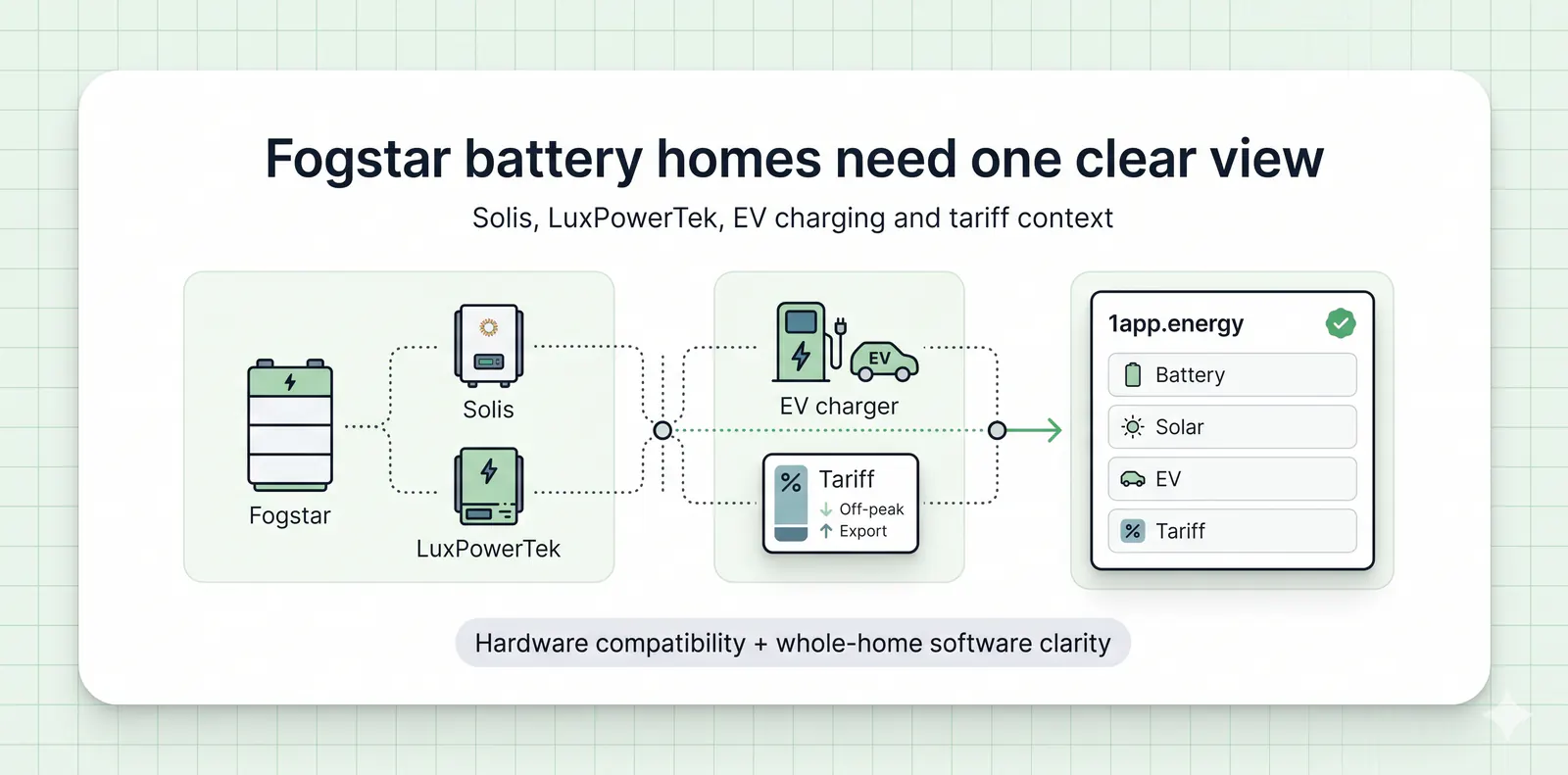
Fogstar batteries have become a common choice in UK solar battery homes, especially where customers want a large 48V battery system at a sensible price point.
That matters for 1app.energy because many homes we see are built around a familiar pattern:
- a Fogstar battery;
- a Solis hybrid inverter or Solis inverter setup;
- solar panels;
- an EV charger;
- an Octopus tariff or another time-of-use tariff;
- a customer trying to understand whether the whole home is behaving properly.
Fogstar has also published that Fogstar Energy batteries are now officially integrated with LuxpowerTek inverters. That is useful news for customers and installers, because it gives another hardware route for a Fogstar battery home.
But it does not remove the customer software problem.
Battery-inverter compatibility helps the battery and inverter communicate. It does not automatically explain EV charging, Octopus smart slots, export value, manual tariffs, daily cost, or why a battery was empty before the evening peak.
That is where the customer layer matters.
The important distinction: hardware compatibility is not whole-home clarity
When a battery is compatible with an inverter, the first job is technical.
The battery management system and inverter need to communicate safely. The inverter needs to understand state of charge, charge and discharge limits, battery availability and protection rules. If that layer is wrong, nothing else matters.
Fogstar's ESR51.2 supported-inverter guidance lists Solis support for the rack battery, and Fogstar's LuxpowerTek announcement says the two products are designed to work together as an integrated storage system. That is the hardware foundation.
The customer question comes after that:
Now that the battery and inverter work together, is the whole home using energy sensibly?
That is a different question.
A customer may still need to know:
- Did the battery charge during the cheapest tariff window?
- Did the EV charger drain the home battery during the day?
- Did the home import from the grid during the expensive evening period?
- Was export actually worth it, or would stored energy have been better kept for later?
- Is the dashboard showing a whole-home picture, or only inverter data?
- Is the tariff data correct for this home, not copied from another customer's setup?
Those are not battery compatibility questions. They are software coordination questions.
Why Fogstar and Solis homes are a strong fit for 1app.energy
Solis remains one of the clearest examples of the software gap in UK renewable homes.
A Solis inverter can be a strong hardware choice. A Fogstar battery can be a strong storage choice. The customer can still end up with multiple apps and no simple explanation of the whole home.
That is why we wrote about the Solis inverter software gap.
The problem is not that the inverter or battery is bad. The problem is that modern homes have more moving parts than a single inverter app is usually designed to explain.
For example, a Fogstar + Solis customer may also have:
- myenergi zappi EV charging;
- Octopus Intelligent Go, Octopus Go, Agile or Flux;
- manual import and export rates;
- solar generation that changes by season;
- export payments;
- a reserve floor they do not want the battery to go below;
- different behaviour on workdays and weekends.
In that home, the useful customer question is not just "is the battery connected?".
It is:
Is my solar, battery, EV charging and tariff working together today?
1app.energy is built around that question.
Why the LuxpowerTek announcement matters
Fogstar's LuxpowerTek announcement is important because it gives customers another supported hardware route.
For a customer planning a new system, that may mean a Fogstar battery and LuxpowerTek inverter can be designed together from the start. For an installer, it may make procurement and compatibility conversations easier. For a customer already comparing Solis and LuxpowerTek options, it gives another reason to think carefully about the whole system, not only the battery size.
But the customer experience still needs the same things:
- live solar, battery, grid and home-load context;
- tariff-aware daily cost visibility;
- EV charging context where supported;
- clear import and export behaviour;
- safe control only where the device path is verified and enabled.
That is why LuxpowerTek homes are in controlled 1app.energy onboarding. The point is not to claim every LuxpowerTek home can be fully automated immediately. The point is to bring LuxpowerTek inverter data into the same customer layer carefully, with telemetry first and control only where the installation supports it.
That is the right way to handle battery control. A customer-facing app should not pretend control exists until credentials, plant selection, inverter profile and readback behaviour are verified.
Where EV charging creates the biggest confusion
For many Fogstar battery homes, the confusion appears when an EV charger is added.
The battery is normally configured to support the home. When household demand appears, the battery discharges. That is sensible for normal loads.
But an EV charger can look like a very large household load.
If the car starts charging during the day, the battery may discharge into the EV session. From the inverter's point of view, it is supporting the home. From the customer's point of view, the battery may have lost stored solar energy before the evening peak.
That is one of the most common reasons customers feel that the system is "not doing what they expected".
We explain this pattern in more detail in why Octopus EV charging can drain a home battery.
For supported homes, 1app.energy helps by putting EV charging, battery behaviour and tariff timing into one view. Where supported and customer-enabled, the app can also protect against unwanted battery drain during peak-rate EV charging.
The key phrase is "where supported and customer-enabled". EV and battery control should always be treated as a verified device-control path, not a marketing promise.
Tariff context is what turns battery data into useful decisions
A battery percentage on its own is not enough.
55% battery at 10:00 may be fine. 55% battery at 17:30 before an expensive evening peak may be a problem. Charging from the grid at 03:00 may be sensible on a cheap tariff. Charging from the grid at 18:00 may be expensive unless there is a specific reason.
That is why tariff context matters.
1app.energy supports Octopus tariff context where available, and also supports manual tariff setup for non-Octopus or manually reviewed tariffs.
That matters for Fogstar battery homes because customers do not all use the same supplier.
Some homes are on Octopus Intelligent Go. Some are on Agile. Some are on fixed day/night tariffs. Some have export rates that need to be entered manually. Some are changing supplier and need the dashboard to stay honest during the transition.
The app should not assume one customer's tariff for another customer.
The right approach is simple:
- use verified tariff data where supported;
- let the customer enter manual rates where needed;
- show costs only against the tariff assigned to that installation;
- avoid confident cost claims when tariff data is missing.
That is better for trust than showing polished but wrong numbers.
What a Fogstar customer should check before relying on any app
Whether the home uses Solis, LuxpowerTek or another inverter, the customer should check the basics first.
1. Is the inverter-battery combination actually supported?
Start with the inverter and battery documentation. Fogstar's supported-inverter page is a useful reference point for ESR51.2 systems, and the LuxpowerTek announcement gives context for Fogstar + LuxpowerTek pairing.
The installer still needs to commission the system correctly. G98, G99 and any export-limitation requirements should be handled through the correct installer and DNO process. We cover that wider paperwork context in G98, G99 and G100 explained for UK solar battery homes.
2. Is the battery state of charge believable?
If the battery says 55%, does that match what happened today?
Look at the solar generation, home demand, grid import, EV charging and export behaviour around it. If the battery percentage changed sharply during an EV session, the EV may have pulled from the battery.
Our guide on reading inverter data to spot energy waste gives a practical checklist for this.
3. Is the tariff set correctly?
Check import periods, export rate, standing charge and timezone.
If the tariff is wrong, cost views and battery decisions can look wrong even when the hardware is working.
4. Is EV charging visible in the same picture?
If the EV charger is outside the energy picture, the customer may not understand why the battery dropped. For zappi homes, CT mapping and source direction also matter. We explain that in zappi CT mapping for solar battery homes.
5. Is automation actually enabled and supported?
Visibility and automation are not the same thing.
An app can show useful telemetry without being allowed to control a battery. Control should only be enabled when the connected inverter path supports it, the customer has enabled it, and the backend has verified the control route.
That is especially important while newer integrations are still being onboarded carefully.
Where 1app.energy fits
1app.energy is not trying to replace Fogstar, Solis, LuxpowerTek or the installer's commissioning work.
Those layers matter.
Fogstar supplies the battery. Solis or LuxpowerTek provides the inverter layer. The installer designs and commissions the system. The supplier provides the tariff. The EV charger manages the car.
1app.energy sits above those parts as the customer-facing coordination layer.
For supported homes, it helps the customer understand:
- solar generation;
- battery charge and discharge;
- grid import and export;
- EV charging context;
- tariff timing;
- daily cost and export credit;
- whether the system is behaving sensibly.
For supported and customer-enabled control paths, it can also help the battery behave around tariff windows and EV charging demand.
That is the value for Fogstar battery customers: not another hardware claim, but a clearer daily customer experience.
Why this helps installers too
Installers are judged long after installation day.
The customer may not remember every wiring choice, protocol setting or commissioning detail. They remember whether the system makes sense when they open the app.
If a Fogstar + Solis or Fogstar + LuxpowerTek customer can see one clear picture of solar, battery, EV and tariff behaviour, the system feels easier to own.
That can reduce avoidable questions such as:
- "Why did my battery empty before the evening?"
- "Did my car charge from the battery?"
- "Why did I import from the grid when it was sunny?"
- "Was my cheap tariff actually used?"
- "Should I change the battery reserve?"
The installer still owns the physical install. 1app.energy helps the customer understand the installed system day to day.
Common questions about Fogstar batteries with Solis or LuxpowerTek
Does Fogstar compatibility mean my whole home is optimised?
No. Battery-inverter compatibility is the hardware foundation. Whole-home optimisation still depends on tariff data, EV charging context, battery reserve settings and supported control capability.
Can a Fogstar battery work with Solis?
Fogstar publishes supported-inverter guidance for its ESR51.2 rack battery, including Solis support. The installer still needs to confirm the exact inverter model, commissioning settings and site design.
Why does the LuxpowerTek announcement matter?
It gives Fogstar customers another hardware route where the battery and inverter can be designed together. It does not remove the need for a customer-facing app that explains solar, battery, EV and tariff behaviour.
Can 1app.energy control every Fogstar battery setup?
No. 1app.energy control depends on the inverter route, verified credentials, telemetry quality and customer-enabled settings. Some homes may start with visibility before control is enabled.
What should a Fogstar customer check first?
Start with hardware compatibility and installer commissioning. Then check whether tariff data, EV charging context and battery behaviour are visible in one place.
Sources checked on 17 June 2026
- Fogstar ESR51.2 supported-inverter guidance, for Solis compatibility context.
- Fogstar LuxpowerTek integration announcement, for the Fogstar and LuxpowerTek pairing.
Final thought on Fogstar battery homes
Fogstar battery compatibility with Solis and LuxpowerTek is useful because it gives customers and installers more hardware choice.
But the customer still needs the system to make sense after handover.
That is where 1app.energy adds value: one clearer customer app for solar, battery, EV charging and tariff behaviour, with automation only where the connected devices support it and the customer enables it.
If you have a Fogstar battery with Solis today, or you are planning a Fogstar + LuxpowerTek setup, visit 1app.energy/signup to check your inverter and start signup.
Does this sound like your home?
Your setup might already qualify.
Tell us which devices and tariff you are on. We review every request and invite in order of fit, not sign-up date.