The Solis software gap: why UK homes need a smarter energy app
Solis inverter homes often need one clearer app for solar, battery, EV charging and tariffs. See how 1app.energy helps close the Solis software gap.
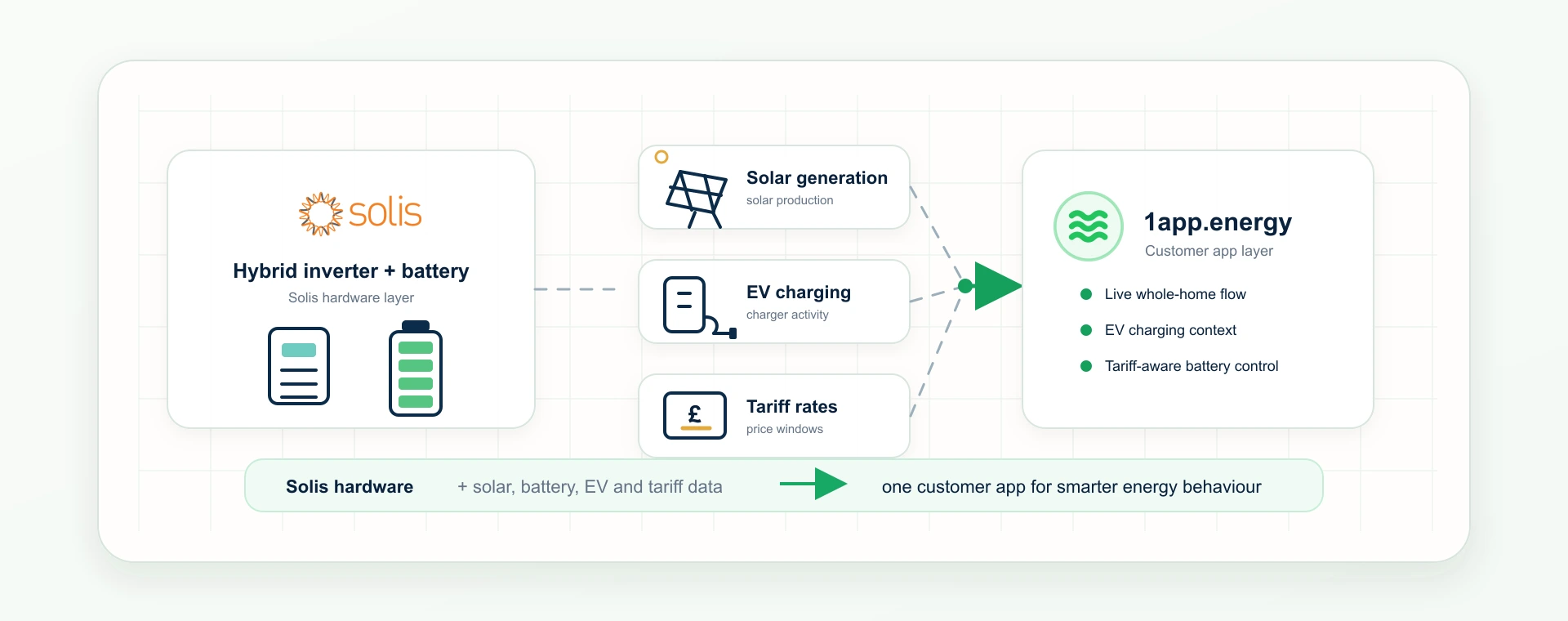
Solis hybrid inverters and Solis inverter systems are widely used in UK solar and battery installations. The hardware can be a strong choice: it gives customers a way to generate solar energy, store it in a battery, import from the grid, export surplus energy and monitor inverter behaviour through SolisCloud.
But once a home adds an EV charger, an Octopus smart tariff, export payments and a battery charging strategy, the customer problem becomes bigger than inverter monitoring.
The missing part is often the connected software layer.
A Solis inverter can show useful inverter data. An EV charger app can show charging sessions. A supplier app can show tariff information. But the customer still has to work out how all of those things affect each other:
- Is the EV charging from the grid, solar or the battery?
- Did the battery charge at the cheapest time?
- Did an EV session drain stored solar energy during the day?
- Is the home importing during peak hours because the battery was used too early?
- Is the tariff helping the battery strategy, or working against it?
That is the Solis software gap 1app.energy is designed to help close.
The problem is not the inverter
It is important to be fair about this. The issue is not that Solis hardware is weak, or that inverter monitoring has no value.
SolisCloud exists to monitor Solis inverter behaviour. Solis documentation also explains more advanced monitoring setups, including how hybrid and string inverter configurations can be represented correctly when the system is configured with the right meter arrangement. That kind of monitoring matters because accurate inverter and household consumption data are the foundation of any good energy system. If you are connecting Solis to 1app.energy with API-key setup, start with the SolisCloud API key guide.
The gap appears when the home becomes more complex than the inverter.
A modern renewable home may include:
- A Solis hybrid inverter
- A battery
- Solar generation
- A myenergi zappi or another EV charger
- Octopus Intelligent Go, Octopus Agile, Octopus Go or another time-of-use tariff
- Export payments
- Manual peak and off-peak periods
- Different household patterns on weekdays and weekends
Each part may work correctly on its own. The customer pain starts when those parts need to work together.
Why customers feel the gap after installation
For many homeowners, the installation day is the exciting part. Solar panels are fitted, the inverter is commissioned, the battery starts charging, and the customer can open an app to see that the system is alive.
The harder questions come later.
A few weeks after installation, the customer starts asking why their battery is low in the evening even though it was sunny during the day. Or why the EV charged while the home battery discharged. Or why their off-peak tariff did not produce the expected cost benefit. Or why the app shows inverter data, but does not clearly explain the whole-home picture.
That is not usually a single-device fault. It is a coordination problem.
The inverter sees power flows. The charger sees the EV. The supplier sees the tariff. The customer sees a bill and a battery percentage. What is missing is the software layer that joins those signals together in a way a normal homeowner can understand.
The EV and battery conflict is a good example
The most common example is EV charging. (We have written about this exact pattern in detail in why does my home battery drain when Octopus charges my EV.)
If a home has solar, a battery and an EV charger, the battery is usually configured to support the home when demand appears. That makes sense for household loads. If the kettle, oven or lights need power, the battery can discharge and reduce grid import.
But an EV charger can look like a large household load.
When the EV starts charging during the day, the battery may see that load and discharge into it. From the battery's point of view, it is simply helping the home. From the customer's point of view, stored solar energy may have been used to charge the car instead of being saved for the evening.
This can be especially confusing on smart tariffs.
Octopus explains that Intelligent Octopus Go can smart-charge a compatible EV or charger, with off-peak charging benefits and possible charging outside the core overnight window. That can be useful for EV-only homes. But for homes with a battery, the EV session and the battery strategy need to be coordinated. Otherwise the customer may get cheap EV charging in theory, while silently consuming stored battery energy in practice. (Octopus Intelligent Go: what really happens to your home battery goes deeper into this specific conflict.)
This is not Octopus doing something wrong. It is not necessarily the inverter doing something wrong either.
It is a missing coordination layer.
Why Solis installers should care
For installers, this is a commercial opportunity.
If you sell Solis hybrid inverter or Solis inverter systems, the customer does not only judge the installation by the hardware. They judge it by the experience they live with afterwards.
Can they understand their energy flow?
Can they explain why the battery did something?
Can they see whether their tariff is helping?
Can they connect the inverter, battery, EV charger and tariff in a way that makes sense?
If the answer is no, the installer may still have delivered a good hardware installation, but the customer may feel that the software experience is incomplete.
That is why 1app.energy is useful as a partner message:
Solis gives the customer strong renewable hardware. 1app.energy adds the customer software layer for solar, battery, EV and tariff optimisation.
This is not about replacing the inverter app. It is about giving the customer a clearer whole-home layer above the individual devices.
What 1app.energy adds
1app.energy is built as a customer app layer for renewable homes.
For Solis-based homes, the goal is to make the connected energy picture easier to understand and, where supported and customer-enabled, easier to optimise.
The customer can connect supported devices and tariff data, homeowners deciding which behaviour mode to run after connecting can read which 1app smart control mode should you use. 1app.energy then brings the useful parts together:
- Live Nexus-style power flow
- Solar generation context
- Battery charge and discharge behaviour
- Grid import and export
- EV charging context where supported
- Octopus dynamic tariff context where supported
- Manual tariff setup for other tariffs
- Daily cost and energy visibility
- Smart battery behaviour where supported and enabled
The important phrase is "where supported and enabled". A good energy app should not pretend that every device combination can do everything. The right approach is to be clear about supported integrations, customer permissions and the control modes available for that site.
One app for solar, battery, EV and tariff
The customer message:
One app for solar, battery, EV and tariff.
That is the part many customers are missing.
They do not want to become energy engineers. They want to know whether their system is working sensibly. They want to know whether their solar is being used well, whether their battery is ready for the evening, whether the EV charger is affecting the battery, and whether the tariff is being used properly.
For a Solis home, 1app.energy can help turn separate device data into a clearer customer experience.
Tariff-aware battery behaviour
Tariffs matter because battery behaviour is only useful when it understands time and value.
Charging a battery from the grid can be sensible during a cheap off-peak window. Discharging a battery can be sensible during expensive peak periods. Holding a battery can be sensible when an EV is charging or when the battery should be saved for later.
But a customer should not have to manually adjust this every day.
1app.energy can use tariff information to guide battery behaviour where the customer enables smart control and where the site supports it. For Octopus customers, that may mean using dynamic tariff context. For customers on other tariffs, manual tariff setup allows import periods, export rate and standing charge to be entered directly. (For a deeper look at how the main Octopus tariffs compare for battery homes, see Octopus Agile vs Go for home battery owners.)
That matters because not every customer is on Octopus. A useful customer app should not only work for one supplier.
Why visibility alone is not enough
Many energy apps show charts. Charts are useful, but they do not automatically solve the customer's problem.
The customer needs to understand cause and effect.
If the battery dropped at 14:00, was that because of the EV? Was it because the home load increased? Was it because the inverter was exporting? Was it because the tariff strategy told the battery to behave that way?
If the home imported from the grid at 18:00, was the battery empty because there was no solar, because the EV drained it, or because the battery was never charged off-peak?
This is where a connected app layer becomes more valuable than another isolated chart. It can give the customer a more coherent picture of what happened across the home.
Where the market is heading
The next stage of renewable homes is not just more hardware. It is better coordination.
Solar panels, batteries, EV chargers and smart tariffs all create value. But if they operate in separate silos, the customer can still lose value through poor timing, avoidable grid import, unnecessary battery cycling or confusing behaviour.
Solis-based homes are a strong place to start because many of these homes already have the hardware foundation. What they need next is the customer software layer that makes the system easier to use.
That is the role 1app.energy is aiming to play.
A practical example
Imagine a home with:
- Solis hybrid inverter
- Solar panels
- A home battery
- A zappi EV charger
- Octopus Intelligent Go
Without coordination, the home may behave like this:
- The battery charges overnight.
- Solar starts filling the battery during the morning.
- Octopus schedules an EV charging session later in the day.
- The EV starts drawing power.
- The battery sees the EV load and discharges.
- The customer reaches the evening with a lower battery than expected.
Nothing has necessarily failed. The problem is that the battery and EV charging session were not coordinated.
With a customer-facing coordination layer, the system can give the customer clearer visibility and, where supported, respond more intelligently. The aim is to preserve the battery when the EV should be using grid energy, charge the battery at suitable off-peak times when needed, and make the behaviour visible in one place.
That is the missing part.
What this means for installers
Installers do not need to overpromise.
The honest message is stronger:
If you install Solis-based renewable systems, 1app.energy helps give your customers one clear place to understand and optimise solar, battery, EV charging and tariff behaviour.
That is a real advantage.
It helps installers educate customers before confusion starts. It gives the customer a clearer post-install experience. It positions the installer as someone who understands not just the hardware, but the ongoing software layer the home now needs.
This is especially important as customers become more aware of smart tariffs, EV charging costs and battery behaviour. They will increasingly expect their renewable system to work as one joined-up home energy system, not a collection of separate apps.
Common questions about Solis, EV charging and 1app.energy
Does 1app.energy replace SolisCloud?
No. SolisCloud remains useful for Solis inverter monitoring. 1app.energy is designed to sit above the individual device apps and give the customer a clearer whole-home view across solar, battery, EV charging and tariff behaviour.
Can 1app.energy help stop an EV charger draining the Solis battery?
Where the site has supported devices and the customer enables smart control, 1app.energy can help protect the battery during EV charging periods. The aim is to avoid the battery silently discharging into the car when tariff-aware behaviour would be better for the home.
Does 1app.energy only work with Octopus tariffs?
No. Octopus dynamic and time-of-use tariffs are supported where available, but customers on other tariffs can manually add their tariff periods, export rate and standing charge so the app still has the right price context.
Is 1app.energy for homeowners or installers?
1app.energy is for the homeowner. Installers can recommend it as a customer app option for supported Solis-based renewable systems, especially where the customer wants one place to understand solar, battery, EV charging and tariff behaviour.
The missing part is the whole-home software layer
The Solis software gap is not about saying Solis has no monitoring. It is about recognising that inverter monitoring is not the same as whole-home energy coordination.
A customer with solar, battery, EV charging and a smart tariff needs more than device data. They need a connected view of the home and a system that can help them make better use of energy when the right permissions and supported devices are in place.
That is what 1app.energy is building.
One app for solar, battery, EV and tariff.
For Solis-based homes, it helps close the missing software layer between strong renewable hardware and the smarter customer experience people now expect.
If you have a Solis-based renewable system, or you install Solis systems for customers, visit 1app.energy/signup to check your inverter and start signup.
Does this sound like your home?
Your setup might already qualify.
Tell us which devices and tariff you are on. We review every request and invite in order of fit, not sign-up date.