Why slower charging can be better for your home battery
Learn how slower smart-tariff charging can improve battery round-trip efficiency, reduce heat loss and protect long-term home battery life in the UK.
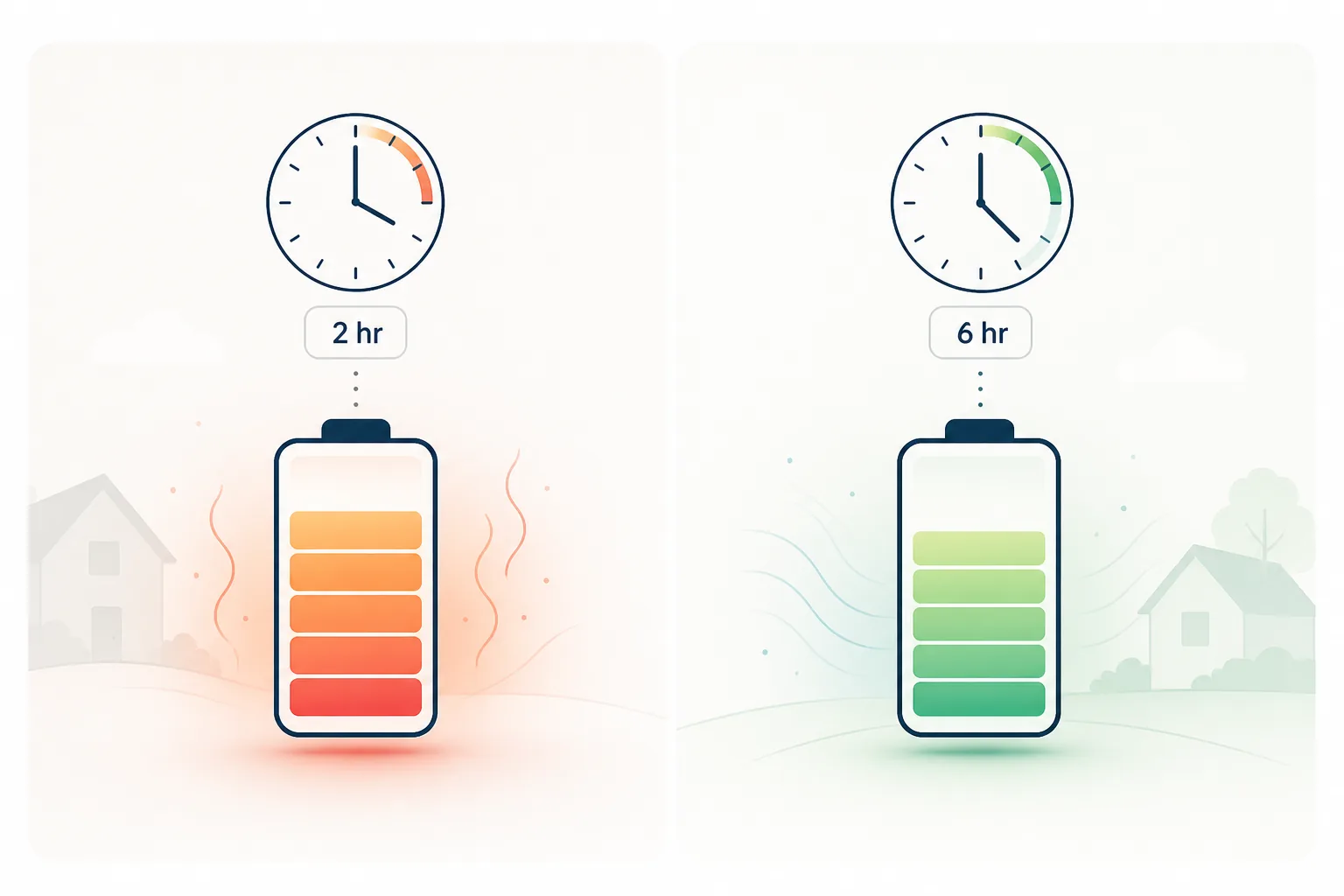
There is a number on every home-battery datasheet that almost nobody talks about: round-trip efficiency. It is the percentage of energy you actually get back out of the battery for every kilowatt-hour you put in. The rest is lost, mostly as heat, during the conversions on the way in and the way out.
For a typical UK home running a battery regularly, small differences in round-trip efficiency can add up. Over a year, a few percentage points can be the difference between a small leak and a steady drip. Over the warranty life of the battery, it can become meaningful.
What very few homeowners or installers realise is that round-trip efficiency is not just a hardware spec. How fast you charge the battery, and how steady that charge is, can affect both efficiency and long-term battery ageing.
The quick version: battery round-trip efficiency
- Round-trip efficiency is the share of stored electricity you actually get back after battery and inverter losses.
- Charging a battery harder than necessary creates extra heat because internal cell losses rise with the square of current.
- Many UK cheap-rate windows are long enough to charge gently rather than racing to full in the first couple of hours.
- Hybrid/DC-coupled systems usually waste less solar energy on the way into the battery than AC-coupled retrofits, because there are fewer conversion steps.
- A tariff-aware control layer can spread charging across the available cheap window where supported, instead of relying on the inverter's default maximum-rate schedule.
What home battery round-trip efficiency means
Imagine you put 10 kWh of electricity into your battery from the grid overnight. Later that day, you discharge it to power your home. If you only get 9 kWh out at the wall sockets, your round-trip efficiency is 90%. The missing 1 kWh became heat, in the inverter, in the wiring, and inside the battery cells themselves.
For most modern UK home batteries, round-trip efficiency usually lands somewhere in the high-80s to mid-90s percent band. The exact number depends on:
- the inverter architecture
- the temperature of the battery
- the depth of charge and discharge
- and, crucially, how fast you charged and discharged it.
The first three are mostly fixed by your hardware and your installation. The fourth is the one nobody explains, and it is the one you can actually do something about.
Why slow steady home battery charging can beat rapid charging
Inside every lithium-iron-phosphate (LiFePO4) cell, there is a small amount of internal resistance. When current flows through that resistance, it generates heat, and the heat lost is proportional to the square of the current. Double the charge rate and you do not double the heat loss. You roughly quadruple it.
That heat does two things. It can nibble a small amount off your round-trip efficiency right now, and it can accelerate the chemical processes inside the cell that age the battery over time. So unnecessarily fast charging can hit you twice, once in operating losses, and once in the long-term life of a battery you may own for many years.
Slower, steadier charging can help keep the cells cooler, keep internal losses lower, and give the battery management system more time to keep cells in balance, all of which supports usable capacity over the long run.
Why cheap tariff windows give batteries time to charge gently
Here is the thing most people miss. Many UK smart tariffs do not give you a single 30-minute cheap window. They give you longer windows or app-managed cheaper periods:
- Octopus Go has a five-hour cheap window (00:30 to 05:30); Octopus Cosy has multiple cheap windows totalling several hours a day; Intelligent Octopus Go currently lists a six-hour whole-home off-peak period (23:30 to 05:30) and can add smart-charging slots outside that window depending on eligibility and schedule; Agile lets you string the cheapest half-hours together, often four or five in a row in the small hours.
- EDF GoElectric, E.ON Next Drive, OVO Charge Anytime, British Gas EV, and Scottish Power EV Saver are examples of EV or time-of-use tariffs built around overnight or app-managed cheaper charging, though exact windows and eligibility can change.
- Even traditional Economy 7 still offers a seven-hour low-rate window overnight.
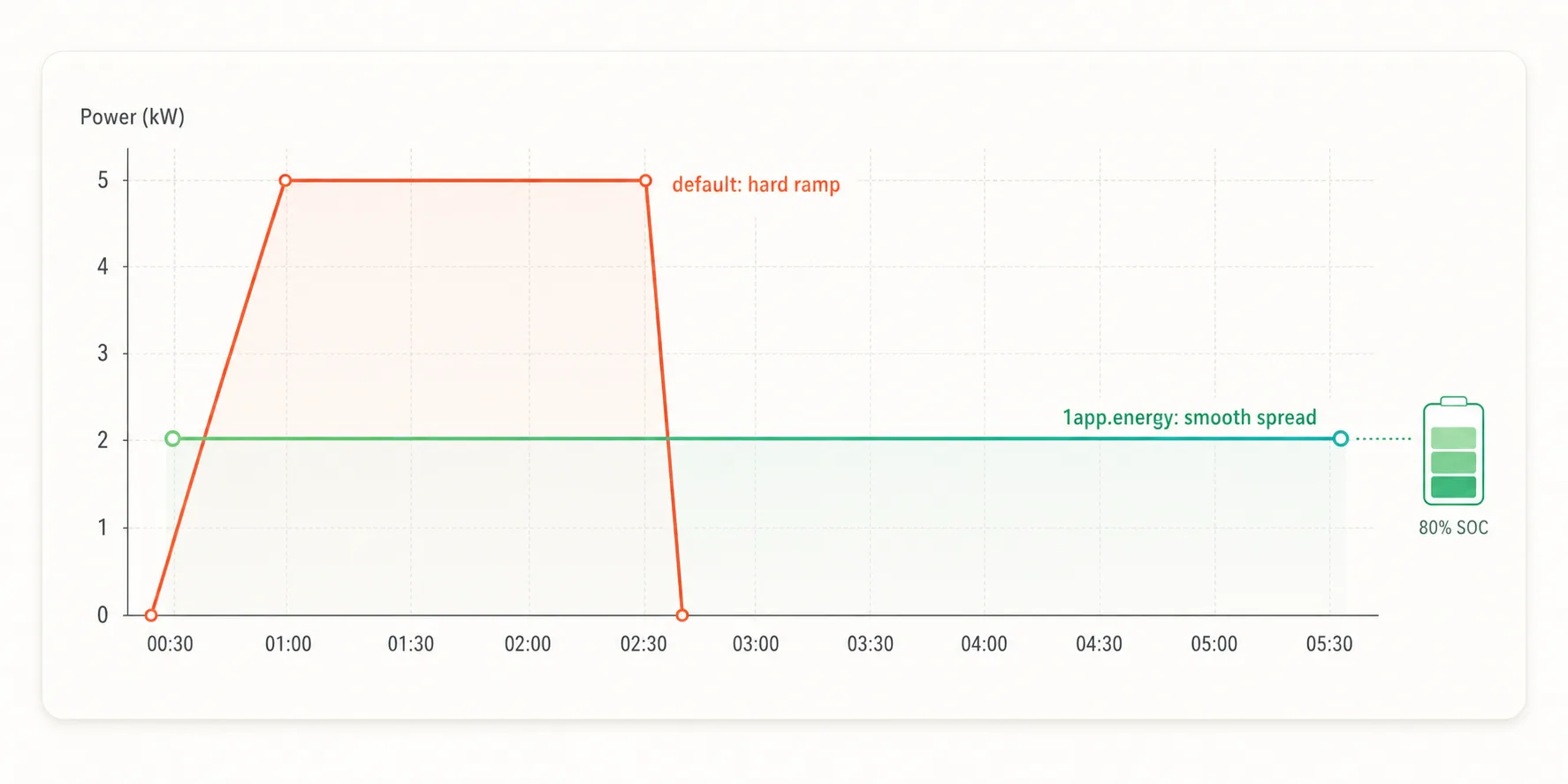
As a simple example, a 10 kWh usable battery starting empty would need an average of about 2 kW to add 10 kWh across a five-hour window, before allowing for efficiency losses and charge limits. Many batteries can charge faster than that. Where the tariff window is long enough, you do not necessarily need to slam-charge, and yet many batteries, by default, still charge hard. They charge as fast as the hardware allows, hit the target early, and then sit idle for the rest of the cheap window.
That can be the wrong default. There is no prize for finishing first if the battery only needed to be ready by the end of the cheap window. There can, however, be a slow penalty for charging harder than necessary.
(For more on which Octopus tariff suits a battery home, see Octopus Agile vs Go for a home battery, and on the new Octopus Power Up and Power Down windows which run for similar long-enough durations.)
How to choose a better battery charge rate
Spread the charge across the available cheap window. Aim to finish charging near the end of the cheap window, not several hours into it. The longer the charge takes, within reason and within manufacturer C-rate limits, the cooler the battery can stay, the better the round-trip efficiency can be, and the less avoidable stress the cells see.
Doing this by hand every day is unrealistic. You would need to:
- Read the cheap window for tonight (which moves on Agile and Intelligent Go).
- Look at how empty the battery is right now.
- Work out the average power that gets it towards your target by the end of the window.
- Set that as a charge limit on your inverter.
- Reset it every single day.
Nobody does this consistently by hand. Which is why many home batteries quietly give away a small but avoidable slice of efficiency on cycles where they charge much harder than the tariff window requires.
This is one of the things 1app.energy can help with where the battery, tariff and control path are supported, but more on that below.
Where round-trip losses actually come from
Every conversion in the chain between the grid and your battery, and back out again, costs a few percent. The number of conversions depends on the architecture.
A round-trip from grid to battery to home goes through the following stages. The values below are illustrative orders of magnitude, not specifications for a particular product:
| Stage | What happens | Typical order of magnitude |
|---|---|---|
| Grid AC → inverter input | Wiring and EMI filtering | Small |
| AC → DC rectification | First conversion to charge battery | Low single digits |
| DC-DC battery charging | Cell-level losses (I²R, BMS overhead) | Low single digits, rate-dependent |
| Battery storage idle | Self-discharge | Usually small for normal daily cycling |
| DC-DC discharging | Cell-level discharge losses | Low single digits, rate-dependent |
| DC → AC inversion | Conversion back to home AC | Low single digits |
| Inverter output → home loads | Wiring | Small |
Add it up and you land in the high-80s to mid-90s percent band that mainstream LiFePO4 systems tend to quote. Vendors with a single integrated inverter and shorter conversion chains land nearer the top of that band; modular AC-coupled retrofits tend to lose more when solar is routed through extra conversions.
Hybrid vs AC-coupled battery efficiency
This is the point most consumer-facing battery comparisons gloss over.
Hybrid (DC-coupled) inverters combine the solar inverter and the battery inverter into one unit. Solar comes in as DC, and if it is going to the battery, it stays as DC the entire way, one DC-DC conversion only. If it is going to home loads, it gets inverted to AC once. Examples include the Solis S6 hybrid range, Sungrow SH series, Tesla Powerwall 3, and GivEnergy AIO.
AC-coupled systems have a separate solar inverter and a separate battery inverter. Solar produces DC, the solar inverter converts it to AC for the home, and if that AC is going to the battery, the battery inverter rectifies it back to DC and stores it. That is three conversions instead of one for the same kWh of solar moving from panel to battery.
For a like-for-like comparison on solar-to-battery conversion path, the important difference is the number of conversion steps:
| Pathway | Steps | Practical implication |
|---|---|---|
| DC-coupled hybrid (solar to battery) | 1 (DC→DC) | Fewer conversions, generally lower losses |
| AC-coupled retrofit (solar to battery) | 3 (DC→AC→DC) | More conversions, generally higher losses |
So for a UK home where most of the battery's charge comes from grid (overnight cheap rate) rather than solar, the round-trip efficiency gap between the two architectures may be modest, both go through similar AC↔DC conversions on grid charging. But for a high-solar home where the battery is mostly filled from rooftop PV, a hybrid system can reduce conversion losses, and that difference can compound across many cycles.
The trade-off is flexibility. AC-coupling may be the practical retrofit option when the homeowner already has an existing string solar inverter and does not want to replace it. For new installs, hybrid is often a strong default to consider, but the right answer still depends on roof layout, existing kit, phase arrangement, system size, installer design and customer goals.
(For a snapshot of the current Solis range covering both architectures, see the three new Solis batteries launching in the UK.)
C-rate: the battery efficiency lever almost nobody pulls
C-rate is a way of expressing charge or discharge current as a multiple of the battery's capacity. A 10 kWh battery charged at 1C draws 10 kW. The same battery charged at 0.5C draws 5 kW. Many residential LiFePO4 systems are designed around a lower continuous or recommended charge/discharge rate than their short peak capability. For example, Solis lists 0.5C as the recommended charge/discharge rate for its FlexHome L battery range.
The reason is the same physics that makes slow charging better at home:
- I²R heating scales with the square of current. Charging at 1C produces roughly 4× the cell-internal heating of charging at 0.5C, for the same energy stored.
- Voltage sag at high C-rate can cause the BMS to see "full" earlier than it would under a gentler charge, and the CV-phase tail-off can reduce usable capacity for that cycle.
- Higher cell temperatures accelerate ageing mechanisms inside the cell. Lab studies of LiFePO4/graphite cells consistently show that temperature, C-rate, depth of discharge, and state of charge all affect capacity fade. The exact penalty varies by cell, pack design, and thermal environment, but the direction is clear: avoid unnecessary high-current cycling when the tariff gives you time to charge gently.
In other words, charging speed can have a real effect on both round-trip efficiency and battery lifetime. Both directions point the same way: avoid unnecessary high-current charging when the manufacturer guidance and tariff window give you time to charge more gently.
The Octopus Go cheap window already gives charging headroom
Here is the maths for a typical UK home with Octopus Go and a 10 kWh battery that is empty at 00:30:
- Window length: 5 hours
- Energy needed: 10 kWh
- Required average charge rate: 2 kW = 0.2C
That is well below a 0.5C recommended charge rate and below the 5 kW many inverters can deliver. In this example, the cheap window already gives enough headroom for slower charging. The hardware just may not know that.
Why default inverter charging can be inefficient
Many hybrid and AC-coupled inverter setups in the UK are configured as "charge at the allowed rate until SOC target is reached", often with limited awareness of the tariff window length. That means:
- The battery slams in at 5 kW for two hours.
- It hits target SOC by ~02:30.
- It then sits idle for the remaining 3 hours of the cheap window.
- It has turned more of the energy you paid for into heat than it needed to.
- It has spent two hours at higher temperatures than necessary, accelerating long-term degradation.
This default exists because manufacturer firmware has no idea what tariff you are on, when your cheap window ends, or what your usage profile looks like the next day. It is just being maximally helpful in the dumbest way it can.
How 1app.energy can shape battery charging where supported
When you connect your battery and your tariff to 1app.energy, the system does the calculation that the inverter cannot do on its own. Every evening, before your cheap window starts, it works out:
- Where the battery is right now (current SOC).
- Where it needs to be at the end of the cheap window (target SOC, based on your forecast next-day usage).
- How long the cheap window is tonight (read live from your tariff, including dynamic tariffs where the cheap window can shift).
It then aims to set the battery's charge rate to the average power required to reach the target near the end of the cheap window, not hours before. The result is intended to be a smoother charge curve across the available window rather than a hard ramp.
This can work where the home has a supported battery/inverter control path and either a supported tariff integration or a manually configured rate schedule. If you are with Octopus, tariff data can be read where supported, including dynamic tariffs such as Agile and Intelligent Octopus Go. For other suppliers, manual tariff setup can give 1app.energy the import rate, export rate and cheap-window information it needs, where the installation is otherwise supported. The supplier name matters less than having a reliable tariff schedule and a controllable battery.
The same logic can apply to discharge where supported. Rather than discharging at peak rate the moment you hit a peak tariff window, which produces the same I²R losses on the way out, 1app.energy can shape discharge around the actual evening load profile.
The user-visible effect is small per cycle. A modest improvement in effective round-trip efficiency does not feel like a revelation when you read it on a dashboard. But across a 10-year battery warranty life:
- That small per-cycle saving compounds into meaningful recovered energy.
- Lower thermal stress on the cells helps protect the actual usable life of the battery.
- Lower-stress cycling may help delay the point where the battery reaches its end-of-warranty capacity threshold.
This is, deliberately, one of the quieter things 1app.energy can do where the battery, tariff and control mode support it. (For homeowners deciding which 1app smart-control mode to run, see the smart control mode guide. For the broader picture of why a smart tariff alone is not enough when a battery, EV, and heat pump live under one roof, see the heat pump and battery write-up.)
A note for installers
If you are an installer reading this, the practical implication is: the round-trip efficiency and longevity figures on a manufacturer datasheet generally assume the battery is operated within the recommended conditions. Out-of-the-box inverter behaviour does not always align neatly with smart-tariff windows. Recommending a tariff-aware control layer can help the real-world install stay closer to the intent of the spec sheet.
For homeowners on supported Solis kit using API-key setup, see our SolisCloud API key guide.
Common questions about battery round-trip efficiency
Is slower battery charging always better?
Not always. The battery still needs to reach the target before the useful window ends. Slower charging is useful when the tariff gives enough time and the manufacturer limits support the chosen rate.
Does rapid charging damage a home battery?
Charging within manufacturer limits is expected behaviour, but unnecessary high-current charging can create more heat and stress than a gentler schedule. The practical point is to avoid charging harder than the home needs.
Is round-trip efficiency the same for every battery?
No. It depends on battery chemistry, inverter architecture, temperature, wiring, C-rate, depth of discharge and whether the system is hybrid/DC-coupled or AC-coupled.
Does a hybrid inverter always save more energy than AC-coupled storage?
Not always. Hybrid systems usually reduce solar-to-battery conversion losses, but AC-coupled systems can be the right retrofit choice when the existing solar inverter is staying in place.
Can 1app.energy guarantee better round-trip efficiency?
No. It can help shape supported battery charging around tariff windows where the control path is verified and customer-enabled, but the measured result depends on the installation, battery and daily usage.
Sources and assumptions checked on 17 June 2026
This guide uses worked examples rather than supplier-specific savings promises. For tariff windows, check the current supplier page before changing settings: Octopus lists Octopus Go as 00:30–05:30 and Intelligent Octopus Go as 23:30–05:30 whole-home off-peak, with additional smart-charging behaviour depending on eligibility and schedule. On the hardware side, Solis publishes 0.5C as the recommended charge/discharge rate for FlexHome L, Tesla lists Powerwall 3 solar-to-grid efficiency at 97.5%, and battery-ageing research from NREL and peer-reviewed LiFePO4 studies shows the expected dependence on temperature, C-rate, state of charge, and depth of discharge.
- Octopus Go tariff details
- Intelligent Octopus Go tariff terms
- Solis FlexHome L product page
- Tesla Powerwall 3 specifications
- NREL: temperature-dependent degradation mechanisms in lithium iron phosphate batteries
Final thought on battery round-trip efficiency
Round-trip efficiency is the spec nobody on the showroom floor mentions, and charge rate is the lever almost nobody pulls. Both quietly determine how much energy you actually get back out of your battery and how long it lasts before it starts to fade.
For homeowners: many UK cheap windows are long enough for gentle, steady charging. Slamming the battery in two hours when you have five available can create avoidable heat and extra stress.
For installers: a tariff-aware control layer can help narrow the gap between manufacturer assumptions and the real-world behaviour the homeowner sees after many cycles.
For both: this is the kind of thing 1app.energy can help with in the background where the installation is supported and the customer enables control.
A battery is a long-life piece of hardware. Charging it well, consistently, is what helps real-world performance stay closer to the spec sheet.
Does this sound like your home?
Your setup might already qualify.
Tell us which devices and tariff you are on. We review every request and invite in order of fit, not sign-up date.