Heat pump + battery + EV: why a smart tariff alone is not enough
Why a smart tariff alone does not coordinate heat pumps, batteries and EV charging, and how whole-home visibility helps UK homes avoid hidden conflicts.
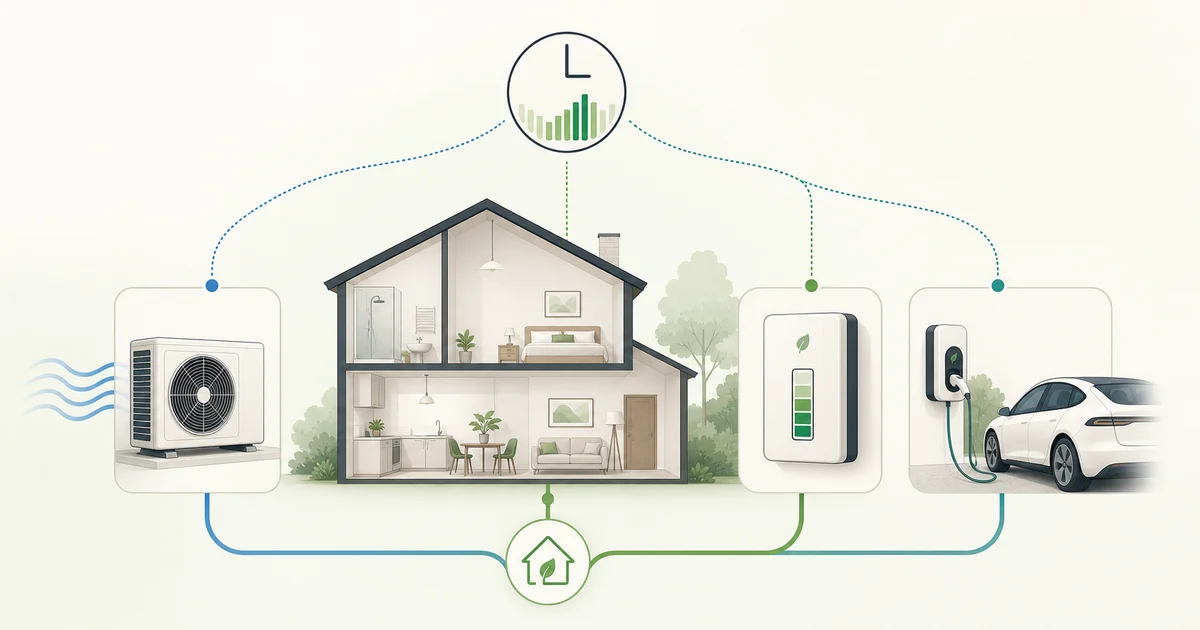
Adding a heat pump to a home that already has solar, a battery, and an EV is presented as the logical next step toward full electrification. The installers are right that all the pieces fit together technically. What they rarely explain is how these devices behave when they are all running on the same smart tariff, competing for the same stored energy, at the same time.
What each device needs in a heat pump battery EV home
To understand the conflict, it helps to think about what each device is optimising for independently.
Your heat pump is optimised for comfort. It wants to run during the coldest parts of the day and night, typically early morning before the house wakes up and early evening when occupants are home and temperatures are dropping. Some heat-pump controllers can be configured to make more use of cheaper periods, but that depends on the heat pump, controls, weather and comfort settings.
Your battery is optimised for bill savings and resilience through expensive periods. In a simple time-of-use setup, it may charge from cheap overnight grid power or daytime solar, then discharge to offset expensive peak-rate imports later. The right target depends on the home, season, reserve setting and tariff.
Your EV is optimised for convenience and cost. It wants to charge overnight when rates are cheapest. On Intelligent Go, Octopus controls when that happens, usually overnight but sometimes during cheap daytime windows.
Each of these devices has a coherent individual strategy. The problem is that they share a battery and a grid connection, and their strategies can directly conflict.
The three-way heat pump, battery and EV conflict
Here is a realistic winter morning in a home with all three:
00:30, The cheap overnight window begins (standard Go, 00:30 to 05:30). Your battery starts charging from cheap grid power. Your EV is also charging via the scheduled Go window. The heat pump runs its overnight low-power cycle. Everything, heat pump and household loads, runs from cheap grid electricity while the battery fills. Battery reaches 85% by 05:00.
05:30, The cheap overnight window ends. Your battery switches from charge mode to discharge mode. The EV has finished charging. The heat pump starts its morning pre-heat cycle and draws 2.5kW. The battery begins discharging to supply this load, that is what it is there for. Battery drops from 85% to 70%.
06:15, The overnight cheap window has ended and the home is back on the higher daytime unit rate. The heat pump is still running. The battery continues discharging to offset the grid.
07:00, Battery is at 55%. The house is warm. Heat pump switches to standby. Everything looks fine.
08:30, You check the inverter app. Battery is at 35%. Winter solar generation is weak, maybe 1–2kWh by midday. The battery will not recover much today.
16:30, The heat pump starts its evening cycle. Outside temperature is 3°C. It runs at 3kW for two hours. Battery drops to 10%. Higher-rate grid imports fill the gap.
17:45, Your EV needs topping up. Octopus dispatches a 45-minute Intelligent Go session. The battery is at 8%, effectively empty. The full EV load comes from the grid.
The result: you spent money on a battery, but the battery spent its entire cycle on heat pump support and never had enough charge left to do what it was installed to do: offset peak-rate imports in the evening.
Why a smart tariff does not solve the heat pump battery EV problem
Smart tariffs and price-led schedules provide useful signals, but they do not automatically coordinate every device in the home. For example, an EV smart tariff may schedule the charger, while price-based tariffs such as Agile or Flux still need the home devices to act on the prices. On their own, they do not:
- Know how much energy the heat pump consumed last night
- Know what the battery's state of charge is before dispatching an EV session
- Adjust the heat pump's schedule to protect battery charge
- Coordinate morning pre-heat with expected solar generation
Octopus's system sees your home as a single electricity meter. It dispatches cheap energy to your EV charger when prices are low. That is all it was designed to do, and it does it well.
The heat pump has its own controller, a manufacturer app or a Modbus interface, that has no connection to Octopus. The battery has its own management system that responds to loads without knowing what caused them. These systems usually do not share enough context with each other.
What whole-home visibility adds for heat pump and battery homes
The missing piece is joined-up visibility across the supported data sources in the home, so battery and EV decisions can take the wider load profile into account:
- Before an EV session: check battery state. If the battery is below a threshold that may be needed for household demand later, hold the battery rather than letting it supply the EV load.
- Before a known high-demand period: check whether the battery has recovered from overnight discharge. If not, allow a partial grid import rather than running the battery below minimum useful charge.
- During overnight cheap periods: prioritise battery charging to cover the home's expected demand before the window closes, where supported and customer-enabled.
This is not a dramatic algorithmic overhaul. It is sequencing and awareness, decisions that a person could make manually if they had supported data and enough context in one place, but that no individual device's controller can make because none of them can see the others.
How 1app.energy helps where the home is supported
1app.energy is built for homes with this type of mixed setup: Solis-style battery systems, zappi or similar EV chargers, Daikin or Mitsubishi heat pumps, Octopus smart tariffs and manually set tariffs.
Depending on the exact hardware and account access, supported data can show battery state, solar generation, grid flow, tariff context, smart charging context, EV session state, and wider household demand patterns.
With supported data sources visible, the decisions become clearer: the battery can be protected before expected high-demand periods, EV sessions can be handled without unnecessarily draining the battery below its useful floor, and solar generation can be preserved for evening demand where it has the highest value.
Is whole-home coordination for every home?
No. A home with just an EV and no battery or heat pump benefits mainly from a good smart EV tariff. The conflict described here only applies when multiple high-draw devices are sharing the same stored energy.
The more devices you add, the more the individual optimisation strategies start working against each other, and the more valuable whole-home visibility and supported control become.
For a broader planning view, see the whole home energy stack guide. If you are still designing the system, what to ask before a solar battery installation is a useful checklist before adding more hardware.
Common questions about heat pumps, batteries, EVs and smart tariffs
Can a smart tariff control my heat pump, battery and EV together?
Usually no. A smart tariff can send a price signal or control one eligible device, but it does not automatically coordinate every heat pump, inverter and EV charger in the home.
Why does my battery empty faster after installing a heat pump?
A heat pump adds a large recurring electrical load, especially in cold morning and evening periods. If the battery is set to discharge into household demand, it can support the heat pump before the evening period you expected it to cover.
Should my battery charge more overnight if I have a heat pump?
Often yes, but the right target depends on the season, comfort settings, battery size, tariff and solar forecast. Overcharging wastes cheap-window capacity; undercharging can leave the home importing at expensive times.
Does an EV smart tariff solve the battery drain problem?
Not by itself. The EV tariff can schedule the car, but the battery still needs to know whether to hold back during that session. That problem is explained in why Octopus can drain a home battery during EV charging.
Can 1app.energy control a heat pump today?
Yes, for supported Daikin heat pumps. 1app.energy can run Heat Pump Autopilot on supported Daikin heat pumps. It is off until you turn it on. When on, it can move flexible heating or hot water into cheaper periods or spare solar, and keeps changes inside the temperature limits you choose. Mitsubishi heat pumps are monitoring only.
Sources checked on 17 June 2026
- Octopus Go tariff page, for the fixed overnight off-peak window used in the worked example.
- Intelligent Octopus Go tariff page, for the smart EV charging product context.
- UK boiler upgrade scheme guidance, for current heat-pump incentive context.
Related reading for heat pump battery EV homes
- Why Octopus can drain a home battery during EV charging
- Home energy dashboard source of truth: what to check
Final thought on smart tariffs and whole-home energy
A smart tariff is a useful signal. It is not a whole-home brain.
If your home has a heat pump, battery, and EV, see how 1app.energy connects supported home energy data, or tell us your exact device and tariff combination and we will review what the current rollout can support for your setup.
Relevant smart controls
These mode pages are the closest product-side follow-on from the issue explained in this article.
Autopilot
The best starting mode for most homes. Autopilot charges when power is cheap, keeps battery back for the home, and can export spare battery power when prices are high.
Home First
A simpler home-first mode. It runs the home from your own solar and battery first and avoids automatic battery export.
Does this sound like your home?
Your setup might already qualify.
Choose your inverter to start. Supported homes create an account straight away; other setups join the compatibility list.