Octopus Prime export tariff: what battery homes should check
Octopus Prime, Outgoing, Agile, SEG and Flux compared for UK solar battery homes, with what to check before chasing export rates.
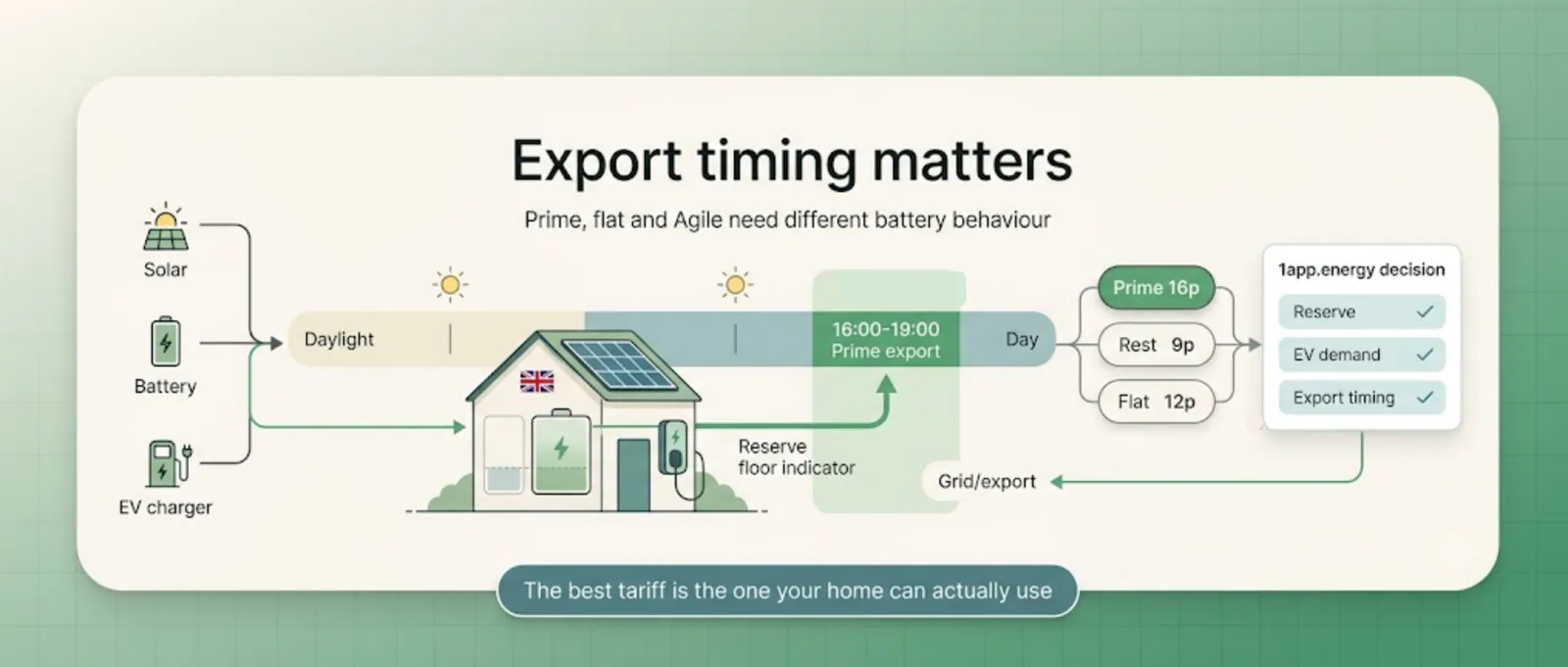
Octopus has added another export option for solar and battery homes: Prime Outgoing Octopus.
That matters because the export tariff question is no longer as simple as choosing the highest headline pence-per-kWh number. A home may now be comparing a flat export rate, a time-based fixed export rate, half-hourly Agile export prices, Flux-style peak export windows and SEG.
For a solar-only home, the answer may still be simple. For a home with solar, a battery, EV charging and a time-of-use import tariff, the answer depends on when the home can export, what the battery needs to keep in reserve and whether later import would undo the benefit.
Prime is not just a new export rate. It is another signal that battery timing is becoming the real value in UK solar homes.
The quick version: Octopus Prime export tariff in 2026
- Octopus now lists Prime Outgoing Octopus as a 12 month fixed-term export tariff.
- Prime pays 16p/kWh from 16:00 to 19:00 and 9p/kWh for the rest of the day, according to Octopus's public Outgoing page and product API.
- The flat Outgoing Octopus route is still listed at 12p/kWh.
- Agile Outgoing remains a half-hourly export tariff based on day-ahead wholesale prices. It can be higher than fixed options in some periods, but it can also be lower.
- Octopus SEG is still listed at 4.1p/kWh and is mainly useful when the customer wants export payments without switching import supply to Octopus.
- Octopus Flux and Intelligent Octopus Flux remain separate solar-and-battery routes with eligibility rules. Intelligent Flux is not a generic tariff for every inverter; Octopus controls compatible batteries.
- The best option depends on the home. Prime only beats 12p flat if enough export can be shifted into the 16:00 to 19:00 window.
What Octopus Prime changes
Outgoing Octopus already had two clear routes.
The flat Outgoing tariff paid a simple rate for exported energy. Agile Outgoing rewarded export differently every half-hour, using day-ahead wholesale pricing.
Prime sits between them.
It gives a fixed formula for 12 months, but it still rewards timing:
| Export route | What changes | Best fit |
|---|---|---|
| SEG | Flat 4.1p/kWh | Export-only customers who do not want an Octopus import tariff |
| Outgoing Octopus | Flat 12p/kWh | Homes that want simplicity |
| Prime Outgoing Octopus | 9p normally, 16p from 16:00 to 19:00 | Homes that can shift export into the evening peak |
| Agile Outgoing | Half-hourly day-ahead export rates | Homes comfortable with dynamic prices and active scheduling |
| Flux / Intelligent Flux | Solar and battery import/export timing | Eligible solar battery homes focused on peak export and battery control |
The important detail is the spread.
Prime pays less than Outgoing Fixed for most of the day, but more during the 16:00 to 19:00 window. That means Prime is not automatically better than 12p. It is better only if the home can put enough of its export into the peak period.
The simple break-even is useful:
If more than about 43% of exported energy lands in the 16:00 to 19:00 Prime window, Prime averages above 12p. If less than that lands in the window, the flat 12p route may pay more.
That is before battery losses, reserve needs, export limits and later import are considered.
For many solar-only homes, most spare export happens around the middle of the day. Prime may not suit that pattern. For a battery home that can hold energy and discharge cleanly between 16:00 and 19:00, Prime becomes more interesting.
This is the same bigger shift covered in why UK solar export tariffs are starting to fall: export value is becoming more conditional, and timing matters more than raw export volume.
Why the 16:00 to 19:00 window matters
The 16:00 to 19:00 period is a familiar peak window in UK energy tariffs.
It appears in Octopus Flux, Intelligent Octopus Flux and now Prime Outgoing Octopus. Octopus describes Flux around the same idea: cheaper periods to charge a battery, then a peak period when discharging and exporting can be more valuable.
That does not mean every battery should empty at 16:00.
A good battery decision should check:
- the export rate;
- the import rate later that evening;
- battery reserve;
- expected home load;
- EV charging demand;
- solar forecast for the next day;
- the home's approved export limit;
- whether the inverter can discharge at the required power.
A high export price can still be the wrong decision if the home then buys electricity back later at a higher total cost. It can also be wrong if the EV is about to charge, the house needs evening reserve, or the battery cannot export fast enough to make the window useful.
The practical checks are covered in home battery export control checks before selling stored energy.
Prime vs Outgoing Fixed: simple rate or timed export
Outgoing Fixed remains the easy option.
At 12p/kWh, the customer does not need to think about whether export happened at lunchtime, evening or overnight. If a home exports whenever spare solar appears, the flat tariff is easier to understand and easier to explain.
Prime asks for a different behaviour.
To benefit from Prime, the home needs to:
- store enough surplus energy before 16:00;
- avoid wasting the battery on low-value export earlier in the day;
- discharge or export during the 16:00 to 19:00 window;
- keep enough reserve for the rest of the evening;
- avoid creating expensive import later.
For a large battery with a strong inverter and a predictable evening strategy, that may be realistic.
For a small battery, a battery already needed for evening home load, or a solar-only home with little stored energy at 16:00, Prime may look better on the headline rate than it behaves in practice.
This is why home batteries matter more as export rates change. The unit rate is only one part of the decision. The timing, capacity and control logic decide whether the rate is usable.
Prime vs Agile Outgoing: fixed formula or daily prices
Agile Outgoing is still the more dynamic option.
Octopus says Agile Outgoing matches half-hourly export prices with day-ahead wholesale rates. That means the customer can see tomorrow's export prices, but the value changes every day.
On some days, Agile Outgoing can beat Prime's 16p peak. On other days, Agile can sit below the flat and Prime options. It is a better fit for homes that can respond to half-hourly prices without constant manual work.
That is where automation becomes important.
If a customer has to check rates, change battery schedules, protect EV charging and remember export limits manually, the tariff may be theoretically good but practically frustrating.
For Solis-based homes, running a Solis inverter on Octopus Agile with 1app.energy explains why tariff-aware control needs to look at the whole home, not just the next cheap or expensive slot.
Where Flux and Intelligent Flux fit
Octopus Flux and Intelligent Octopus Flux are not the same as Prime.
Flux is a combined import and export tariff for homes with solar and battery storage. Octopus describes a lower-cost period from 02:00 to 05:00 and a 16:00 to 19:00 peak window for discharging and exporting.
Intelligent Octopus Flux goes further. Octopus says it pairs with compatible batteries and controls charging and discharging. Its FAQ says customers hand over scheduling control to Octopus, and that import and export rates match across peak and non-peak periods.
That can work well for eligible homes, but eligibility matters.
Intelligent Flux is not a universal route for every inverter. Octopus lists battery compatibility requirements, and the live Octopus eligibility flow should be treated as the source of truth. A Solis or LuxpowerTek home should not assume Intelligent Flux control is available just because the tariff page exists.
For a deeper check, see Intelligent Octopus Flux: what battery owners should check.
What homeowners should check before switching export tariff
Before choosing Prime, Outgoing Fixed, Agile Outgoing, SEG or Flux, write down how the home actually behaves.
Start with these checks:
- When does the home export today? If most export is midday solar, Prime may not beat the flat rate unless the battery can move that energy.
- How much export can fit into 16:00 to 19:00? Battery capacity and inverter discharge power matter.
- What happens after 19:00? Exporting too much may leave the home importing later.
- What does the EV do? Evening EV charging can drain the battery or change the value of holding reserve.
- Is there a DNO export limit? A high rate is less useful if the home cannot export enough power during the window.
- Who controls the battery? Supplier control, inverter schedules and a third-party optimisation layer should not fight each other.
- Is the tariff compatible with the import tariff? Octopus export options have pairing and eligibility rules.
The export tariff is not the whole plan. It is one input into the home's daily energy strategy.
For customers who are still setting up tariff data manually, manual tariff setup for solar, battery and EV homes explains why neutral defaults and accurate time windows matter.
How 1app.energy helps with this decision
1app.energy is built for homes where the hardware is strong, but the customer still needs one clear software layer.
For supported Solis-based homes, 1app.energy brings solar, battery, EV charging and tariff context into one app. That makes export decisions easier to understand because the customer can see what happened across the whole home, not just in the supplier app or inverter app.
Where supported, verified and customer-enabled, 1app.energy can also help with tariff-aware battery behaviour. That may include charging during useful cheap periods, protecting reserve, avoiding unnecessary EV battery drain, and considering export only when the wider home context supports it.
This is not a promise that every tariff, inverter or charger can be automated. It is a practical software layer for supported homes that need clearer daily decisions.
The customer problem is simple:
The best tariff is not always the tariff with the highest number. It is the tariff your home can actually use.
Common questions about Octopus Prime export tariff
Is Octopus Prime a real export tariff?
Yes. Octopus lists Prime Outgoing Octopus on its public Outgoing page, and the Octopus product API lists OUTGOING-PRIME-FIX-12M-26-06-23 as an export product available from 23 June 2026.
What does Octopus Prime pay?
Octopus lists Prime Outgoing Octopus at 16p/kWh from 16:00 to 19:00 and 9p/kWh for the rest of the day. Rates and eligibility can change, so customers should check the live Octopus page before switching.
Is Prime better than Outgoing Fixed at 12p?
Not automatically. Prime beats 12p only if enough export happens in the 16:00 to 19:00 window. A rough break-even is about 43% of exported energy during the Prime peak window.
Is Agile Outgoing better than Prime?
Sometimes. Agile Outgoing can pay more than Prime during strong half-hourly periods, but it can also pay less. It suits homes that can respond to day-ahead prices without putting the customer in a manual scheduling loop.
Is SEG still useful?
SEG is still useful for customers who want an export-only arrangement without moving import supply to Octopus. Octopus lists SEG at 4.1p/kWh, which is lower than its main Outgoing routes.
Does 1app.energy choose the export tariff for me?
No. 1app.energy does not replace tariff advice or supplier eligibility checks. It helps supported homes understand solar, battery, EV and tariff behaviour in one place, and where supported and customer-enabled, can help coordinate battery behaviour around tariff windows.
Final thought on Octopus Prime export tariff
Octopus Prime is a useful new middle ground: less volatile than Agile, more timing-aware than flat Outgoing, and simpler than a full supplier-controlled battery tariff.
But it is still a timing tariff.
For a solar battery home, the question is not "which tariff has the highest rate?" It is "can my home place energy into the right window without creating a worse cost later?"
That is where battery visibility, tariff data and EV context become more valuable than another app screen.
Visit 1app.energy/signup to check your inverter and start signup.
Sources checked on 25 June 2026
Does this sound like your home?
Your setup might already qualify.
Tell us which devices and tariff you are on. We review every request and invite in order of fit, not sign-up date.