Why home batteries matter more as export rates change
Why changing solar export tariffs make home batteries more important for UK homes, and how storage, EV charging and tariffs should work together.
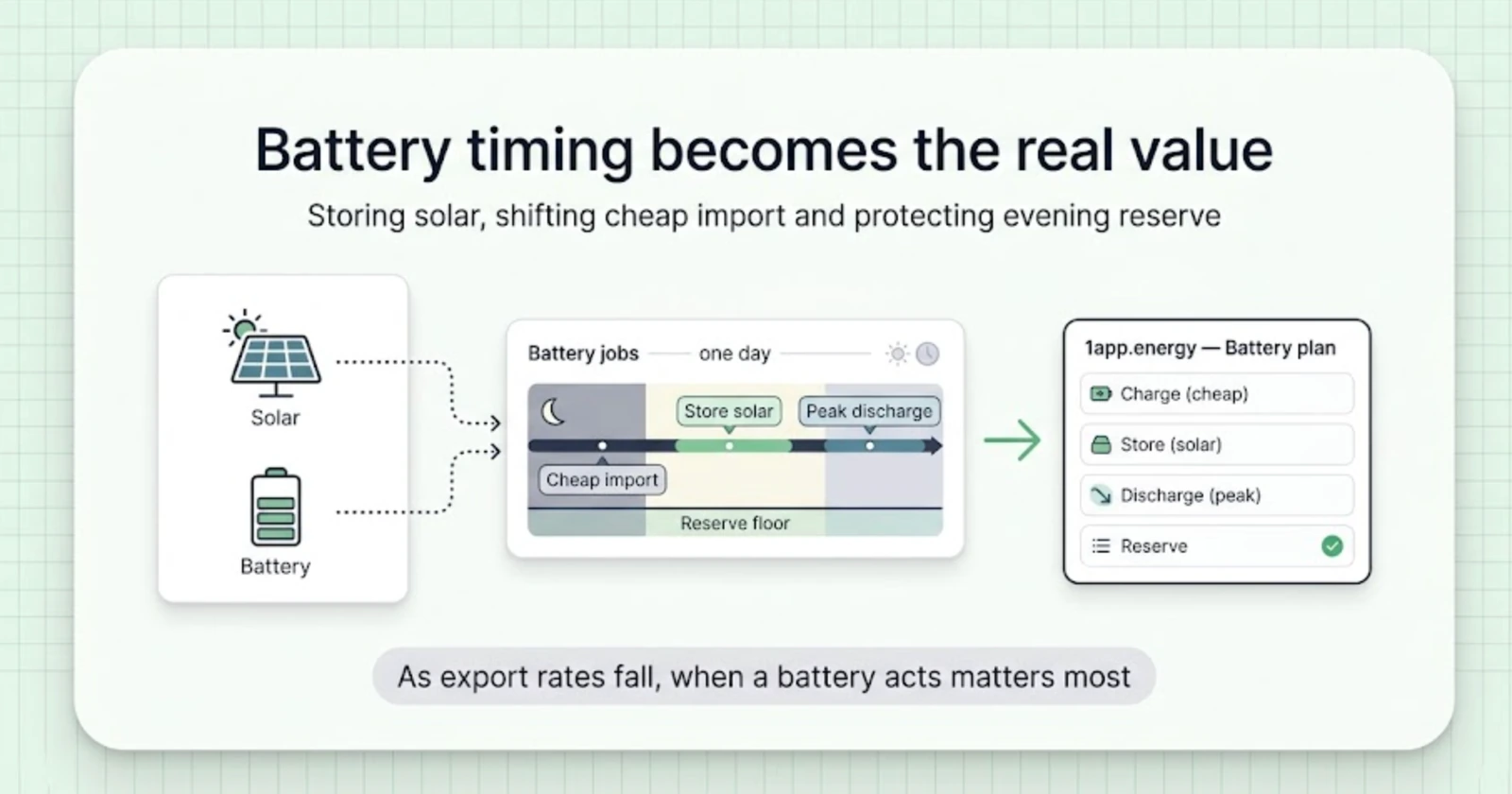
When export rates are high and simple, a solar home can look easy to understand. Generate electricity during the day, use what the home needs, export the rest.
When export rates fall, vary by time, or come with tighter eligibility rules, that simple story starts to break.
The battery becomes more important because it gives the home a choice. Instead of treating every spare solar unit as immediate export, the home can decide whether to store it, use it later, protect it for evening demand, or export it when the wider context makes sense.
That is why batteries are becoming central to the next phase of UK domestic solar.
The quick version: why home batteries matter as export rates change
A home battery is no longer just an add-on for storing spare solar.
In a modern UK solar home, the battery has several jobs:
- store surplus solar when export is less valuable or capped;
- reduce expensive grid import later in the day;
- charge during cheaper import periods where supported;
- hold energy for evening demand, EV conflicts or heat-pump load;
- support export only when tariff, reserve, refill and DNO conditions make sense.
The battery's value comes from timing. A battery without timing is only a storage box. A battery with good tariff and home context becomes a flexibility asset.
The three jobs of a home battery
A good battery strategy usually has three layers.
| Battery job | What it means | Why it matters |
|---|---|---|
| Self-consumption | Store solar that would otherwise be exported or clipped | Helps the home use more of its own generation |
| Peak protection | Keep energy available for expensive or high-demand periods | Reduces reliance on grid import at poor times |
| Flexible value | Charge or export based on tariff windows where supported | Helps the home respond to changing import and export prices |
Most customer confusion happens when these jobs fight each other.
For example, exporting stored energy may improve export credit in one hour but leave the home importing later. Charging the battery overnight may be useful before a cloudy day but waste solar opportunity before a sunny day. Discharging into an EV may look like normal home support but leave the battery too low for the evening.
The battery needs a plan, not just a percentage display.
Why lower export rates make storage more useful
If a home exports spare solar at a lower rate and then imports later at a higher rate, the customer may have been better off storing that energy.
That does not mean export is bad. It means export should be compared against the value of keeping energy for the home.
The decision depends on:
- the import rate the home would otherwise pay later;
- the export rate available now;
- battery round-trip efficiency;
- battery reserve requirements;
- whether solar or cheap grid energy can refill the battery later;
- whether EV charging or heating demand is coming;
- whether the DNO export limit affects export.
This is why a battery export decision should not be a simple "rate is high, export now" rule.
The deeper export checklist is covered in home battery export checks before selling stored energy.
Cheap import windows make the battery a planning tool
Time-of-use tariffs make the battery more useful because they create cheap and expensive periods.
If the home has a predictable cheap import window, the battery can be charged when electricity is cheaper and used when electricity is more expensive. That can be useful in winter, on cloudy days, or when the home has high evening demand.
But cheap charging should still be planned.
Charging to full every night may leave no room for solar the next day. Charging too little may leave the home exposed during the evening. Charging while an EV also charges may overload the customer's expectation of what the cheap window can achieve.
That is why the battery needs to know more than the tariff. It needs to know the home.
For customers using manual tariff setup, manual tariff setup for solar battery and EV homes explains why import periods, export rate and standing charge need to belong to the actual property.
EV charging is the battery stress test
An EV charger is often the load that exposes whether a battery system is well coordinated.
When the car starts charging, the battery may see a large home load and discharge into it. From the inverter's point of view, that can look logical. From the customer's point of view, it may be a problem.
If the EV is charging during a cheap supplier-controlled window, the customer may want the car to use cheap grid electricity while the battery is held for later. If the EV is charging during a sunny afternoon, using surplus solar may be the better outcome. If the customer has no EV tariff, the answer may change again.
The point is that EV charging is not just another appliance.
It is a large flexible load that can change the battery's value across the whole day.
The customer needs to understand:
- whether the EV is visible to the home energy system;
- whether charger CT mapping is correct;
- whether EV load should be included in battery export logic;
- whether the battery should hold during cheap EV charging;
- whether the battery reserve is high enough for later home demand.
The practical EV conflict is explained in why your home battery can drain when Octopus charges your EV.
Heat pumps make reserve and winter planning more important
Heat pumps add another reason to treat the battery as part of a whole-home plan.
Heating demand is not evenly spread through the year. It rises when the weather is colder, and that often coincides with lower solar generation. A home with a heat pump may need more evening or morning electricity than it did before.
That does not make solar and batteries less useful. It makes battery reserve and tariff planning more important.
A home that plans to add a heat pump should ask:
- Will winter demand change the battery size decision?
- Should the battery reserve be higher in colder months?
- Is the tariff still suitable once heating is electric?
- Will cheap import windows be long enough for battery and EV demand?
- Does the customer dashboard show heating load separately or only as home usage?
Public product claims should stay tied to supported integrations, but the planning point is clear: future heat demand changes the battery's job.
Export limits make battery space valuable
DNO export limits also increase the importance of battery timing.
If the home has a capped export level, the battery can absorb some surplus solar that would otherwise push against the limit. But only if the battery has space at the right time.
A battery that is full before the strongest solar period cannot absorb much midday surplus. A battery that charges overnight without considering the next day's solar may reduce the system's ability to use free solar later.
This is the part customers often miss.
The useful question is not simply "how big is the battery?"
It is:
Will the battery have capacity available when the home needs to store surplus, and enough reserve when the home needs protection?
Those are different moments.
For the network side of this problem, G98, G99 and G100 forms: UK solar and battery DNO guide explains why export approval and export limitation matter before the customer starts optimising around export.
A practical day in a solar battery home
Consider a home with solar panels, a Solis hybrid inverter, a battery, an EV charger and a time-of-use tariff.
Overnight, the tariff is cheap. The battery may need some charge for the morning. The EV may also need to charge.
In the morning, the home uses power before solar is strong. The battery may cover the home, but it should not drop below the protected reserve.
At midday, solar is strong. The battery should ideally have some space if the home expects surplus generation.
In the afternoon, export may be available, but the battery still needs to consider evening demand and any EV session.
In the evening, the home may need stored energy to avoid peak import.
That is one day, but it contains several decisions. A battery that only reacts to the current load will often do something technically reasonable but economically poor.
How 1app.energy helps
1app.energy is built around this whole-home battery problem.
For supported homes, it brings solar, battery, EV charging and tariff behaviour into one clearer view. For supported Solis-based homes, it helps close the gap between inverter data and the customer's actual question: "Is my home using energy sensibly?"
Where supported, verified and customer-enabled, 1app.energy can help with tariff-aware battery behaviour. That can include off-peak charging when needed, reserve protection, EV context where supported, and export decisions that consider more than one attractive rate.
The important boundary is that automation should only run where the device, tariff and control path are supported and safe enough to act. Some homes may start with visibility before control. That is the right order.
For supported Solis homes, this is part of the wider Solis software gap: the customer needs more than an inverter reading; they need to understand the whole-home consequence of battery decisions.
What homeowners should check before buying more storage
Before increasing battery size, ask:
- How much electricity does the home use after sunset?
- How often does the current battery fill before midday?
- How often is solar clipped or exported at a low rate?
- Does the EV charge from the battery unintentionally?
- Is there a cheap import window, and how long is it?
- Is there a DNO export limit?
- Will a heat pump or second EV change future demand?
- Can the customer see battery charge, discharge, EV and tariff context together?
If those questions are not answered, the battery size may be guessed rather than designed.
Common questions about home batteries and export rates
Is battery export always profitable when the export rate is high?
No. The home may need that stored energy later. Battery export should account for reserve, replacement import cost, refill opportunity, EV demand, battery losses and export limits.
Should my battery charge from the grid every night?
Not automatically. It depends on tomorrow's demand, solar expectation, tariff window, battery size and reserve. Filling too much can leave no room for solar.
Can a bigger battery fix an export-limited system?
It can help if the home regularly has surplus solar that can be stored and used later. It cannot remove the export limit, and it may not justify the cost if the home cannot cycle the extra capacity.
What battery reserve should a solar home use?
There is no universal reserve percentage. The right reserve depends on evening demand, weather, tariff periods, EV charging and how much backup margin the customer wants. Battery reserve floor: what UK solar homes should check explains the tradeoff.
Can a home battery charge from cheap tariffs and still store solar?
Yes, but only if the schedule leaves enough room for solar later. A battery that fills too early on cheap import can waste midday solar opportunity, especially in spring and summer.
Final thought on home batteries and changing export rates
As export rates change, home batteries become more important because timing becomes more important.
The value is not just in owning storage. It is in using storage well: holding energy when the home needs it, filling it when energy is cheap or abundant, and exporting only when the wider home context supports it.
Visit 1app.energy/signup to check your inverter and start signup.
Sources checked on 17 June 2026
Does this sound like your home?
Your setup might already qualify.
Tell us which devices and tariff you are on. We review every request and invite in order of fit, not sign-up date.