Why UK solar export tariffs are starting to fall
Why UK solar export tariffs are under pressure, what falling rates mean for solar battery homes, and why timing matters more than raw export.
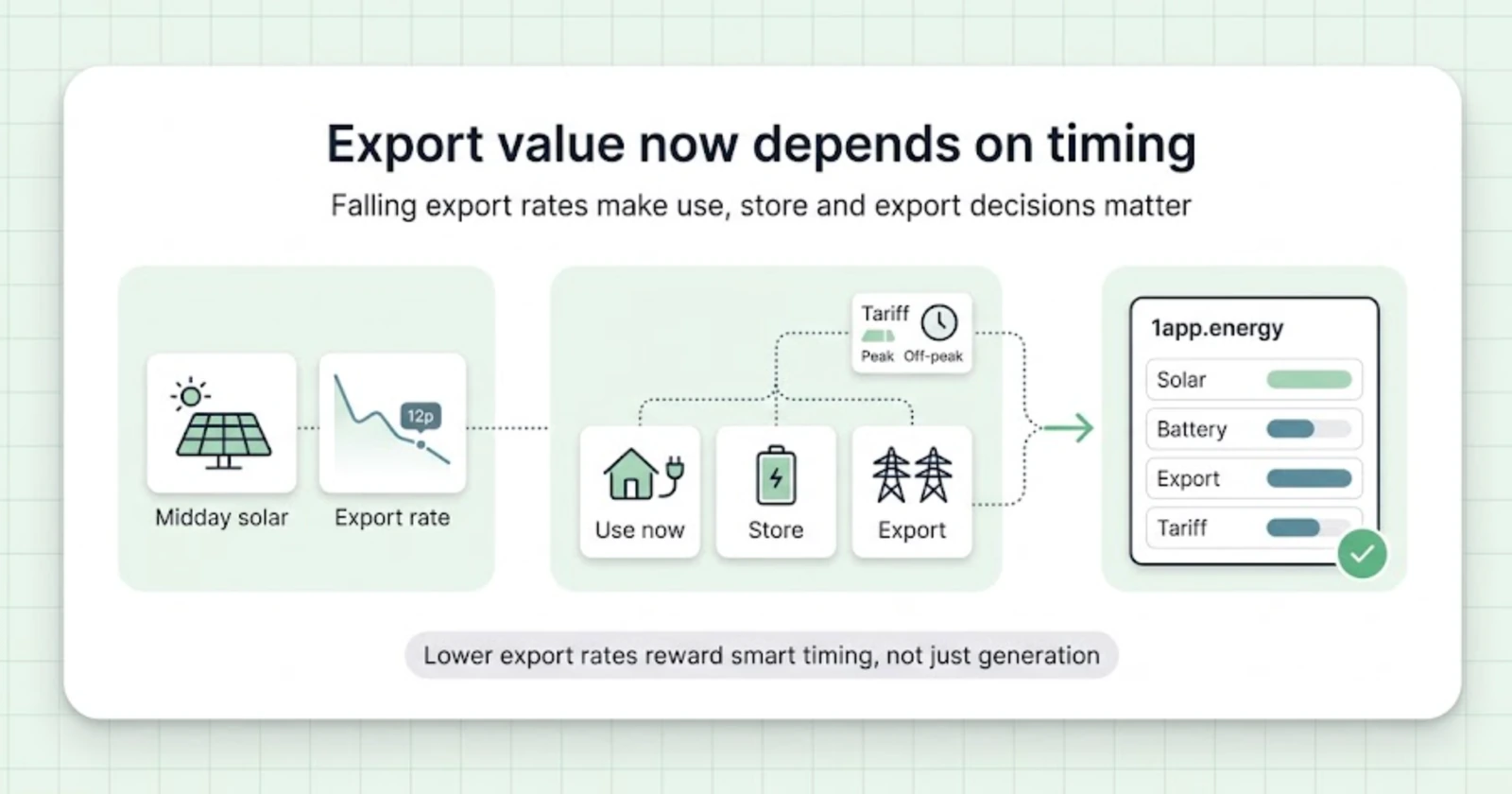
For a few years, UK solar customers could look at export tariffs and feel that the direction was simple: install solar, send spare electricity to the grid, and get paid a useful rate for every exported unit.
That story is becoming more complicated.
Some visible export tariffs have moved down, including Octopus Energy's flat Outgoing rate moving to 12p/kWh from 1 March 2026. Other suppliers still offer different rates and eligibility rules, and some tariffs reward export at specific times rather than through one flat number. The important signal is not that every supplier is doing the same thing. It is that export value is becoming more conditional.
For solar and battery homes, that changes the conversation.
The question is no longer only:
How much electricity can I export?
The better question is:
When should my home use, store or export energy so that the whole day makes sense?
That is the shift customers and installers need to understand.
The quick version: UK solar export tariffs in 2026
UK solar export tariffs are under pressure because export payments are set by suppliers, not guaranteed forever by one national rate. At the same time, more homes are installing solar and batteries, which means more electricity can arrive on the local network during sunny low-demand periods.
Solar is still valuable. But the value is moving away from simple export volume and towards timing, self-consumption, battery storage, tariff choice and export limits.
For a modern UK home, the strongest setup is usually not the one that exports the most at any cost. It is the one that can decide whether energy should be used in the house, stored in the battery, held for the evening, used for EV charging, or exported when export is genuinely useful.
Why export tariffs can change
The Smart Export Guarantee, usually shortened to SEG, makes sure eligible small-scale low-carbon generators can be paid for exported electricity. It does not set one fixed national export price for every customer.
GOV.UK guidance says SEG suppliers are required to offer a tariff, but are free to decide the tariff terms. Ofgem also lists SEG suppliers and explains the scheme, but the commercial tariff itself belongs to the supplier.
That means export tariffs can differ by:
- supplier;
- tariff type;
- whether the customer also imports from that supplier;
- whether the rate is fixed or variable;
- whether the home has a smart export meter;
- whether battery export is allowed;
- whether the tariff is flat or time-based;
- whether the customer has specific hardware or installer eligibility.
This is why a single rate on one supplier page should not be treated as a permanent market truth.
For customers, the safer assumption is:
Export income is useful, but the home should not depend on one export rate staying unchanged for the life of the system.
Why more solar changes the value of export
Solar generation has a timing problem.
On bright days, many homes produce the most electricity around the middle of the day. That is often when domestic demand is lower than it is in the evening. If many homes in the same area export strongly at the same time, the local network has to absorb that power.
From the customer's point of view, midday solar feels like free energy. From the network's point of view, it can be a local capacity and voltage issue. From the supplier or market point of view, electricity exported when supply is plentiful is not always as valuable as electricity available when the system is under pressure.
That is the basic reason timing matters.
The home may still generate the same number of kWh across the day, but those kWh are not all equally useful:
| Solar moment | What the customer may see | Why the value is different |
|---|---|---|
| Sunny midday with low home demand | Spare solar export | Useful, but often less scarce in the wider system |
| Evening peak with no solar | Battery discharge or grid import | More valuable to avoid expensive import |
| Cheap overnight period | Grid charging opportunity | Can prepare the battery for later demand |
| Export reward window | Timed battery or solar export | Useful only if reserve, refill and export rules support it |
This is why simple export thinking can mislead customers. A unit exported at the wrong time may be less valuable than a unit stored for later.
The same timing principle sits behind home battery export checks before selling stored energy: the export rate is only one input. Reserve, later demand, EV charging and refill opportunity all matter.
Why the grid is part of the tariff story
Export tariffs and DNO export limits are not the same thing, but they are connected by the same underlying issue: timing and local capacity.
A Distribution Network Operator, or DNO, has to keep the local network operating safely. If a street has more solar and battery systems than the local network can absorb at full export, the DNO may approve a lower export limit or require a G100 export limitation scheme.
That does not mean solar is a problem. It means the local network was not originally designed around every home exporting at once.
For customers, this can feel frustrating. A homeowner may want a large solar array and battery, but the approved export limit may be lower than the inverter can technically deliver. If the home is not using power, the battery is full and solar is strong, generation above the useful local demand and approved export level may be clipped.
This is the part of the market that is often under-explained. The future of solar is not just about panel prices or export tariffs. It is also about how intelligently homes manage energy inside real network limits.
For the deeper paperwork side, see G98, G99 and G100 forms: UK solar and battery DNO guide.
The Middle East, gas prices and energy security context
Recent geopolitical instability has also made energy security more visible to ordinary customers.
Ofgem has warned that sustained disruption to global gas markets can put pressure on future price-cap periods, even while UK energy supplies remain secure. The UK Government's Clean Power 2030 material also frames clean electricity as a route to lower exposure to volatile global fossil-fuel markets.
That does not prove that one overseas event caused one export tariff change.
The more accurate point is that customers are reacting to a broader reality: energy prices can move for reasons outside the home. Solar, batteries, EVs and heat pumps are becoming part of how households try to make bills more predictable.
So the case for solar is not disappearing. It is becoming more strategic.
What homeowners should not conclude
Falling or changing export rates do not mean solar is no longer worth considering.
They do mean three common assumptions need to be handled carefully.
| Assumption | Better way to think about it |
|---|---|
| "Export rate is the main value of solar" | Avoided import, self-consumption, battery use and tariff timing can be just as important |
| "Bigger system always means better return" | Bigger systems need battery capacity, local demand, export approval and good timing |
| "A battery should export whenever the rate is high" | Battery export should consider reserve, future demand, EV charging, refill opportunity and DNO limits |
The customer should not panic. But they should ask better questions before and after installation.
What this means for a solar battery home
A well-designed solar battery home should be able to answer practical questions across the day.
In the morning, should the battery cover the home or preserve reserve?
At midday, should solar run the house, fill the battery, charge the EV or export?
In the evening, should the battery protect the home from peak import?
Overnight, should the battery charge from a cheaper tariff period?
On a high export period, is it actually sensible to export stored battery energy, or will the home buy back electricity later at a worse time?
These questions are not only technical. They decide whether the customer feels their system is working.
This is where many homes still struggle. The inverter app may show solar and battery data. The charger app may show the car. The supplier app may show tariff information. The customer still has to work out whether the whole home behaved sensibly.
How 1app.energy fits in
1app.energy is built for that post-install software gap.
For supported homes, especially Solis-based solar and battery homes, 1app.energy gives one clearer place to understand solar, battery, EV charging and tariff behaviour. It can show live energy flow, daily energy context, tariff-aware cost information and EV charging context where supported.
Where supported, verified and customer-enabled, 1app.energy can also help with tariff-aware battery behaviour. That might mean charging during useful off-peak periods, protecting reserve, avoiding unnecessary battery drain into EV charging, or considering export only when the wider home context supports it.
The wording matters. A good energy app should not promise that every home, inverter, charger or tariff can be automated. It should show what is supported, what is pending, and what should not be guessed.
That is the same customer problem described in the Solis software gap. Strong hardware is only part of the experience; customers still need one clear way to understand the whole home.
What installers should explain now
Installers can help customers by changing the sales conversation from "how much can you export?" to "how will the home use energy across a real day?"
The handover should explain:
- the expected solar generation pattern;
- the battery size and reserve logic;
- the DNO export approval and any export limit;
- whether the inverter can charge from grid;
- whether battery export is supported and allowed;
- how EV charging may affect the battery;
- which tariff assumptions were used in the quote;
- what app the customer should use to understand daily behaviour.
This does not make the sale harder. It makes the customer expectation more realistic.
For the first week after installation, customers should also know how to read the numbers. Why your solar dashboard numbers do not add up is a useful companion because it separates live power, daily energy, import, export and battery throughput before customers start changing settings.
Common questions about UK solar export tariffs
Are all UK solar export tariffs falling?
No. Export tariffs vary by supplier, eligibility, product type and date. The safer point is that export rates can change, and some visible tariffs have moved down. Customers should check their current supplier terms before making financial decisions.
Does a lower export rate make batteries more important?
Often, yes. A battery can help the home use more solar locally, avoid expensive import later, and respond to tariff periods. The right battery size still depends on usage, tariff, DNO approval and budget.
Should a customer rush into solar before export limits get stricter?
Customers should not rush into a poor design. But they should understand that local network headroom is real, and DNO approval can affect larger systems. A good installer should discuss export limits early.
What should I compare besides the solar export rate?
Compare the import rate, the export rate, standing charge, battery size, daylight usage, EV charging demand, future heat-pump plans and any DNO export limit. Is solar still worth it if export rates drop? explains why the whole-home value often matters more than one export number.
Do time-of-use export tariffs change battery strategy?
Yes. If export is worth more at certain times, the battery strategy should check reserve, refill opportunity, EV demand and export limits before discharging. Home battery export checks before selling stored energy covers the practical checks.
Final thought on UK solar export tariffs
The UK solar market is not moving away from renewables. It is moving away from simple assumptions.
Export tariffs can change. Local networks can become constrained. Batteries can help, but only when they are used with the right timing and context. EVs and heat pumps can make the home energy picture stronger, but also more complex.
The future value of solar is not just generation. It is coordination.
Visit 1app.energy/signup to check your inverter and start signup.
Sources checked on 17 June 2026
Does this sound like your home?
Your setup might already qualify.
Tell us which devices and tariff you are on. We review every request and invite in order of fit, not sign-up date.