Is solar still worth it if export rates drop?
How UK homeowners should judge solar value when export rates fall, including self-consumption, batteries, EV charging and tariff timing after rates change.
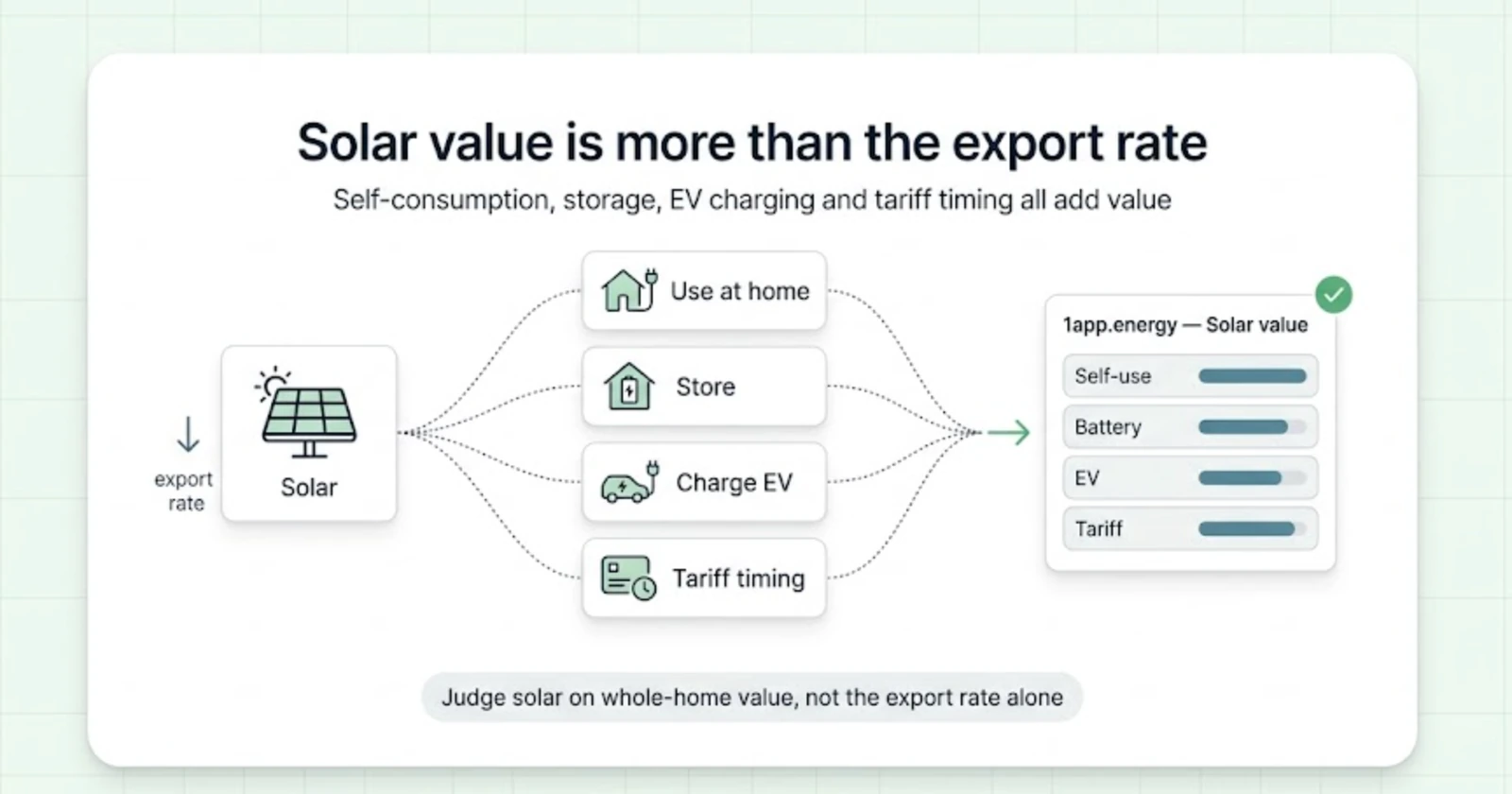
When export rates fall, it is natural for homeowners to ask whether solar still makes sense.
That question is fair, but it is often asked in the wrong way. Solar is not only an export-income product. For many homes, the larger value is the electricity the home does not have to buy, the peak-rate import the battery can avoid, and the flexibility the customer gains when solar, battery, EV charging and tariffs are managed together.
If the original business case depended almost entirely on selling surplus electricity at one high export rate forever, it was too fragile.
A stronger solar case looks at the whole home.
The quick version: is solar still worth it in 2026?
Solar can still be worth it when export rates drop, but the value case changes.
The customer should judge solar by four layers:
- How much solar the home can use directly.
- How much surplus can be stored and used later.
- How the import and export tariff changes the value of timing.
- Whether the system fits the home's future loads, such as EV charging or a heat pump.
Export income still matters. It is just not the only pillar.
Why export income should not be the whole business case
Export tariffs are easy to compare because they are visible numbers. A supplier says it will pay a certain p/kWh rate, and the customer can imagine every spare solar unit turning into credit.
But exported electricity is only the energy the home did not use or store first.
If the export rate is lower than the customer's import rate, using solar inside the home may be more valuable than exporting it. If the home has a battery, storing surplus solar for the evening may beat exporting at midday and importing later. If the customer has a time-of-use tariff, charging or discharging at the right time may be more important than the headline export rate.
This is why the question "what is the export rate?" is incomplete.
The better questions are:
- What does the home use during daylight?
- How much evening demand can the battery cover?
- Does the tariff have cheap import periods?
- Does the export tariff reward specific times?
- Is the home likely to add an EV or heat pump?
- Is there a DNO export limit?
- Can the customer see what actually happened after installation?
Those questions decide whether the system works as a home energy plan.
The value of self-consumption
Self-consumption means using your own solar inside the home instead of exporting it.
That can happen directly, for example when solar runs appliances during the day. It can also happen indirectly, when solar charges the battery and the battery powers the home later.
Self-consumption matters because avoided import is often the most reliable part of the value case. If the home can use a solar unit instead of buying a grid unit, that saving is tied to the import cost the customer avoided.
This is especially useful for homes with:
- daytime occupancy;
- working from home;
- electric cooking;
- battery storage;
- EV charging during solar hours;
- heat-pump hot water or heating demand;
- flexible appliance use.
The more of the home's own electricity it can use sensibly, the less exposed it is to changes in export rates.
Why batteries change the answer
A battery gives solar a second chance to be useful.
Without a battery, solar has to be used at the moment it is generated or exported. With a battery, some of that midday surplus can support the evening, early morning or expensive tariff periods.
That does not mean every battery is automatically a good investment. Battery value depends on size, usage, tariff, charge/discharge rate, export rules, degradation, reserve settings and installation cost.
But strategically, the battery solves the core timing problem.
| Without a battery | With a battery |
|---|---|
| Midday surplus may be exported immediately | Midday surplus can be stored for later |
| Evening demand often comes from the grid | Evening demand can be partly covered from storage |
| Export rate has more influence on value | Avoided import and tariff timing become more important |
| EV charging can create large grid demand | EV charging can be planned against battery and tariff context |
The battery is most useful when it is not treated as a dumb tank. It needs to know when to charge, when to hold, and when to let the home use stored energy.
For a deeper view of battery export decisions, see home battery export checks before selling stored energy.
For customers still choosing a control style, which 1app smart control mode should you use explains the difference between Autopilot, Home First and Time-based Control.
EV charging can make solar more valuable, or more confusing
An EV charger changes the home energy profile dramatically.
The car may use more energy than the rest of the house on a charging day. That creates an opportunity: if charging can happen during cheap tariff windows or sunny periods, the home may use energy more intelligently.
It also creates a risk.
If the EV starts charging and the battery sees that charger as ordinary home demand, the battery may discharge into the car. Sometimes that is fine. Sometimes it means the home reaches the evening with a low battery and buys grid electricity at a worse time.
This is why solar, battery and EV charging should not be planned separately.
A customer who has, or expects to buy, an EV should ask how the battery behaves during charging. The answer may depend on charger data, CT mapping, tariff, inverter settings and whether the control system understands EV load.
The common EV-battery conflict is explained in why your home battery can drain when Octopus charges your EV.
Heat pumps make the long-term case more serious
Heat pumps are part of the wider electrification picture. The Boiler Upgrade Scheme has made eligible heat-pump installations more accessible in England and Wales, and more customers are now thinking about solar, batteries and heating together.
A heat pump can make solar and battery storage more useful because the home uses more electricity. But the timing is different from summer solar production.
Heating demand is often highest in winter, when solar output is lower. That means a customer should not assume that solar alone will cover a heat pump. The right design needs to consider insulation, heat demand, tariff windows, battery reserve and seasonal generation.
The practical point is not "solar plus heat pump gives zero bills". That would be too broad.
The practical point is:
If your home is moving from gas, petrol or diesel towards electricity, your electricity strategy matters more than it used to.
Solar and batteries can be part of that strategy when designed properly.
Government support helps, but design still matters
UK policy has helped the market.
GOV.UK VAT guidance covers zero-rated VAT for qualifying residential energy-saving material installations in Great Britain during the current relief period. That can include solar panels, battery storage and heat pumps, subject to the detailed rules.
The Boiler Upgrade Scheme also provides grants for eligible low-carbon heating installations in England and Wales.
These supports can improve the upfront case. They do not make every quote sensible.
A discounted poor design is still a poor design. The customer still needs the system to fit the roof, the home, the tariff, the DNO approval and future demand.
A better way to judge whether solar is worth it
Before deciding from export rates alone, look at the home in layers.
| Layer | Question to ask | Why it matters |
|---|---|---|
| Roof and generation | How much useful solar can the roof produce? | Sets the energy opportunity |
| Household demand | When does the home use electricity? | Decides self-consumption value |
| Battery | Can surplus be stored and used later? | Reduces dependence on export |
| Tariff | When is import cheap or expensive? | Changes the value of timing |
| Export | What can be exported, and at what rate? | Adds income but may change |
| DNO approval | Is export limited? | Affects usable system design |
| EV and heat pump | Will electricity demand grow? | Changes future sizing and timing |
| Software | Can the customer understand daily behaviour? | Prevents value being lost after installation |
This is a more useful framework than asking whether solar is "worth it" in the abstract.
For one home, the answer may be yes because daytime usage is high and the tariff is suitable. For another, the answer may depend on battery size. For another, the priority may be EV charging or future heat-pump demand.
How 1app.energy helps after installation
The difficult part of solar value often appears after the installer leaves.
The customer starts seeing real days. A sunny day with unexpected import. A battery that drained into the EV. A cheap window that did not seem to reduce cost. An export payment that looks lower than expected. A dashboard where solar, battery, grid and tariff values do not line up.
1app.energy is built for that stage.
For supported homes, it gives one clearer place to understand solar, battery, EV charging and tariff behaviour. For supported Solis-based homes, it helps close the customer software gap between strong hardware and whole-home energy understanding.
Where supported, verified and customer-enabled, 1app.energy can help with tariff-aware battery behaviour. It can charge during useful off-peak windows, protect reserve, and use EV or tariff context where supported.
It should not be treated as a magic savings claim. It is a customer-facing software layer that helps supported homes use their equipment more intelligently.
What homeowners should ask before deciding
Before saying yes or no to solar, ask the installer or quote provider:
- What export tariff assumption is used?
- What import tariff assumption is used?
- What happens if export rates fall further?
- Is a battery included, and why that size?
- Will the DNO approval include an export limit?
- How will EV charging affect battery behaviour?
- Is the system designed with future heat-pump demand in mind?
- What app will show solar, battery, EV, grid and tariff together?
If the quote only answers panel count and export income, it is not complete enough for a modern renewable home.
The same is true after installation. Why your solar dashboard numbers do not add up is useful because a customer should separate kW, kWh, import, export, battery throughput and tariff windows before deciding whether the system is performing well.
Common questions about solar value when export rates drop
Is solar only worth it with a battery now?
No. Some homes can still benefit from solar without a battery, especially if they use a lot of electricity during daylight. A battery becomes more important when daytime usage is low, evening usage is high, or tariff timing matters.
Should I wait because export rates might change again?
Waiting may make sense for some customers, but export rates are only one part of the case. A better decision is based on roof, usage, tariff, battery design, DNO approval and future electrification plans.
Can solar, battery and EV charging reduce bills to zero?
Some well-designed homes can reach very low annual net bills, but this is not a promise. Standing charges, weather, usage, tariff rules, export eligibility, heating demand and upfront cost all matter.
What is the best way to judge solar payback if export rates change?
Look at the full value stack: avoided import, useful export, battery cycling, EV charging, future heat-pump demand and the DNO-approved export position. A quote that only models export income is too fragile for a modern UK home.
Does an export limit ruin the case for solar panels?
Not automatically. An export limit changes how the system should be designed and managed. DNO export limits for UK solar battery homes explains how local use, storage, EV charging and tariff timing can keep solar useful inside the approved limit.
Final thought on solar value when export rates drop
Solar is still worth considering, but the reason is changing.
The strongest future case is not "export everything at a high rate". It is "use, store and export energy at the right time for this home."
That is a more realistic and more resilient way to think about UK solar.
Visit 1app.energy/signup to check your inverter and start signup.
Sources checked on 17 June 2026
Does this sound like your home?
Your setup might already qualify.
Tell us which devices and tariff you are on. We review every request and invite in order of fit, not sign-up date.