DNO export limits: why UK solar battery homes need a smarter plan
What DNO export limits mean for UK solar battery homes, why they happen, and how to design around them without wasting useful solar generation.
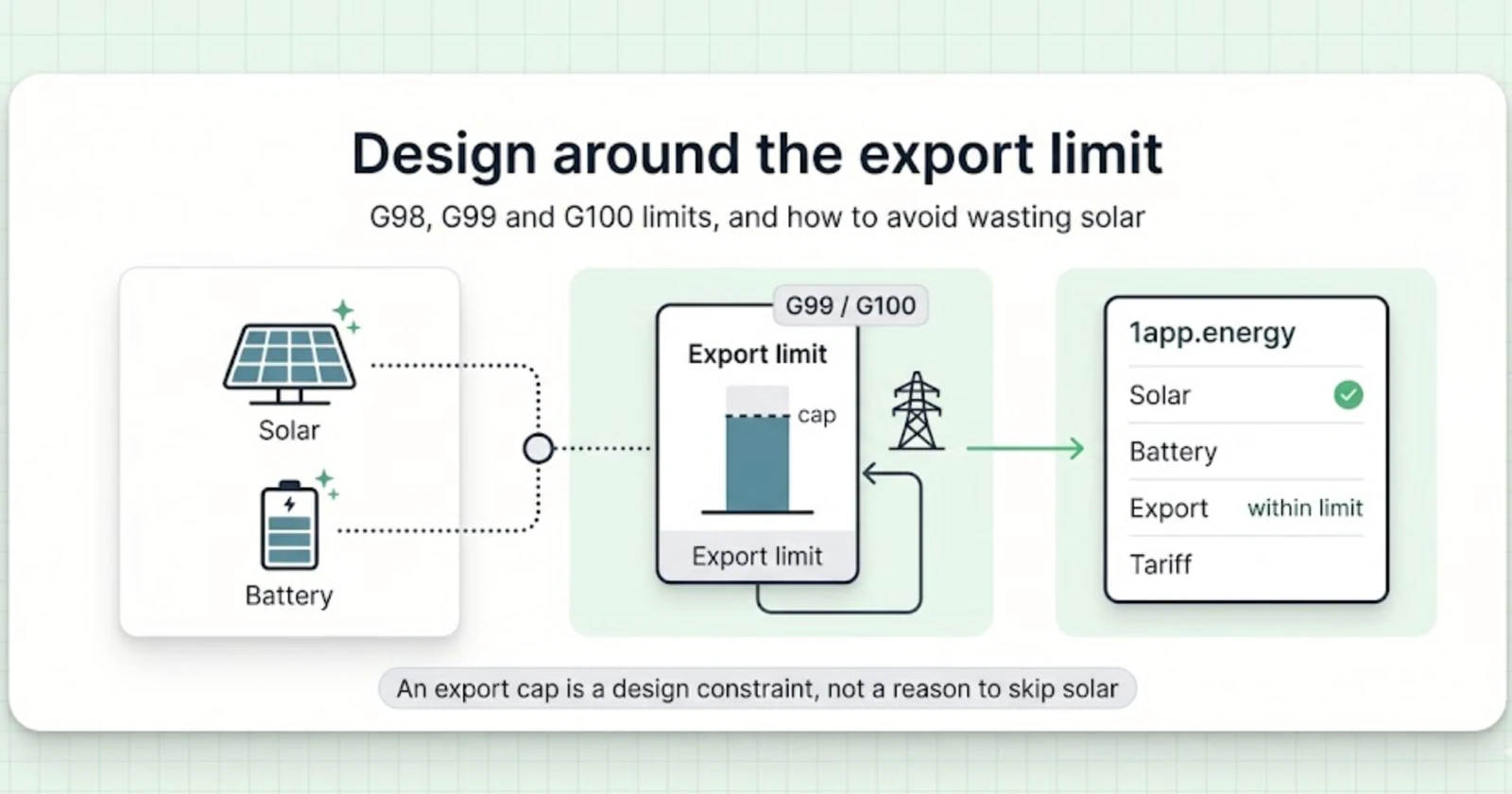
A UK homeowner can install a strong solar and battery system and still be told they cannot export everything the hardware could technically produce.
That can feel contradictory.
The panels may be capable. The hybrid inverter may be capable. The battery may be capable. But the local electricity network still has to approve what the home can send back to the grid.
That is where DNO export limits become important.
For customers, this is one of the most under-explained parts of the solar market. It affects system size, payback assumptions, battery value, EV charging, tariff choice and the customer's day-to-day experience after installation.
The quick version: DNO export limits for UK solar battery homes
A DNO export limit is the maximum power a property is approved to export back to the local electricity network.
It does not automatically make a solar system bad. It does mean the home needs a better plan for using energy locally, storing surplus, charging flexible loads and staying inside the approved export limit.
The problem appears when all of these happen at once:
- solar generation is high;
- home demand is low;
- the battery is already full;
- the EV is not charging;
- the export limit is lower than the power the system could otherwise send out.
At that point, the inverter or export limitation scheme must keep export within the approved limit. Extra generation may be reduced. Customers often call that "wasted solar", although the technical term is usually clipping or curtailment.
The best answer is not to ignore the export limit. It is to design and manage the home so less useful energy reaches that dead end.
Why the DNO cares about export
Your energy supplier sends bills and pays export credit. Your DNO owns and operates the local electricity network.
The DNO's job is not to decide whether solar is a good investment for your home. Its job is to keep the network safe and stable.
When many homes export at the same time, the local network can face:
- voltage rise;
- transformer loading;
- cable loading;
- reverse power flow;
- protection issues;
- power-quality limits.
National Grid Electricity Distribution's export limitation guidance refers to thermal capacity, protection and voltage as checks for export limitation schemes. That is the engineering context behind the customer experience.
Most homes were connected to a network designed mainly for electricity flowing into properties. Solar and batteries mean electricity can also flow out. That is a major change at street level.
G98, G99 and G100 without turning this into a paperwork article
The detailed paperwork is covered in G98, G99 and G100 forms: UK solar and battery DNO guide. The practical version is enough for this article.
For many small domestic generation systems, G98 is the simpler route. Once the generation or storage capability goes above the small-system threshold, the installation normally moves into G99. If export or import has to be capped, G100 is the standard used for the limitation scheme.
The customer does not need to memorise every form. They do need to understand what the approval means.
| Term | Customer meaning |
|---|---|
| G98 | Usually the simpler route for small type-tested generation |
| G99 | The DNO connection process for larger generation or storage capability |
| G100 | The method used when export or import must be limited |
| Export limit | The maximum approved power the home can send to the grid |
The export limit should be treated as part of the system design, not an afterthought.
Why export limits are becoming more common in customer conversations
In the early days of domestic solar, many streets had only a small number of solar homes. A new system often had plenty of local network headroom.
That is changing.
More homes are installing solar. More homes are adding batteries. More customers are thinking about EV chargers and heat pumps. The UK policy direction is clearly towards electrification, and government material on distribution networks recognises that local networks need to prepare for rising demand and distributed generation.
As adoption grows, the local network position matters more.
Two similar homes can receive different outcomes because they are connected to different parts of the network. One customer may get the requested export level. Another may be offered a lower export level. Another may be told that reinforcement or a different connection arrangement is needed.
This is why installers should not leave DNO approval until the customer has already mentally committed to a specific system size and export-income assumption.
What an export limit changes in daily use
An export limit does not usually stop the home using its own solar.
Solar can still power appliances. It can still charge the battery. It can still support EV charging if the timing lines up. It can still reduce grid import.
The limit applies to what crosses the grid boundary as export.
That means the customer should separate three ideas:
| Question | What it means |
|---|---|
| How much can the panels generate? | The roof and weather opportunity |
| How much can the home use or store? | The local value inside the property |
| How much can the home export? | The DNO-approved grid boundary |
If those numbers are confused, the customer can end up with unrealistic expectations.
A customer may have a large roof array and still be export-limited. They may have a large battery and still clip solar if the battery is full by midday. They may have a good export tariff and still be unable to export above the approved limit.
None of those mean the installation is automatically wrong. They mean the system needs to be managed around the approved boundary.
A practical example: large solar, full battery and a capped export
Imagine a home with:
- a large solar array;
- a hybrid inverter;
- a home battery;
- a DNO-approved export limit;
- a flat export tariff;
- an EV charger that normally charges overnight.
On a sunny day, the battery may fill by late morning. The house may be using very little power. The EV may not be plugged in. Solar generation remains high.
At that point, the system has only a few options:
- Use more electricity in the home.
- Store energy in the battery, if there is space.
- Export up to the approved limit.
- Reduce generation above what can be used, stored or exported.
The fourth option is the one customers dislike, but it is the necessary result when there is nowhere approved or useful for the energy to go.
That is why good design should ask how often this situation will happen and what can be done about it.
Three-phase upgrades and the economic tradeoff
Some customers are told that a larger system may need a three-phase upgrade or other network work.
That can be the right answer for some homes. It can also be expensive enough that the extra export does not justify the upgrade.
The calculation should not be reduced to "three phase means better". The better question is:
Will the extra usable generation, export opportunity and flexibility justify the additional infrastructure cost over the life of the system?
That depends on the customer's roof, usage, battery, tariff, EV charging, heat-pump plans, export rates and DNO outcome.
Sometimes a smaller or export-limited system with better battery and tariff management is the more sensible design. Sometimes the upgrade is justified. The point is that the customer should see the tradeoff before committing.
How to design around an export limit
An export-limited home should be designed around useful local energy first.
Useful strategies include:
- sizing the battery around real surplus and evening demand;
- leaving battery space for predictable midday solar where appropriate;
- charging the EV during sunny periods or cheap windows where sensible;
- using flexible loads such as hot water or heat-pump operation carefully where the setup supports it;
- choosing tariffs that reward the home's actual behaviour;
- avoiding export-income assumptions that exceed the approved export limit;
- reviewing one normal sunny day after installation to see whether clipping is happening.
The goal is not to push more power through the export boundary. The goal is to make more of the energy useful before it reaches that boundary.
That is why export-limit planning sits close to tariff setup and battery control. Manual tariff setup for solar battery and EV homes explains the tariff side, while home battery export checks before selling stored energy explains why export should be a checked decision rather than a reflex.
Why software matters after the DNO paperwork is complete
The DNO paperwork tells the system what it is allowed to do. It does not help the customer understand whether the home is behaving well.
After installation, the customer still wants to know:
- Did solar cover the home today?
- Did the battery fill too early?
- Was energy clipped because export was capped?
- Did the EV charge from solar, battery or grid?
- Did the home import during an expensive period?
- Did the tariff strategy make sense?
That is a software and visibility problem.
The customer may have passed all technical commissioning and still feel confused if the app experience is split across inverter, charger and supplier tools.
For the dashboard side, why your solar dashboard numbers do not add up gives customers a safer way to check live power, daily energy, import, export and battery movement before blaming the hardware.
How 1app.energy helps
1app.energy does not replace DNO approval, G98 notification, G99 application, G100 export limitation or installer commissioning.
It helps with the part customers live with after installation.
For supported homes, 1app.energy gives one clearer view of solar generation, battery behaviour, grid import and export, EV charging context and tariff timing. Where supported, verified and customer-enabled, tariff-aware battery behaviour can help the home charge, hold, use or export energy more sensibly within the approved setup.
For Solis-based homes, this is part of closing the customer software gap: the hardware can be capable, the paperwork can be correct, and the customer may still need one app that explains what the home is actually doing.
What installers should explain at handover
A strong solar and battery handover should include the export limit in practical language.
The customer should know:
- the approved export level;
- whether G100 export limitation is part of the design;
- where the limit is enforced;
- whether the customer should avoid changing inverter export settings;
- what happens when the battery is full and solar is high;
- how the EV charger may help or complicate energy use;
- which app or dashboard should be used to review daily behaviour.
This prevents a common customer complaint: "I paid for a bigger system, but I cannot export everything."
The better framing is:
Your system is designed to work inside this network limit. Here is how we make the energy useful before it has to be curtailed.
Common questions about DNO export limits
Does an export limit mean I should not install solar?
No. It means the system should be designed around local use, battery storage and the approved export boundary. Solar can still reduce import and support the home.
Can a battery solve an export limit?
A battery can help by storing surplus solar that might otherwise be exported or clipped. But once the battery is full, the export limit still matters.
Can I change the export limit myself?
No. Export limits are part of the approved connection setup. Speak to your installer and DNO before changing export settings or equipment.
What is the difference between G99 and G100 export limitation?
G99 is a connection application route for larger generation equipment. G100 export limitation is a way to keep export within an approved limit. For a fuller paperwork guide, see G98, G99 and G100 forms for UK solar and battery systems.
Will a DNO export limit affect my export tariff income?
It can. The supplier pays based on metered export and tariff terms, but a lower approved export limit can reduce how much surplus power reaches the grid at peak generation times. The design should therefore prioritise useful local demand, battery storage and sensible timing before export is capped.
Final thought on DNO export limits
DNO export limits are becoming part of the normal UK solar conversation.
That is not a reason to walk away from solar. It is a reason to design more intelligently. The best homes will use solar locally, store it when useful, coordinate EV and tariff behaviour, and stay inside the approved network limits.
Visit 1app.energy/signup to check your inverter and start signup.
Sources checked on 17 June 2026
- Energy Networks Association, connecting generation to the electricity networks
- National Grid Electricity Distribution, Generation G99
- National Grid Electricity Distribution, Customer Export Limitation Schemes
- GOV.UK, registering energy devices in homes or small businesses
- GOV.UK, Electricity Distribution Networks Study response
Does this sound like your home?
Your setup might already qualify.
Tell us which devices and tariff you are on. We review every request and invite in order of fit, not sign-up date.