What to ask before installing solar and battery in the UK
A practical UK solar battery checklist covering DNO approval, export limits, inverter size, battery sizing, EV charging, tariffs and software.
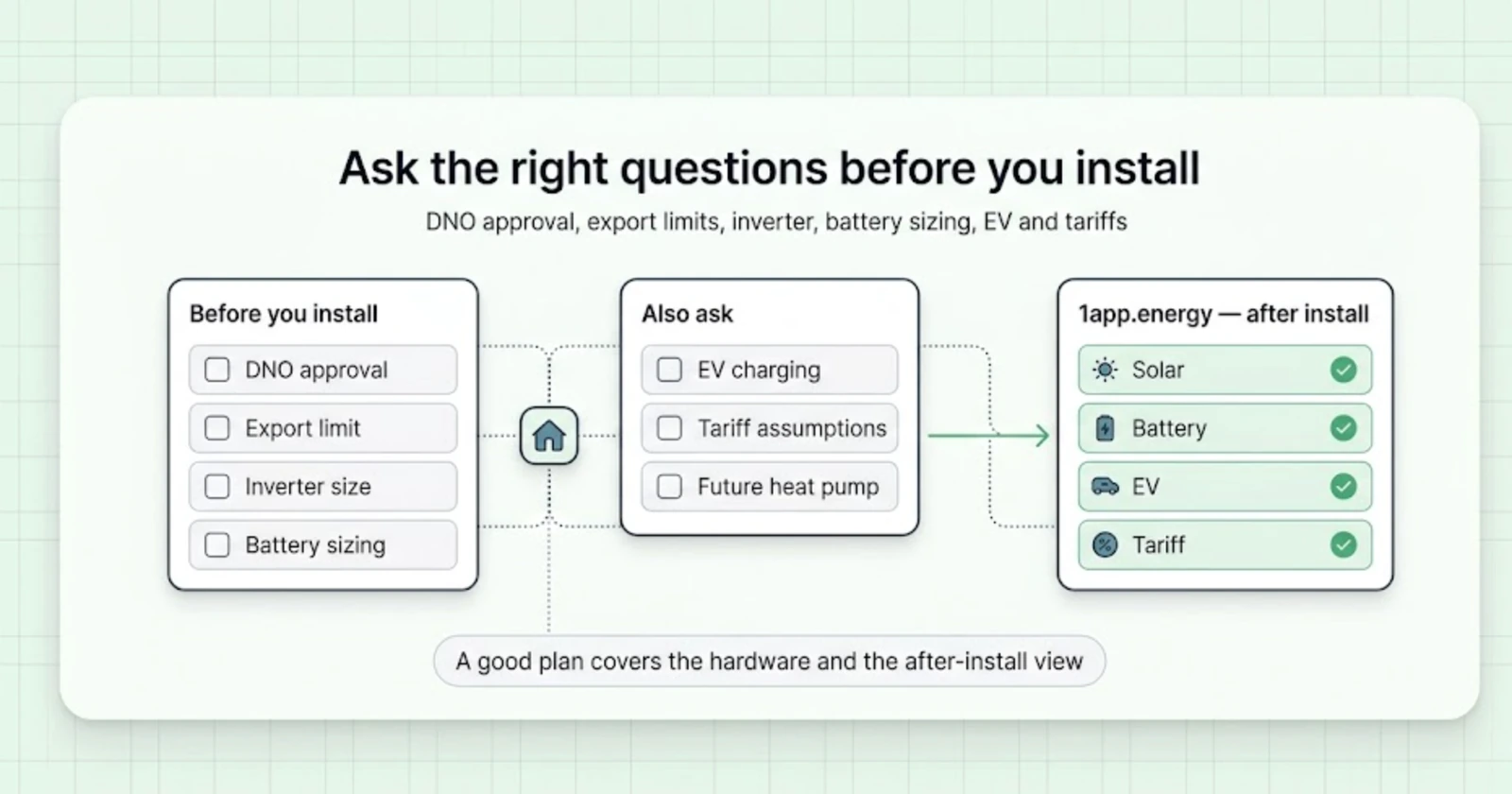
Solar and battery quotes can look professional while still leaving out the questions that decide whether the system will work well for the customer.
Panel count is not enough. Battery capacity is not enough. A projected annual saving is not enough if it assumes an export rate, tariff, usage pattern or DNO approval that may not match the home.
For a modern UK home, the installation should be designed around the household, the local network, the tariff and future electrification plans.
This guide is a practical way to question a solar and battery quote before the system is installed.
The quick version: what to ask before a UK solar battery install
Before installing solar panels and battery storage in the UK, customers should ask about eight areas:
- DNO approval and export limits.
- Inverter size and phase supply.
- Battery size and reserve.
- Solar generation and clipping risk.
- Import and export tariff assumptions.
- EV charging behaviour.
- Future heat-pump demand.
- The app or software layer used after installation.
The best installer should be able to explain these without making the customer feel difficult for asking.
Start with the DNO question
The DNO question should come early because it can change the system design.
Your DNO is the local network operator, not your electricity supplier. It needs to know whether the solar and battery system can connect safely and how much power it may export.
Ask:
- Which connection route applies to this design?
- Is this a G98 notification, G99 application or export-limited G100 setup?
- Does approval need to happen before installation?
- What export level is being requested?
- What happens if the DNO approves a lower export level?
- Will I receive the approval and commissioning documents?
If the quote includes export income, ask whether that income assumes the requested export level or the approved export level. Those may not be the same.
For the deeper paperwork guide, see G98, G99 and G100 forms: UK solar and battery DNO guide.
Understand the export limit before judging system size
An export limit is not always a reason to reject a solar design. But it should change how the design is explained.
If the home has a large solar array, low daytime demand, a full battery and a capped export level, some solar generation may be clipped. That is not a billing issue. It is a design and network-limit issue.
Ask the installer:
- What export limit do you expect?
- What export limit was approved?
- How will the inverter or export limitation scheme enforce it?
- What happens on a sunny day when the battery is full?
- Is the system designed to use energy locally before it gets clipped?
This is especially important where the customer is choosing a larger array or hybrid inverter because the economics may depend on using more energy inside the home rather than exporting everything.
Check the inverter, not just the panels
Solar quotes often lead with the number of panels. The inverter is just as important.
The inverter affects how much power the home can use, how much it can export, how quickly the battery can charge or discharge, what DNO route applies, and what software control options may be available.
Ask:
- What is the inverter AC rating?
- Is the home single-phase or three-phase?
- Is the solar array oversized against the inverter?
- What are the battery charge and discharge limits?
- Can the inverter charge the battery from grid?
- Does the inverter support the control behaviour I expect?
- Is this model supported by the app or optimisation layer I plan to use?
The last question matters. Seeing inverter data is not the same as being able to control the inverter safely.
For Solis homes, the software gap is explained in the Solis software gap: why UK homes need a smarter energy app.
Size the battery around real behaviour
A battery should not be sized only around what fits in the quote package.
It should be sized around how the home actually uses energy.
Useful inputs include:
- daily electricity use;
- evening and overnight demand;
- solar generation pattern;
- EV charging habits;
- heat-pump plans;
- tariff windows;
- export limit;
- customer reserve preference;
- whether the battery will charge from grid.
A battery that is too small may fill quickly and leave useful solar exported or clipped. A battery that is too large may cost more than the home can cycle regularly.
The right question is not simply "how many kWh is the battery?"
It is:
What job is this battery doing for this home?
If the quote assumes the battery will export stored energy, ask for the guardrails as well as the headline benefit. Home battery export checks before selling stored energy explains why tariff source, reserve, EV demand and export limits all need to be checked first.
Make tariff assumptions explicit
Tariff assumptions can make a quote look stronger or weaker than it really is.
Ask the quote provider:
- Which import tariff was used in the saving estimate?
- Which export tariff was used?
- Is the export rate fixed, variable or time-based?
- Does the tariff allow battery export?
- Are standing charges included in the estimate?
- What happens if the customer changes supplier?
- Can manual tariff periods be entered if supplier sync is not supported?
A solar battery home on a simple flat tariff behaves differently from a home on a cheap overnight tariff. A home with an EV tariff behaves differently again.
This is why tariff setup should be treated as part of the system, not admin. Manual tariff setup for solar battery and EV homes goes deeper into this.
Ask what happens when the EV charges
EV charging is one of the most common post-install surprises.
The customer expects the car to charge cheaply. The battery sees a large home load and discharges into it. The customer then reaches the evening with less stored energy than expected.
That may not be a fault. It may be a coordination problem.
Ask:
- Will the EV charger be visible to the energy app?
- Can the system tell EV load apart from normal home load?
- Will the battery discharge into the EV?
- If I use a smart EV tariff, should the battery hold during charging?
- How will EV sessions appear on the dashboard?
If the answer is unclear, the customer may need to manage EV charging manually or use software that understands the charger context where supported.
Include future heat-pump plans
If a heat pump is likely in the next few years, mention it before the solar and battery design is finalised.
A heat pump changes electricity demand. It can increase winter usage and shift more of the home's energy from gas to electricity. That may affect battery size, reserve settings, tariff choice and the value of solar self-consumption.
Ask:
- Is the system sized with future heating demand in mind?
- Would a larger battery actually help in winter?
- Will the cheap tariff window be long enough for EV, battery and heat demand?
- Should insulation or heating design be handled before the energy system is finalised?
The answer will vary by home. The important point is that future electric heating should not be ignored.
Ask what the customer will see after installation
The best installation still needs a good customer experience afterwards.
After installation, the customer should be able to understand:
- live solar generation;
- home consumption;
- grid import and export;
- battery state, charge and discharge;
- EV charging context where supported;
- tariff periods and daily cost;
- export credit where the rate is known;
- whether the system is behaving as expected.
If those signals are split across three apps, the customer may struggle to understand the system even if the hardware is working.
This is why post-install software should be part of the buying decision.
Red flags in a solar and battery quote
| Red flag | Why it matters |
|---|---|
| Export income is shown without discussing DNO approval | The home may not be approved to export at the assumed level |
| Battery size is presented without usage context | The battery may be too small or unnecessarily large |
| EV charging is ignored | The battery may drain into the car unexpectedly |
| Heat-pump plans are not discussed | Future electricity demand may be underestimated |
| Tariff assumptions are vague | Savings may depend on a rate the customer does not have |
| Software control is promised for every setup | Control depends on supported hardware, permissions and verification |
| No first-week review is suggested | The customer may not know whether the system is behaving correctly |
These red flags do not automatically mean the installer is bad. They mean the customer needs clearer answers before committing.
How 1app.energy helps after installation
1app.energy is designed for the part of the journey that starts after the hardware is fitted.
For supported homes, especially supported Solis-based solar and battery setups, it gives one clearer place for solar, battery, EV and tariff behaviour. Where supported, verified and customer-enabled, it can help with tariff-aware battery behaviour.
It does not replace a good installer. It does not replace DNO approval. It does not make unsupported hardware controllable.
It helps the customer understand and manage the system they live with every day.
Common questions before installing solar and battery storage
Should I choose the quote with the biggest solar array?
Not automatically. A bigger array needs useful local demand, battery capacity, export approval and sensible timing. Otherwise extra generation may be exported at a low rate or clipped.
Is a battery always worth adding?
No. A battery should be sized around the home, tariff and future loads. It is most useful when the home can use stored energy regularly or respond to cheap and expensive periods.
Can software fix a poor installation design?
Software can help supported homes use equipment more intelligently. It cannot change the roof, wiring, inverter rating, battery size or DNO approval. Good design comes first.
What documents should I receive after a solar battery installation?
Ask for the DNO approval or notification evidence, commissioning details, inverter and battery settings, warranties, handover information and any relevant certification. If export limitation is used, ask where the limit is enforced and what the approved export level is.
Should I mention future EV or heat-pump plans before the quote?
Yes. EV charging and heat-pump demand can change the right inverter, battery, tariff and export-limit conversation. Solar, battery, EV and heat pump: the new home energy stack explains why those decisions should not be treated separately.
Final thought before installing solar and battery storage
Solar and battery installation is no longer just a hardware quote.
It is a whole-home energy design. The customer should understand the DNO limit, battery job, tariff assumptions, EV behaviour, future heat demand and software layer before signing.
Visit 1app.energy/signup to check your inverter and start signup.
Sources checked on 17 June 2026
- GOV.UK, registering energy devices in homes or small businesses
- Energy Networks Association, connecting generation to the electricity networks
- National Grid Electricity Distribution, Generation G99
- Energy Saving Trust, Solar panels
- Energy Saving Trust, Storing energy
- GOV.UK, VAT on energy-saving materials
Does this sound like your home?
Your setup might already qualify.
Tell us which devices and tariff you are on. We review every request and invite in order of fit, not sign-up date.