Solar, battery, EV and heat pump: the new home energy stack
Why UK homes should plan solar, batteries, EV charging, heat pumps and tariffs as one joined-up energy system together before adding hardware.
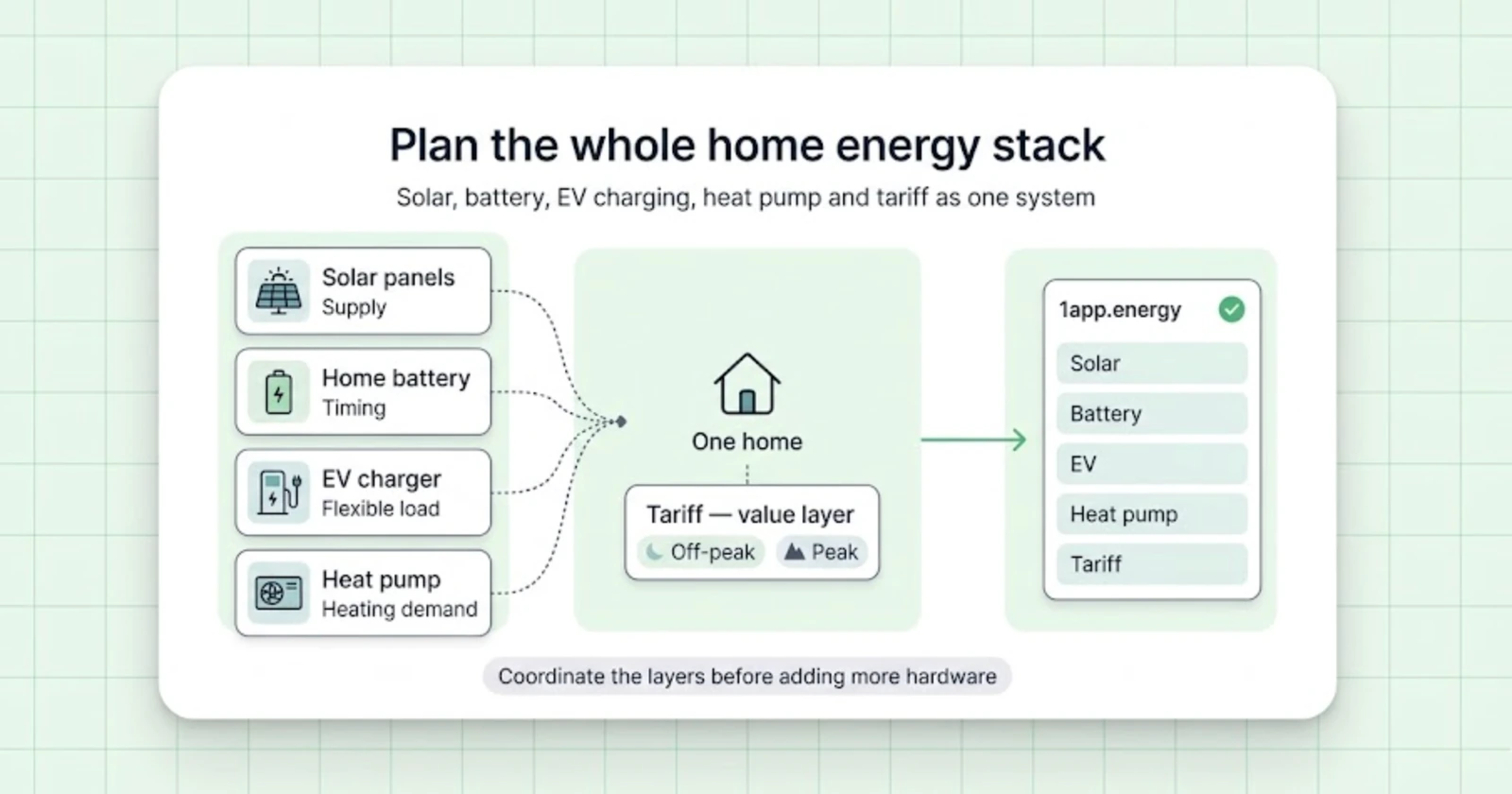
UK home energy used to be easier to separate.
Solar panels were one decision. A battery was another. An EV charger was another. A heat pump was another. The electricity tariff sat in the background and the customer mostly thought about the annual bill.
That separation is becoming less realistic.
A home with solar, battery storage, EV charging, a time-of-use tariff and future heat-pump demand is not a collection of isolated products. It is one energy system. Each part affects the others.
That is why homeowners and installers need to think in terms of a whole-home energy stack.
The quick version: solar, battery, EV and heat pump planning
Solar, battery storage, EV charging and heat pumps work best when they are planned together.
The reason is timing.
Solar changes when the home has supply. A battery changes when energy can be used. An EV charger adds a large flexible load. A heat pump changes heating demand. A smart tariff changes when electricity is cheap, expensive or valuable to export.
If those parts are managed separately, the customer can lose value even when each device works correctly.
The stronger home energy question is:
How will the whole home behave across a real day and season?
Solar is the supply layer
Solar gives the home its own electricity source. That is the foundation of the stack.
But solar production does not follow household demand perfectly. It rises in daylight, often peaks around the middle of the day, and falls before the evening peak. Winter output is lower than summer output. Cloud can change generation quickly.
Solar is therefore valuable, but it needs a destination.
That destination may be:
- the home using power immediately;
- the battery storing surplus;
- the EV charging;
- another flexible load;
- the grid, within the export rules and approved limit.
If the home has nowhere useful for the solar to go, surplus may be exported at a lower rate or reduced by the inverter when export is capped.
The battery is the timing layer
The battery is what turns solar from "power now" into "energy later".
It can store midday surplus for the evening. It can charge during cheaper tariff periods where supported. It can protect the home from peak import. It can hold energy when an EV is about to charge. It can export where the tariff, reserve, refill and DNO setup support that behaviour.
But a battery can also make poor decisions if it only reacts to the current load.
For example:
- it may discharge into an EV during a cheap smart-charging period;
- it may fill overnight and leave no space for solar;
- it may export energy that the home needs later;
- it may cycle unnecessarily if the tariff context is wrong.
This is why battery behaviour has to be planned around the whole home.
The deeper battery decision is covered in home battery export checks before selling stored energy.
The EV charger is the flexible load layer
An EV charger can be one of the largest loads in the home.
That sounds like a challenge, but it is also an opportunity. Unlike a kettle or oven, an EV often has some flexibility. The car may be plugged in for hours while only needing a certain amount of charge by morning.
That flexibility can work well with:
- cheap overnight import;
- sunny daytime charging;
- supplier smart-charging slots;
- battery reserve planning;
- grid flexibility schemes.
The risk is that the EV charger and home battery do not always understand each other.
If the car starts charging and the battery simply sees a large house load, stored energy may flow into the car. That may be sensible during solar surplus. It may be wasteful during a cheap EV charging window.
This is why EV charging should be treated as a specific energy use, not just another anonymous household load.
For a practical example, see why your home battery can drain when Octopus charges your EV.
The heat pump is the heating demand layer
A heat pump moves part of the home away from fossil-fuel heating and into the electricity system.
That can be positive for decarbonisation and long-term energy planning, but it changes the household load profile. Heating demand is seasonal. It is often highest in colder months when solar output is lower. It may create morning or evening electricity demand that the battery needs to understand.
The Boiler Upgrade Scheme has made eligible heat-pump installations more accessible in England and Wales. That support is important, but it does not remove the need for whole-home planning.
If a customer expects to add a heat pump later, the solar and battery design should not ignore it.
Useful questions include:
- Will winter electricity demand increase significantly?
- Will the battery still cover the evening after heating demand is added?
- Does the tariff still make sense?
- Is the home insulated well enough for the heat pump to run efficiently?
- Will EV and battery charging compete for the same cheap window?
The heat pump does not need to be controlled by the same app to matter in the design. It changes the home's energy shape.
The tariff is the value layer
The tariff decides when energy is cheap, expensive or valuable to export.
A simple flat import tariff makes timing less visible. A time-of-use tariff makes timing central. A dynamic tariff makes timing even more important because rates can change by half-hour.
The same hardware can produce different outcomes under different tariffs.
| Tariff context | What the home may need |
|---|---|
| Flat import, flat export | Focus on self-consumption and battery reserve |
| Cheap overnight import | Charge battery and EV carefully during the cheap window |
| High peak import | Protect battery for expensive periods |
| Time-based export | Export only when reserve and refill checks support it |
| Dynamic tariff | More cautious automation and stronger tariff source checks |
The tariff is not just a billing detail. It is a control signal.
That is why manual tariff setup has to be accurate where a supplier sync is not available. See manual tariff setup for solar battery and EV homes for the detailed setup checks.
The customer problem is fragmentation
The hardware stack creates a software problem.
A customer may have:
- an inverter app;
- a battery screen;
- an EV charger app;
- a heat-pump controller;
- a supplier app;
- a smart meter portal;
- a DNO export approval email;
- tariff terms in a PDF.
Each piece can be useful. None of them necessarily explains the whole home.
The customer still wants simple answers:
- Did solar cover the home today?
- Why did the battery drain?
- Did the EV charge from grid, solar or battery?
- Did the home import during the expensive period?
- Did export happen when it was actually useful?
- Is the battery ready for the evening?
- Is the system respecting the export limit?
This is why the next phase of renewable homes is a software problem as much as a hardware problem.
A practical day in the whole-home stack
Imagine a UK home with solar, a battery, an EV charger and a fixed cheap overnight tariff.
Overnight, the home may charge the EV and top up the battery. But if both need energy, the cheap window has to be used intelligently.
In the morning, the battery may support the home before solar is strong. It should still protect a reserve.
At midday, solar may cover the house and refill the battery. If the battery is already full, export or clipping may happen.
In the afternoon, the EV may be plugged in. If the system understands the charger, it can make a better decision about whether solar, grid or battery should supply it.
In the evening, the home may need stored energy to avoid expensive import.
That day cannot be managed well by looking at one device at a time.
How 1app.energy helps
1app.energy is built for homes where the stack needs to make sense to the customer.
For supported homes, especially supported Solis-based solar and battery setups, 1app.energy gives one clearer place for live energy flow, battery behaviour, EV charging context and tariff visibility. Where supported, verified and customer-enabled, it can help with tariff-aware battery behaviour.
The product message is simple:
One app for solar, battery, EV and tariff.
The important boundary is just as important: automation only where supported, verified and customer-enabled. Heat pumps are part of the wider electrification context customers should plan around, but any control promise should only be made when the specific home and integration are supported.
What installers should explain
Installers can help customers by presenting the system as a whole-home energy design.
The customer should understand:
- which device measures solar;
- which device measures grid import and export;
- whether the battery can charge from grid;
- whether the EV charger is visible to the energy app;
- what export limit applies;
- what tariff assumptions were used;
- whether the home is heat-pump-ready;
- what the customer should check in the first normal week.
This creates a better handover than giving the customer three apps and hoping they join the dots.
For that first-week review, why your solar dashboard numbers do not add up is a useful companion because it helps customers separate live flow, daily totals, import/export and tariff windows.
Common questions about the home energy stack
Should I install solar, battery, EV charger and heat pump all at once?
Not necessarily. The important point is to plan them together, even if installation happens in stages. Future EV or heat-pump demand can change today's solar and battery design.
Is the battery or EV charger more important?
They do different jobs. The battery shifts energy across time. The EV charger adds a large flexible load. In a good setup, they should be planned together.
Can one app manage every device?
Only where integrations are supported and verified. 1app.energy focuses on supported homes and should not be described as working with every device or controlling every technology.
Should I size my battery for a future heat pump?
Future heat-pump demand should be part of the design conversation, but it does not automatically mean buying the largest battery. Heat pumps add seasonal demand, so the battery plan should consider winter solar, tariff windows, reserve and the home's real heating pattern.
Why do separate apps make whole-home optimisation harder?
Each app may show one part of the system correctly while missing the wider context. A battery app may not know the EV is about to charge, and an EV app may not understand the battery reserve. Home energy dashboard source of truth explains why the source for each number matters.
Final thought on the home energy stack
The modern renewable home is a stack: solar, battery, EV, heat pump plans and tariff context.
Each layer can help the customer. Each layer can also create confusion if it is managed alone.
The better future is a whole-home view that helps customers understand what is happening and why.
Visit 1app.energy/signup to check your inverter and start signup.
Sources checked on 17 June 2026
Does this sound like your home?
Your setup might already qualify.
Tell us which devices and tariff you are on. We review every request and invite in order of fit, not sign-up date.