Why the grid needs smarter homes, not just bigger upgrades
Why UK grid upgrades matter, but smarter solar, battery, EV and tariff-aware homes can also reduce pressure on local networks as electrification grows.
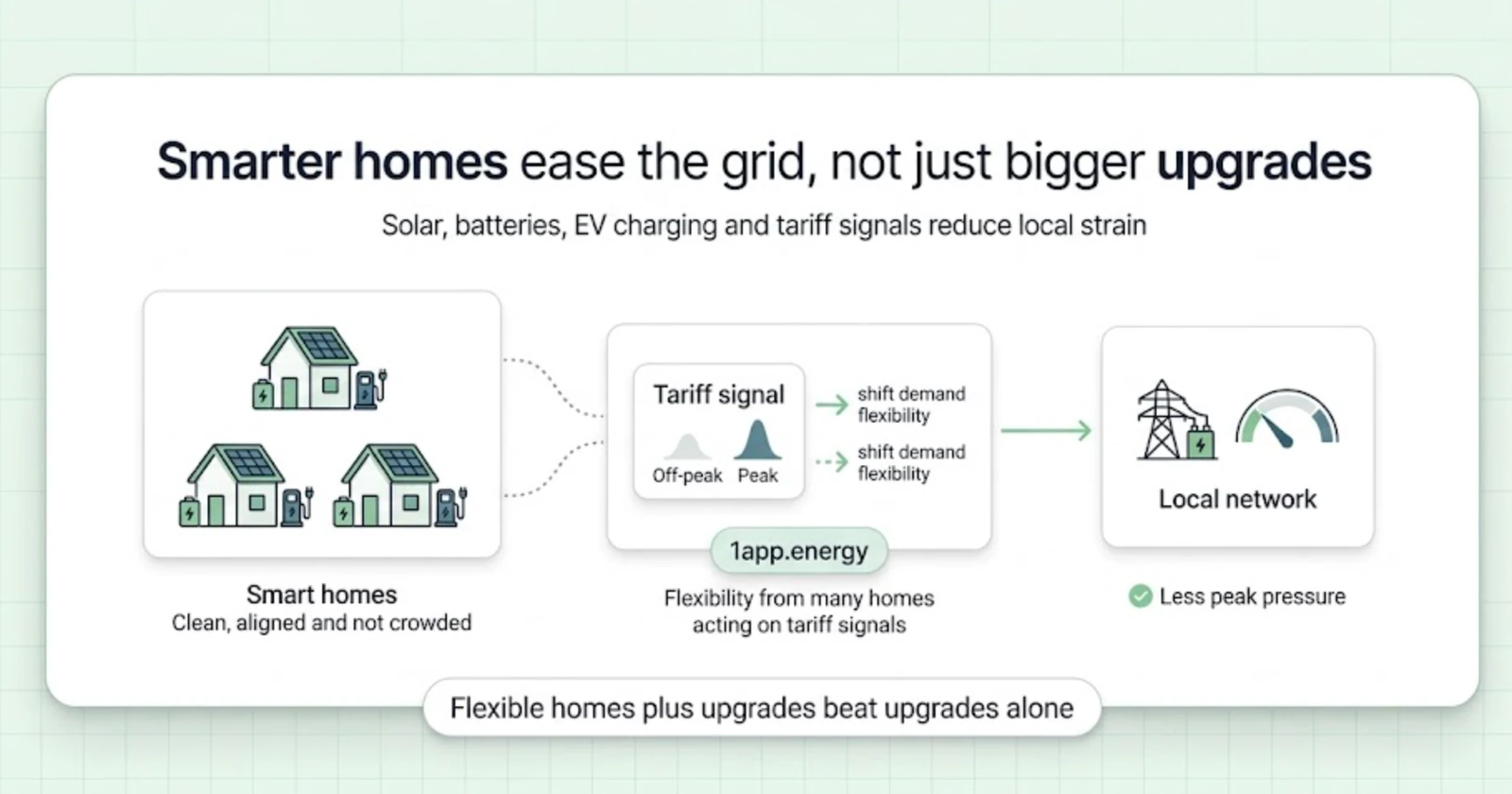
The UK electricity network needs investment. That is clear.
More EVs, more heat pumps, more solar panels, more home batteries and more electric heating all change what local networks have to carry. Government, Ofgem, NESO and network operators all recognise that the distribution network has to prepare for a more electrified future.
But bigger infrastructure is not the only answer.
Homes themselves are changing. They are no longer just passive electricity consumers. A modern home may generate solar power, store energy, charge a car, heat water, run a heat pump and respond to tariff signals.
Managed badly, those homes can add pressure at the wrong times. Managed well, they can become useful flexible assets.
The quick version: why the grid needs smarter homes
The grid needs both physical upgrades and smarter homes.
Physical upgrades create capacity. Smarter homes improve timing.
Solar can create midday export peaks. EV chargers and heat pumps can increase demand. Batteries can either help smooth the home or make the problem worse if they charge and discharge at poor times. Tariffs and flexibility schemes can encourage better behaviour, but only if the home understands the signals.
The future grid is not just about more wires. It is also about better coordination at the edge of the network.
Why the old network model is changing
For decades, domestic electricity networks were mainly designed around one direction of power flow: from large generators, through transmission and distribution networks, into homes.
Solar changes that.
When a home exports solar, power flows back towards the local network. When many homes export at the same time, local voltage and capacity limits matter. This is why DNO export limits and G100 export limitation are becoming more visible in domestic solar projects.
For homeowners who want the practical paperwork version, G98, G99 and G100 forms: UK solar and battery DNO guide explains how those connection routes fit together.
EVs and heat pumps change the other side of the equation.
An EV charger can add a large load. A heat pump can move heating demand onto electricity. If many homes import heavily at the same evening peak, the local network needs more capacity.
So the network has to handle two new pressures:
- more local generation at some times;
- more local demand at other times.
That is the grid-edge challenge.
Why midday solar and evening demand create different problems
Solar is valuable, but it does not always arrive when the home or grid most needs it.
On a sunny day, domestic solar often peaks around the middle of the day. At the same time, many homes may have lower demand because people are out, heating demand is lower, or evening cooking and EV charging have not started.
Later, demand rises. People come home, cook, heat rooms, charge cars and use appliances. Solar output falls.
That mismatch creates the value case for batteries and smart control.
| Time of day | Common grid/home issue | Useful flexible response |
|---|---|---|
| Sunny midday | Local solar export can exceed useful demand | Store energy, run flexible loads, charge EV where sensible |
| Early evening | Household demand rises as solar falls | Use stored energy and avoid unnecessary peak import |
| Overnight cheap window | Lower demand or cheaper tariff periods may appear | Charge battery or EV where the home needs it |
| High export reward period | Grid may value energy more | Export only if reserve and refill checks support it |
The same home can either worsen the mismatch or reduce it, depending on how it behaves.
Why flexibility matters
Flexibility means moving electricity demand or supply in time without making the customer worse off.
At domestic level, flexibility can look like:
- charging an EV overnight instead of at the evening peak;
- charging a battery when prices are low or renewable supply is abundant;
- using stored battery energy during expensive or constrained periods;
- shifting flexible appliances away from peak times;
- using heat-pump or hot-water timing carefully where comfort and equipment allow;
- avoiding unnecessary battery discharge into an EV when the car is already on a cheap smart-charging slot.
This is not about forcing customers to live around the grid. It is about making the home smarter so the customer can keep comfort and convenience while using energy at better times.
NESO's clean-power and future-energy material places flexibility alongside generation, storage and networks. Ofgem has also asked how distributed flexibility should develop. The direction is clear: flexibility is becoming part of the energy system, not a side topic.
Customer-facing flexibility is already becoming visible through supplier schemes and time-based events. Octopus Power Up and Power Down: what it means for UK homes is one example of how batteries, EVs and flexible demand can become useful when the grid is asking homes to shift behaviour.
Why tariffs are becoming control signals
Time-of-use tariffs are one way the energy system tells homes when energy is more or less valuable.
A cheap overnight rate can encourage EV and battery charging when demand is lower. A high peak rate can encourage the home to use stored energy instead of importing. A time-based export rate can reward energy sent back when the grid needs it more.
But tariffs alone do not make a home smart.
The home still needs to know:
- the real tariff for the property;
- whether the battery has enough reserve;
- whether an EV is charging;
- whether export is allowed;
- whether the DNO export limit is respected;
- whether the inverter can be controlled safely;
- whether the customer has enabled automation.
Without that context, a tariff signal can produce poor behaviour. A battery may chase export but leave the home importing later. An EV may drain the battery during a cheap grid-charging slot. A battery may fill overnight and leave no room for solar.
The tariff is only useful when the home can interpret it properly.
That is why manual tariff setup for solar battery and EV homes matters. If the tariff source is wrong, the flexibility decision can be wrong even when the hardware is working.
Why grid upgrades still matter
Smarter homes are not a substitute for network investment.
The UK still needs distribution network upgrades, faster connections, more monitoring, better planning and capacity for electrified heat and transport. The Government's response to the Electricity Distribution Networks Study says electricity demand is expected to at least double by 2050, driven by decarbonisation of heating, transport and industrial processes.
That scale of change cannot be solved only by domestic batteries.
But flexibility can reduce waste and improve timing while the network grows.
The real answer is both:
- upgrade the network where capacity is needed;
- make connected homes behave more intelligently where flexibility is possible.
What this means for solar customers
For homeowners, the grid conversation can feel distant. It becomes very real when it affects a solar quote.
It may show up as:
- a lower approved export limit;
- a longer DNO application;
- a three-phase upgrade discussion;
- an export limitation requirement;
- a tariff that rewards export at specific times;
- a supplier scheme that rewards demand shifting;
- a battery setting that suddenly matters more than expected.
The customer does not need to become a network engineer. They do need to understand that their home is now part of a wider system.
This is why the best solar and battery designs explain:
- what the home can generate;
- what it can use locally;
- what it can store;
- what it can export;
- when it should import;
- how the tariff changes the decision;
- how the customer will see whether it worked.
How 1app.energy helps
1app.energy focuses on the customer-facing software layer for supported renewable homes.
For supported homes, it brings solar, battery, EV charging and tariff behaviour into one clearer view. Where supported, verified and customer-enabled, it can help with tariff-aware battery behaviour such as charging during useful cheap windows, protecting reserve, avoiding poor EV-battery interactions and treating export as a checked decision rather than a reflex.
That does not replace network investment. It does not bypass DNO limits. It does not make unsupported devices controllable.
It helps the customer operate better inside the real rules of the home, tariff and network.
What installers and partners should take from this
The installer opportunity is not only to fit more hardware.
It is to help customers understand the new energy system they are joining.
A better handover explains:
- why export limits exist;
- why battery timing matters;
- why EV charging can affect the battery;
- why tariff setup is not admin;
- why future heat-pump demand should be discussed;
- why the customer needs one clear post-install view.
That helps prevent customer disappointment and makes renewable homes feel more reliable.
Homes that can respond to tariff or grid signals also need realistic battery rules. Home battery export checks before selling stored energy is a useful example of how a good decision should check reserve, EV demand, export rules and refill opportunity before acting.
Common questions about smarter homes and grid upgrades
Can smarter homes avoid all grid upgrades?
No. Network investment is still needed. Smarter homes can reduce pressure, improve timing and make better use of existing capacity, but they cannot replace physical infrastructure.
Are DNO export limits bad for solar?
Not necessarily. They are a network safety tool. The customer impact depends on system design, battery size, local demand, tariff and how often surplus generation would otherwise exceed the limit.
Do smart tariffs help the grid?
They can, if customers and devices respond in useful ways. The tariff needs to be paired with equipment, software and customer settings that understand the home context.
What is domestic flexibility?
Domestic flexibility is the ability for homes to shift demand, storage or export away from stressful periods and towards more useful periods. A solar battery home can contribute when its battery, EV charging and tariff behaviour are coordinated safely.
Can batteries make grid pressure worse?
Yes, if many batteries charge or export at the wrong time without local context. Batteries help most when they respond to tariff, network and home demand signals rather than acting as isolated devices.
Final thought on smarter homes and grid upgrades
The UK grid needs upgrades, but it also needs smarter demand and smarter local energy use.
Solar, batteries, EV chargers and heat pumps can make the system harder to manage if they act blindly. Managed well, they can help customers and the grid move energy to better times.
The future home is not just connected to the grid. It participates in it.
Visit 1app.energy/signup to check your inverter and start signup.
Sources checked on 17 June 2026
Does this sound like your home?
Your setup might already qualify.
Tell us which devices and tariff you are on. We review every request and invite in order of fit, not sign-up date.