EDF GoElectric Smart Charging and your home battery
Learn how EDF tariff windows and provider-created Smart Charging dispatches differ, and how supported battery homes can coordinate around both.
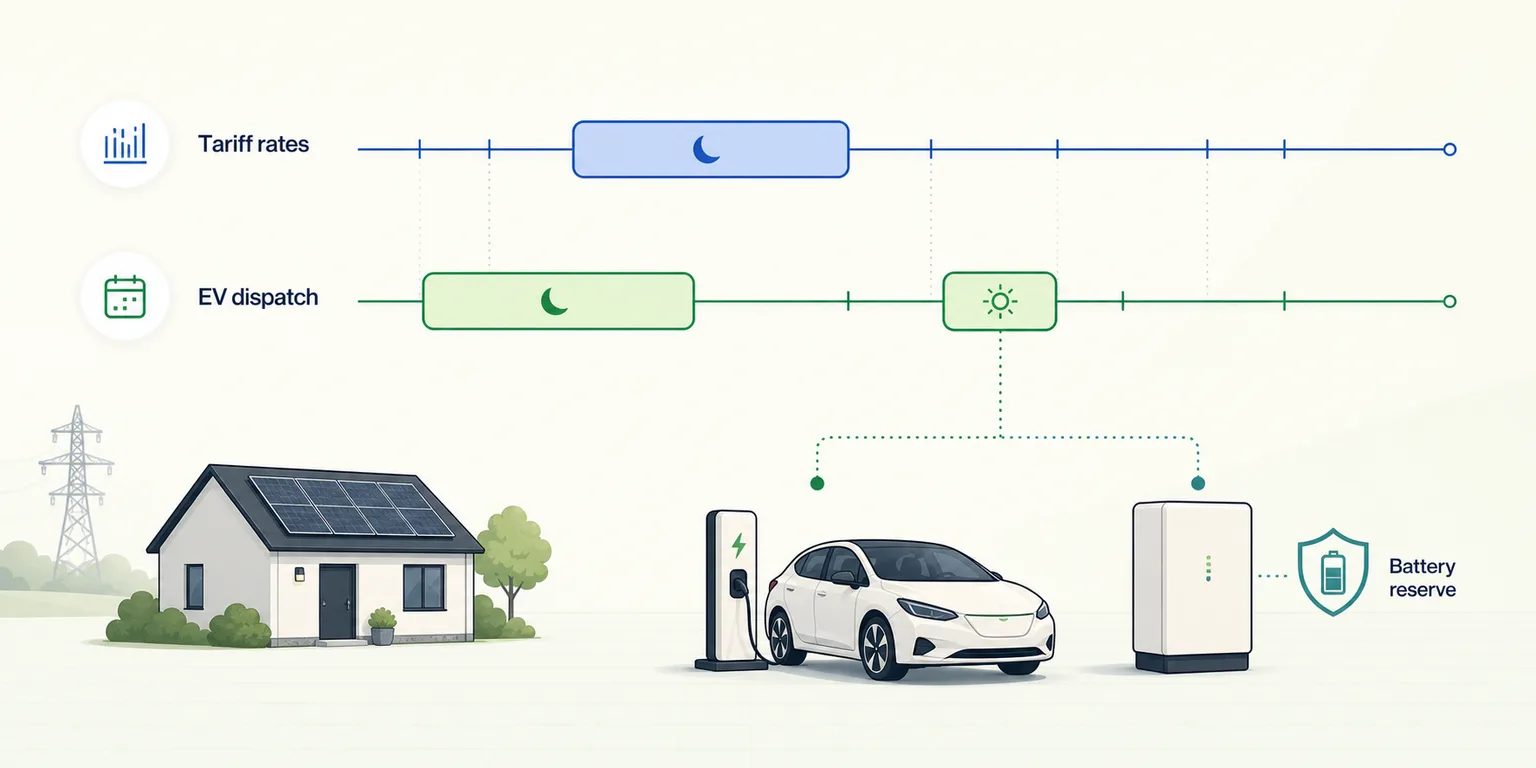
An EDF EV tariff can give a home regular cheaper periods. EDF Smart Charging can also choose additional times to charge an eligible car or charger.
Those two ideas sound similar, but they are not the same data.
The tariff describes electricity rates. The Smart Charging dispatch describes when EDF plans to charge the EV. A solar and battery home needs to understand both, because a provider-created daytime charging window can change what the battery should do.
The quick version
- EDF tariff-rate sync and EDF Smart Charging dispatch sync are separate.
- EDF creates the eligible EV charging schedule from the customer's readiness settings and connected car or charger.
- 1app.energy does not create or replace that EDF schedule.
- 1app.energy can read supported tariff and dispatch context and place it beside solar, battery, grid and household demand.
- Supported battery behaviour can work around a retained EDF dispatch only where the inverter is verified and Smart Control is customer-enabled.
- Eligibility, tariff terms, compatible cars and chargers can change, so customers should check EDF's current information before switching or connecting.
What is EDF GoElectric Smart Charging?
EDF currently presents GoElectric as an EV tariff with a regular overnight off-peak period. Customers can add EDF Smart Charging where their account, car or charger and smart-meter setup are eligible.
The customer tells EDF when the car should be ready and how much charge it needs. EDF then creates the charging plan and controls the eligible vehicle or charger through its own service.
EDF also says Smart Charging can create off-peak treatment outside the standard tariff window for eligible charging periods. That makes the provider-created dispatch important to the whole home, not only the car.
Tariff details and eligibility rules change. Use EDF's live pages and terms for the current rates, windows, rewards and compatibility list rather than relying on an old screenshot or article.
Tariff windows and dispatch windows are different
A tariff window answers:
What rate applies to electricity used during this period?
A Smart Charging dispatch answers:
When does EDF currently plan to charge this eligible EV or charger?
The standard cheaper period may repeat at familiar times. A provider dispatch can be created around the customer's readiness target, connected device and EDF's charging plan.
This separation matters in software. A home may have valid EDF tariff rates even when no Smart Charging dispatch is active. Another eligible home may have an EDF dispatch that extends cheap treatment beyond the usual overnight window.
1app.energy keeps the two evidence paths separate rather than converting them into one generic schedule.
Why a daytime EDF dispatch matters to a home battery
Imagine the EV is plugged in during the afternoon and EDF schedules an eligible charging period before the usual overnight window.
The charger may start correctly according to EDF, but the home battery does not automatically know why the new load appeared. If the inverter remains in normal self-use, stored energy may discharge into the car.
That can create a poor whole-home result:
- the EV receives energy during a provider-selected period;
- the battery loses reserve intended for the evening;
- the home later imports more electricity after the battery has emptied;
- separate apps can each appear correct while the combined outcome is confusing.
The issue is not that EDF scheduled the car incorrectly. It is that the battery and EV are controlled by different systems with different information.
How 1app.energy uses EDF context
For an eligible connected home, 1app.energy can bring supported EDF tariff evidence into the same view as the rest of the property.
Where EDF Smart Charging dispatch evidence is available, 1app.energy can also show that provider-created charging context and use the retained dispatch boundary in supported battery decisions.
This can help the customer understand:
- the current EDF rate and upcoming tariff windows;
- whether EDF has planned an eligible EV charging period;
- when that charging period overlaps with solar generation or battery discharge;
- whether the battery needs protection during the provider dispatch;
- how the combined event affected daily import and cost.
Battery coordination is not enabled simply because an EDF tariff connects. It requires a supported inverter, installation-specific control verification and a customer-enabled Smart Control mode.
Who creates the EV charging schedule?
EDF does.
The customer manages vehicle readiness, charge targets and the connected car or charger through EDF's supported workflow. EDF creates and updates the eligible schedule.
1app.energy reads the available provider dispatch context. It does not choose the EV readiness target, invent EDF slots or replace the EDF app and MyAccount journey.
This boundary also protects the customer when data is unavailable. If the provider dispatch cannot be read safely, 1app.energy should not assume that no smart slot exists and issue a conflicting battery action on that basis.
What homes should check before connecting
An EDF Smart Charging and battery setup is strongest when the customer can answer four questions:
- Is the EDF tariff active for this electricity account?
- Is the car or charger eligible and connected to EDF Smart Charging?
- Is the home inverter supported and verified for the intended battery action?
- Has the customer explicitly enabled the relevant Smart Control behaviour?
The EDF and Octopus tariff connectors are separate choices in 1app.energy. One installation should not present both suppliers as the active electricity tariff source at the same time.
The secure EDF connection method may also evolve as provider authentication changes. Follow the current 1app.energy onboarding flow instead of storing instructions from an older password screen.
Common questions
Does 1app.energy create my EDF charging schedule?
No. EDF creates the eligible Smart Charging schedule. 1app.energy uses available dispatch context to explain the whole-home result and, where supported and enabled, coordinate battery behaviour around it.
Is an EDF tariff window the same as a Smart Charging dispatch?
No. The tariff window describes the electricity rate. The dispatch describes a provider-planned EV charging period. A connected home can have tariff data without an active dispatch.
Will connecting EDF automatically control my battery?
No. Battery control requires a supported and verified inverter plus customer-enabled Smart Control. Tariff connection alone does not authorise device writes.
What happens if the EDF schedule changes?
The provider remains responsible for the EV schedule. 1app.energy uses the available retained dispatch evidence and must avoid conflicting actions when that evidence is missing or uncertain.
Does 1app.energy replace EDF MyAccount?
No. Keep EDF MyAccount and the EDF app for tariff management, Smart Charging preferences, eligibility and supplier support. 1app.energy adds supported whole-home tariff, battery and device context.
Related reading
- Manual tariff setup for solar, battery and EV homes
- Intelligent Octopus Go Charge Cap and home batteries
- Why a smart tariff alone is not enough for a heat pump, battery and EV
- How to identify the source of truth in a home-energy dashboard
Final thought
EDF Smart Charging can make EV demand more flexible, but a battery home still needs a shared view of the provider schedule and the rest of the property. Keeping tariff rates, EDF dispatches and battery authority separate gives customers a clearer and safer whole-home picture.
Explore the EDF Energy integration, review the smart tariff EV charging use case, or visit 1app.energy to start early-access onboarding.
Does this sound like your home?
Your setup might already qualify.
Choose your inverter to start. Supported homes create an account straight away; other setups join the compatibility list.