SigEnergy monitoring beta in 1app.energy
SigEnergy homes can join 1app.energy monitoring beta for clearer solar, battery, grid, home-demand and tariff context, with Smart Control off.
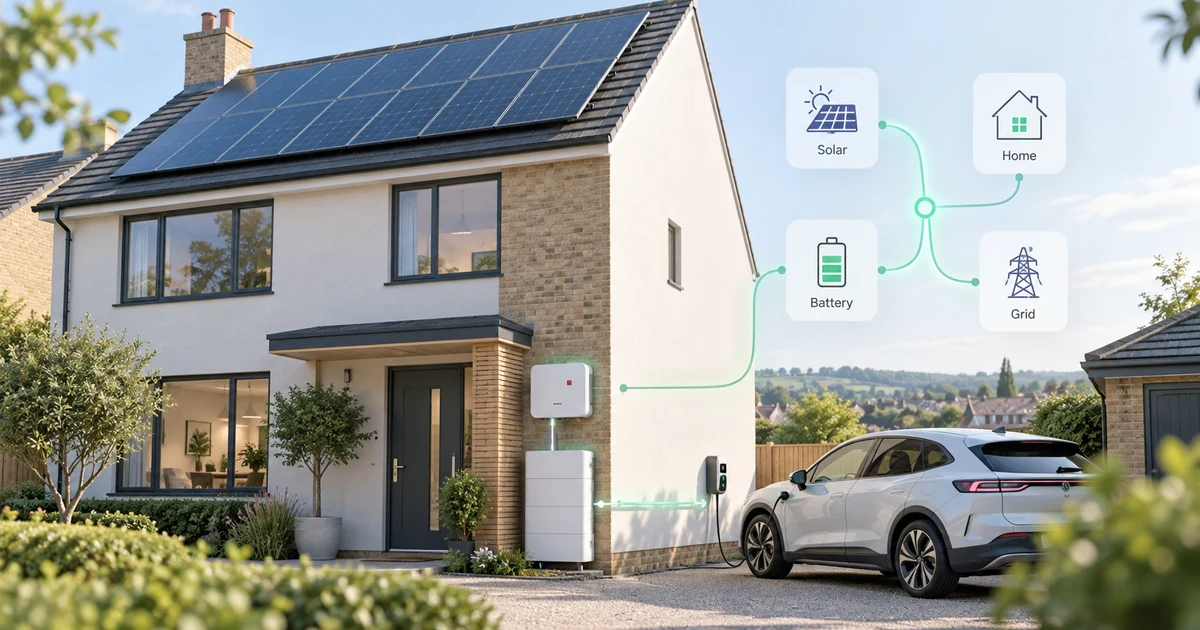
SigEnergy homes are now a serious part of the UK solar and battery conversation.
The hardware is capable, the native mySigen experience matters, and many customers already use SigEnergy to understand their inverter and battery system.
But a modern home usually has more than one energy product. It may also have an EV charger, an Octopus tariff, a manual tariff, export payments and daily cost questions that sit outside the inverter app.
That is why 1app.energy is adding a SigEnergy monitoring beta.
The goal is simple:
Give SigEnergy homes a clearer whole-home monitoring view first. Keep battery commands in SigEnergy until control support is separately proven.
The quick version: SigEnergy monitoring in 1app.energy
SigEnergy support in 1app.energy is monitoring-only in this rollout.
That means:
- supported SigEnergy homes can connect for monitoring;
- solar, battery, grid, state-of-charge and home-demand readings can sit beside tariff and EV context where data is available;
- daily dashboards can help explain import, export, solar generation, battery movement and home use;
- mySigen and SigEnergy remain the primary tools for setup, native settings, diagnostics and manufacturer support;
- 1app.energy does not send SigEnergy battery charge, discharge, export or hold commands in this rollout.
This is deliberately close to how we talk about monitoring-first inverter paths such as LuxpowerTek hybrid inverter beta support, but with an even stricter control boundary for SigEnergy today.
Visibility comes first. Control waits for separate command, readback and safety proof.
Why SigEnergy homes still need a whole-home view
An inverter app can be good at showing the inverter.
That does not automatically answer every household question.
A SigEnergy customer may want to know:
- did the battery charge during the cheapest tariff window?
- did the EV charger pull energy that could have covered the evening?
- did solar refill the battery or go to the home?
- how much energy came from the grid today?
- was export worth anything?
- why does one dashboard number not match another?
Those are whole-home questions.
They need inverter readings, tariff context, EV context, grid movement and daily cost in one place.
The same trust problem appears in many dashboards, which is why we wrote home energy dashboard source of truth: what to check. A nice-looking number is not enough. The customer needs to know which source it came from and what it means.
What 1app.energy adds for SigEnergy monitoring
1app.energy is not trying to replace mySigen.
mySigen and SigEnergy stay important for:
- native account and system setup;
- SigenStor settings;
- native strategies and device-specific behaviour;
- alarms and diagnostics;
- firmware, warranty and manufacturer support;
- battery commands available through SigEnergy.
1app.energy adds the customer coordination layer around that system.
For supported SigEnergy homes, the useful customer view is:
- live solar generation where the API provides it;
- battery power and state of charge;
- grid import and export;
- home-demand context;
- daily energy movement;
- tariff periods and daily cost context;
- EV charging context where another supported charger or tariff integration is connected.
That matters because the customer often wants one answer, not five separate screens.
If the customer sees a number that does not add up, the next question is usually about source and attribution. That is covered in why solar dashboard numbers do not add up, and it is especially relevant when a new inverter monitoring path is added.
What SigEnergy monitoring does not mean
Monitoring is not Smart Control.
In this SigEnergy rollout, 1app.energy does not:
- change SigEnergy battery settings;
- schedule a SigEnergy charge window;
- force a SigEnergy discharge;
- hold or export from the SigEnergy battery;
- replace mySigen setup, alarms, diagnostics or support;
- claim that every SigEnergy account or system exposes every reading.
That distinction protects customers.
Battery control is not a marketing checkbox. Before 1app.energy can safely control a battery, the command path, permission model, device behaviour, readback and fallback behaviour all need to be proven.
For SigEnergy, that is a future phase, not part of the current monitoring beta.
What the customer should use mySigen for
Customers should keep using mySigen for the SigEnergy-native parts of the system.
That includes system setup, account management, device settings, modes, alarms and manufacturer-specific workflows.
SigEnergy describes mySigen as the app experience for monitoring and managing the energy system, and its SigenStor material is the right place to understand the native product family. The SigEnergy mySigen app page and SigenStor product page are the primary public references for that native layer.
1app.energy sits beside that as the home-energy context layer.
That is why the public comparison page says: keep mySigen for SigEnergy-native work, and use 1app.energy for the wider monitoring view. You can read that comparison at 1app.energy vs SigEnergy.
Where EV charging makes SigEnergy monitoring more useful
EV charging is often the moment a home battery starts to feel confusing.
A car can be a large household load. If the battery is allowed to discharge into that load, the customer may see the battery drop faster than expected.
That does not always mean the inverter has done something wrong. It may simply be responding to the home demand it can see.
The customer problem is context.
They need to know:
- when the car charged;
- whether the battery discharged at the same time;
- whether the tariff window was cheap or expensive;
- whether the battery recovered before the evening;
- whether the home imported during peak periods.
That pattern is explained in Intelligent Octopus Go charge caps and home batteries. The same principle applies to SigEnergy homes: the battery reading becomes more useful when the EV and tariff context sit beside it.
Why tariff context matters for SigEnergy homes
Battery data without tariff context is only half the story.
Charging the battery at 03:00 may be sensible on a cheap overnight rate. Importing at 18:00 may be expensive. Exporting may be useful or poor value depending on the tariff.
That is why 1app.energy connects inverter monitoring to tariff context.
Some homes use Octopus tariff sync where supported. Others use manual tariff setup.
Manual tariffs are important because not every customer is on the same supplier. The dashboard should reflect the tariff for that installation, not a generic assumption.
That approach is covered in manual tariff setup for solar battery and EV homes.
What SigEnergy customers should check before joining
Before relying on any monitoring view, customers should check the basics.
1. Is the SigEnergy account active?
The SigEnergy account should already show the relevant system in the native SigEnergy experience.
1app.energy is not a commissioning route. It should connect after the SigEnergy system exists and can be verified for monitoring.
2. Is the correct system selected?
If an account has more than one site or system, the selected system matters.
A monitoring dashboard is only useful when it reads from the right home.
3. Are fresh readings available?
The SigEnergy developer portal documents API access, but an authenticated response does not automatically mean every metric is fresh, complete or useful for a customer dashboard.
The 1app.energy monitoring path should check fresh readings before treating the home as healthy.
4. Is the tariff set correctly?
If the tariff is wrong, cost and import/export interpretation will be wrong.
The customer should check import rate, export rate, standing charge, cheap periods and timezone.
5. Is EV charging visible if it affects the battery?
If the home has an EV charger, it helps to connect supported charger or tariff context too.
Otherwise the customer may see battery movement without understanding the load that caused it.
For a practical reading checklist, see how to read inverter data to spot energy waste.
Common questions about SigEnergy monitoring
Is SigEnergy generally available in 1app.energy?
SigEnergy is available as a monitoring-only beta path for supported homes. It is not a blanket promise that every SigEnergy system or account will expose every reading.
Can 1app.energy control a SigEnergy battery?
Not in this rollout. SigEnergy Smart Control, charge, discharge, export and hold commands are not available in 1app.energy yet.
Does this replace mySigen?
No. Keep mySigen for setup, native settings, device-specific behaviour, alarms, diagnostics and manufacturer support.
What does 1app.energy add?
It can place supported SigEnergy readings beside tariff, EV, grid, daily cost and whole-home context.
Why not turn on control now?
Because battery control needs command proof, readback proof, permission checks and safety fallback behaviour. Monitoring can be useful before that control layer is ready.
Sources checked on 15 September 2026
- SigEnergy mySigen app, for the native SigEnergy app context.
- SigEnergy SigenStor, for native product context.
- SigEnergy developer portal, for the public OpenAPI entry point.
- 1app.energy SigEnergy integration, for current public rollout status.
Final thought on SigEnergy monitoring
SigEnergy is a strong hardware and native-app ecosystem.
1app.energy should not pretend to replace it.
The right first step is to give SigEnergy homes a clearer monitoring layer: solar, battery, grid, home demand, tariff and EV context in one place.
That gives customers value now, without pretending that Smart Control is ready before it has been proven.
Visit 1app.energy/signup to check your inverter and start signup.
Does this sound like your home?
Your setup might already qualify.
Tell us which devices and tariff you are on. We review every request and invite in order of fit, not sign-up date.