Solis battery not charging overnight? What to check
If your Solis battery is not charging overnight, check grid charging, time-of-use windows, reserve, discharge slots, telemetry and verified control.
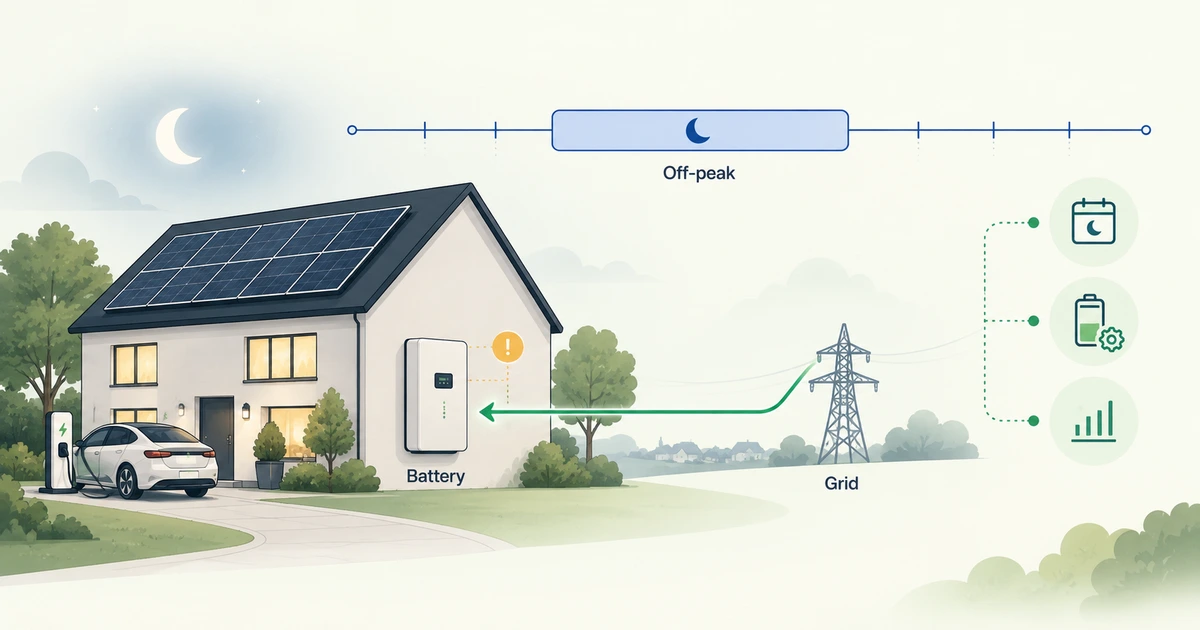
If your Solis battery is not charging overnight, start with the boring checks: whether grid charging is allowed, whether the Time of Use charge window matches your cheap period, whether a discharge window is accidentally active, whether the battery target is already satisfied, and whether the data is fresh enough to prove what happened.
In 1app.energy, supported Solis homes also need verified device access, tariff evidence and customer-enabled Smart Control before automated charging can act. Seeing Solis data or an Octopus tariff in one place is useful, but it is not the same thing as proving a battery command ran or that the battery physically charged.
The quick version: Solis battery not charging overnight
Check these before changing random settings:
- Grid charging: confirm the inverter is allowed to charge the battery from the grid.
- Charge window: make sure the Solis Time of Use charging window covers the actual cheap period.
- Discharge window: if you do not intend to discharge overnight, check that a discharge slot is not enabled.
- Reserve and target: a battery near its target may not need much charging.
- Fresh data: a short SolisCloud snapshot can miss part of the night.
- 1app.energy control readiness: monitoring, tariff visibility and battery control are separate stages.
That last point matters. If a setting, permission, tariff period or control path is missing, the safer behaviour is to show the incomplete state rather than pretend the battery was controlled.
Start with the native Solis charging checks
Solis publishes separate guides for self-use mode, Time of Use charging and remote-control settings. The wording varies by inverter model, firmware and account permissions, so treat the names below as a practical checklist rather than a universal screen-by-screen promise.
For a simple overnight top-up, check whether the Solis setup has:
- the correct battery and meter selected;
- self-use mode or the relevant storage mode enabled;
- charge from grid allowed;
- Time of Use charging enabled;
- a charge period that covers your cheap tariff window;
- a sensible charge power or current limit for the battery and inverter;
- no unintended discharge period during the same window.
Solis's own setup guide says lower-tariff or overnight charging normally belongs in a charge period, and that a discharge period is not usually needed unless you intentionally want timed discharge. See the Solis self-use and Time of Use charging guide.
The newer Solis remote-control guide also shows settings for grid charging, reserve state of charge and charge power limits. It warns that menus and available parameters can differ by account and device, and tells customers to contact Solis support if they are unsure. See the SolisCloud remote control settings guide.
If you are still connecting Solis to 1app.energy, use SolisCloud sign-in or API-key setup. If you specifically need API Management, read how to get your SolisCloud API key.
Check the off-peak tariff window
A battery can only follow a cheap-window plan if the window is real and correctly represented.
Check:
- the cheap period start time;
- the cheap period end time;
- whether the window crosses midnight;
- whether the cheap period applies every day or only on some days;
- whether your supplier has separate smart EV slots;
- whether your manual tariff settings match your bill or supplier account.
For non-Octopus or fixed-rate setups, manual tariff setup for solar battery and EV homes explains the basics. For day-specific tariffs, check your supplier account, bill or tariff confirmation before entering the window.
Octopus Agile is a different case because the price changes by half hour. If you are using Agile with a Solis battery, read Solis inverter on Octopus Agile: how control works before treating it like a fixed overnight timer.
Do not confuse a snapshot with the whole night
One bad-looking chart point does not prove the battery failed to charge.
Solis explains that cloud data can be uploaded in five-minute intervals, and that a screen can show a moment in time rather than the whole physical sequence. See Solis: not charging or discharging when expected.
For a useful overnight check, compare:
- battery state of charge at the start of the cheap window;
- battery state of charge at the end of the cheap window;
- grid import during the same period;
- battery power during the same period;
- any EV charging load during the night;
- whether the inverter, tariff and dashboard are using the same local time.
If those pieces do not line up, call the result inconclusive until you have better evidence. A single accepted setting, a single app screen or one flat battery percentage is not enough.
For the wider evidence pattern, read home energy dashboard source of truth: what to check.
Why 1app.energy might deliberately wait
For supported Solis homes, 1app.energy can bring inverter data, tariff context, EV charging context and Smart Control into one place. That does not mean it should always force an overnight charge.
Time-based Control is the mode that most naturally fits a clear cheap window. Where supported and customer-enabled, it can charge during cheaper tariff periods toward a chosen battery target, while preserving a reserve floor and avoiding optimiser-led export.
Even in that simpler mode, the app may wait or show setup as incomplete if:
- the battery is already near the target;
- the reserve floor and target do not make sense together;
- the cheap window is missing or wrong;
- Solis telemetry is stale or unavailable;
- battery capacity is missing where the mode needs it;
- grid charging permission is not available;
- the Solis control path has not been verified for this installation.
For mode selection, see which 1app.energy Smart Control mode should you use. For the reserve side, see battery reserve floor: what UK solar homes should check.
A practical Solis off-peak checklist
Use this when a customer says the battery did not charge overnight.
| Check | What good looks like |
|---|---|
| Cheap window | Start and end times match the real tariff, including midnight crossover |
| Grid charging | Solis is allowed to charge from the grid where that is the intended behaviour |
| Charge slot | The charge period covers the cheap window and has a sensible power limit |
| Discharge slot | No unintended discharge period overlaps the charge window |
| Battery target | The target is above reserve and not already satisfied |
| Reserve floor | The protected level matches the customer's actual aim |
| Telemetry | State of charge, grid import and battery power are fresh enough to compare |
| EV charging | Any overnight car charging is visible and not mistaken for ordinary house load |
| 1app.energy status | Solis, tariff and Smart Control readiness are all verified before control is expected |
The right first action is usually to check the setup and the evidence, not to keep increasing the charge current.
What not to claim from one failed night
A missed or partial overnight charge can be real, but one night does not prove everything.
Do not claim:
- that the inverter is faulty without checking settings and telemetry;
- that the tariff is wrong without checking the supplier source;
- that 1app.energy controlled the battery unless a verified control path and customer-enabled mode were active;
- that an API key proves battery control;
- that an accepted command proves physical charging;
- that a single home proves a fleet issue;
- that a visible saving or loss exists without tariff, import/export and battery evidence.
Solis also states that API access is separate from remote-control access. If you are using API-key setup, treat it as a data-access route unless the specific installation has verified control support. See Solis: request API access.
Common questions
Does a SolisCloud API key let 1app.energy control my battery?
Not by itself. API-key setup can help 1app.energy access supported Solis data. Battery control depends on the inverter, permissions, verified capability, customer settings and the selected Smart Control mode.
Should Solis discharge time be 00:00-00:00?
If you do not intend timed discharge, Solis's self-use guide indicates that a discharge time is usually not needed. Many customers leave discharge at 00:00-00:00 for a simple overnight charge setup. Check your installer guidance before changing inverter settings.
Why does SolisCloud show no charge even though the battery moved?
It may be a snapshot problem. Check the state of charge across the whole cheap window, not just one screen refresh. Compare SolisCloud with 1app.energy's selected-day view where the home is connected and reporting.
Can 1app.energy charge every Solis battery overnight?
No. Solis support depends on the inverter, account route, telemetry, provider capability, customer consent and the selected mode. 1app.energy should show unavailable or incomplete states where those requirements are not met.
What should I do before changing installer settings?
Record the current settings, check the tariff window, compare overnight telemetry, and ask your installer or Solis support if a parameter is unclear. Avoid changing several inverter settings at once, because that makes the next night harder to interpret.
Sources checked on 15 September 2026
- Solis self-use and Time of Use charging guide, for grid charging, Time of Use charging and discharge-window guidance.
- SolisCloud remote control settings guide, for remote setting names, reserve and charge-power context.
- Solis not charging or discharging when expected, for cloud snapshot and timing caveats.
- Solis request API access, for the boundary between API access and remote-control access.
- Current 1app.energy Solis integration, Solis setup and Smart Control public pages.
Ready to check a supported Solis home? Review the Solis integration, then start 1app.energy setup.
Does this sound like your home?
Your setup might already qualify.
Tell us which devices and tariff you are on. We review every request and invite in order of fit, not sign-up date.