Middle East gas disruption and UK energy bills this winter
What Middle East shipping and LNG disruption means for UK winter energy bills, and how solar, batteries, EVs and heat pumps can respond.
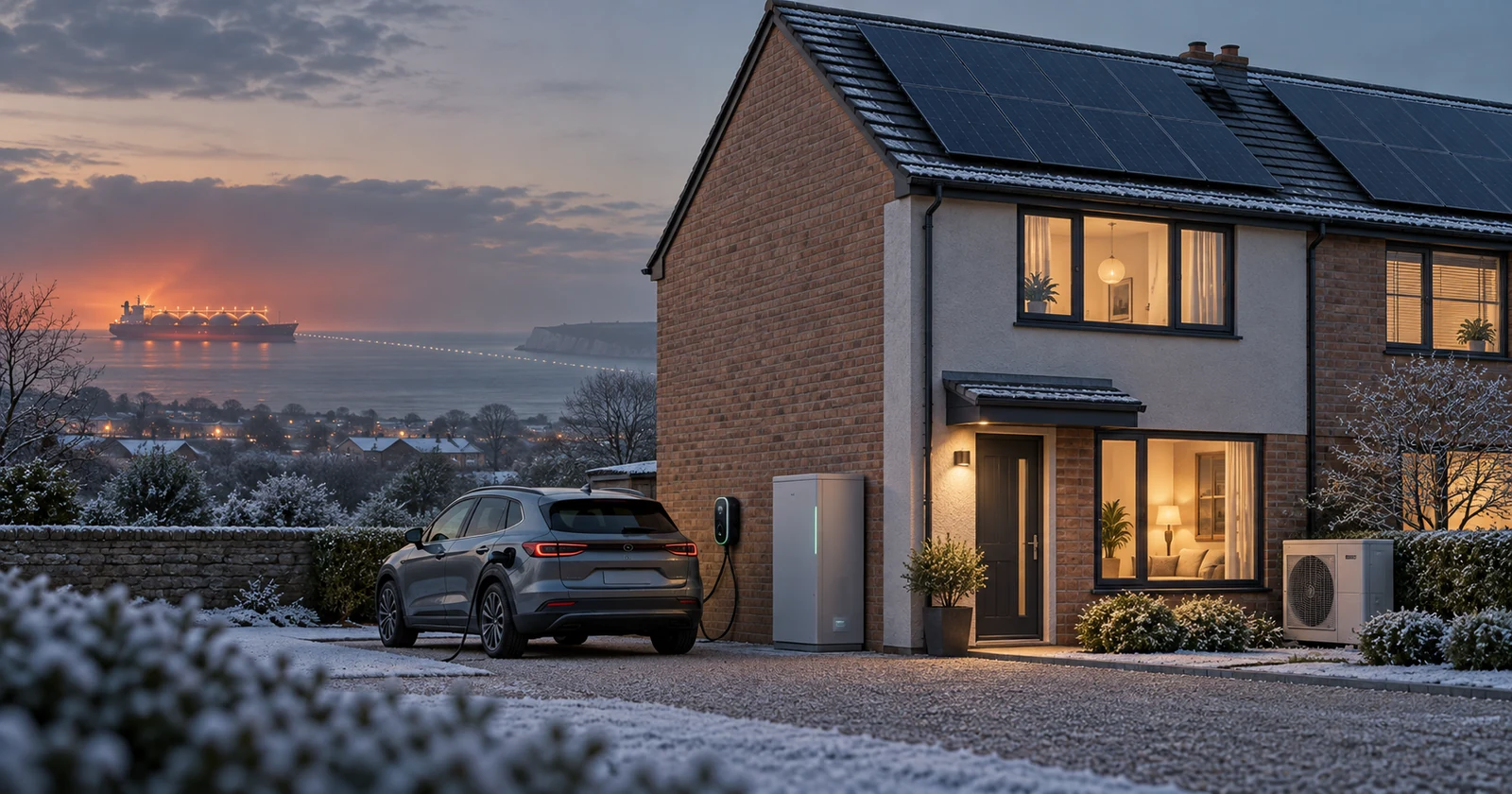
The concern behind the recent energy headlines is real. Disruption around the Strait of Hormuz has tightened the global gas market, wholesale prices have risen, and UK households face a higher price cap from October.
But some of the most alarming claims mix together different things. Shipping risk is not the same as every route being closed. Low storage is not the same as having only one day of energy left. A higher wholesale price is not the same as every household bill doubling.
The useful question is simpler:
What has actually changed, what could it mean for a UK home this winter, and what can the household control?
The quick answer
The Middle East conflict has created a genuine global gas shock. The International Energy Agency's Q3 2026 report says LNG flows through the Strait of Hormuz had accounted for almost 20% of global LNG supply before the disruption. From March to June 2026, combined LNG loadings from Qatar and the United Arab Emirates fell by 35 billion cubic metres compared with the same period in 2025.
Other producers added about 27 billion cubic metres over that period, offsetting around three quarters of the Gulf loss. Global LNG production still fell by 8 billion cubic metres, or 4%.
That shock matters to the UK because gas is traded in an international market and often helps set the wholesale electricity price. It does not mean Britain directly lost one fifth of its own gas supply.
For households, the clearest confirmed effect is the energy price cap. Ofgem set the typical annualised dual-fuel cap at £1,723 from 1 October to 31 December 2026, up 4% from the previous quarter. The regulator said wholesale prices had risen 11% over the previous three months.
At the same time, NESO's early winter view expects Great Britain to have enough electricity, with a 5.5GW margin and an 8.8% buffer over expected peak demand. Price pressure and supply security are related, but they are not the same question.
Checking the headline claims
Recent warnings about winter energy pressure point in the right direction, but several figures need context before they become useful to a household.
| Headline claim | What the current evidence supports |
|---|---|
| Hormuz disruption affected a fifth of global LNG | Supported. IEA and EIA put the pre-disruption share at about 20% |
| Qatari exports fell by more than 95% | Do not treat this as a current all-period figure. EIA's comparable route data shows Hormuz LNG flow down about 92% between Q4 2025 and Q2 2026; IEA reports Qatar and UAE loadings down 35 bcm from March to June |
| GB storage is less than one third full | Supported for 16 September: 31.31% of GB working storage capacity |
| That storage covers only one day | Misleading. Storage is one part of a continuously supplied system, not the country's only gas source |
| Winter electricity prices have doubled | A wholesale forward contract can move very differently from a household tariff. Ofgem's confirmed October household cap is 4% above the previous quarter and 7% higher year on year after adjusting for inflation, not double |
This does not make the warning harmless. It makes the risk more precise: Britain faces higher gas costs and less storage cushion, while the official electricity outlook still expects adequate supply.
What is happening at the two Middle East chokepoints?
The Strait of Hormuz and Bab el-Mandeb matter for different reasons.
The Strait of Hormuz is the route out of the Gulf for LNG from Qatar and the United Arab Emirates, as well as a large share of global oil exports. The IEA describes a de facto closure after the conflict escalated in early 2026. Traffic later began to recover, but remained well below its earlier level and the timetable for a full return stayed uncertain.
Bab el-Mandeb connects the Red Sea with the Gulf of Aden. It is important for traffic using the Suez route. Houthi attacks and the latest fighting have increased risk and reduced traffic, particularly for exposed or Saudi-linked shipping.
That risk increased again on 10 and 11 September. Associated Press reported that Houthi forces captured the Red Sea port of Mokha and Mayun, also called Perim, an island inside the strait. Saudi Arabia also shut its East-West oil pipeline as a precaution after a drone attack. That pipeline had become more important as an alternative to Hormuz.
It is not accurate to describe Bab el-Mandeb as completely closed to all shipping. The better description is a high-risk route carrying reduced traffic, with the possibility of further disruption.
That distinction matters. A closed route, a restricted route and a route that shipowners avoid because insurance and security costs are too high can all affect prices, but they are not the same event.
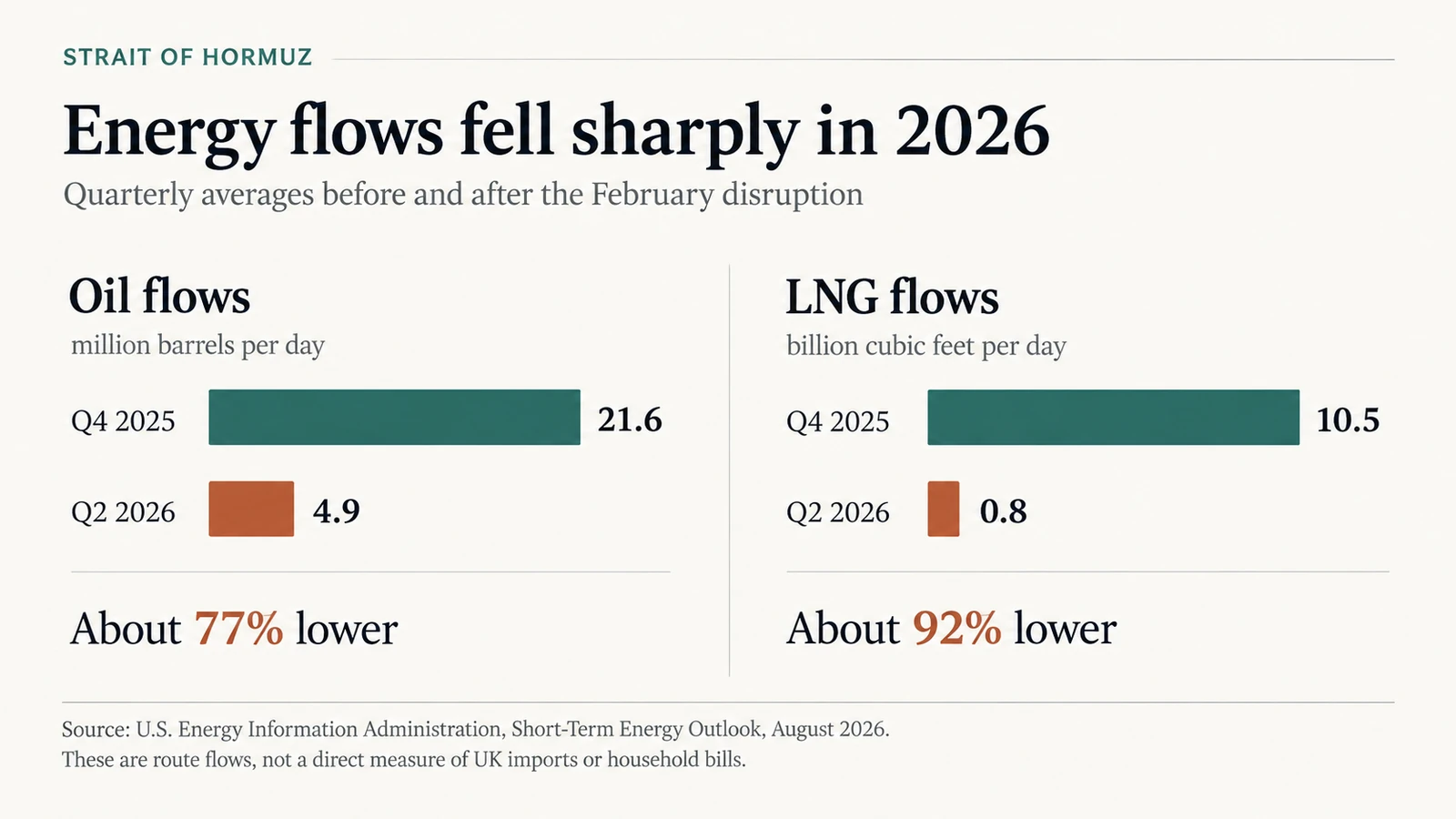
The latest comparable EIA quarterly data shows the scale clearly. Oil flows through Hormuz fell from 21.6 million barrels per day in the fourth quarter of 2025 to 4.9 million in the second quarter of 2026, a fall of about 77%. LNG flows fell from 10.5 to 0.8 billion cubic feet per day, about 92%.
Bab el-Mandeb carried 8.1 million barrels of oil per day in the second quarter, up from 5.4 million in the fourth quarter of 2025. That shows why the Red Sea route became more important as Hormuz weakened, and why the September escalation matters even though it has not stopped every ship.
The numbers behind the gas shock
The IEA's July 2026 gas market report gives the clearest view of the first half of the year:
| Measure | Change | What it means |
|---|---|---|
| LNG previously passing through Hormuz | Almost 20% of global LNG supply | A disruption there affects buyers far beyond the Gulf |
| Qatar and UAE loadings, March to June | Down 35 bcm year on year | The largest part of the immediate supply loss |
| Additional non-Gulf LNG supply | Up about 27 bcm year on year | New and existing producers replaced roughly three quarters of the loss |
| Global LNG production, March to June | Down 8 bcm, or 4% | The market tightened, but did not lose the full Gulf volume |
| European TTF gas price, second quarter | Up 32% year on year | Europe paid more even after prices eased from March highs |
This is a more useful picture than saying that a fifth of global gas simply vanished. A large supply route was disrupted, other producers responded, and the remaining shortfall still pushed prices higher.
Why UK bills can rise even when most gas does not come from the Gulf
Ofgem says only 1% of UK gas imports in 2025 came from the Gulf. The UK also receives domestic production, pipeline gas from Norway and LNG from other exporters. In 2025, LNG from the United States accounted for 15% of UK gas imports.
So why did the conflict affect British bills?
Because LNG cargoes move between markets. When Gulf supply falls, buyers in Europe and Asia compete harder for flexible cargoes from the United States, Africa and elsewhere. That raises the international price even for countries that were not buying much gas directly from Qatar.
Gas can then affect electricity prices. Gas-fired generation often supplies the last block of power needed to balance the GB system, especially when demand is high or renewable output is lower. That more expensive generator can set the wholesale electricity price for the period.
The chain looks like this:
- LNG shipping or production is disrupted.
- Importing regions compete for fewer flexible cargoes.
- Wholesale gas prices rise.
- Gas-fired electricity becomes more expensive.
- Suppliers' hedging costs feed into later retail tariff periods.
The final step is not instant. Suppliers buy energy ahead, and Ofgem updates the default tariff cap every three months. Customers on a fixed tariff are affected differently, while customers on dynamic or time-of-use tariffs may see market conditions reflected through their tariff rules sooner.
What the October 2026 price cap actually says
The October cap is higher, but the detail is important.
| Ofgem measure | July to September 2026 | October to December 2026 |
|---|---|---|
| Typical annualised dual-fuel cap | £1,663 | £1,723 |
| Average electricity unit rate | 26.11p/kWh | 26.32p/kWh |
| Average gas unit rate | 7.33p/kWh | 7.97p/kWh |
Ofgem said most of the 4% cap increase came from gas. The gas part of the typical bill rose by 8%, while the electricity increase was less than 1% after the removal of VAT from domestic electricity bills.
The £1,723 figure is not a maximum total bill. It is an annualised illustration for a typical household at the capped rates. A household using more energy still pays more, and a household using less pays less.
Around 35% of households were on fixed tariffs when Ofgem announced the change, so the October cap did not apply to them in the same way.
What the latest storage figures do and do not mean
The UK's gas storage capacity is small compared with several large European markets. Rough, the country's only large-scale storage facility, has also been at the centre of a debate about its future and the commercial case for filling it.
Gas Infrastructure Europe's dashboard reported the following position at 06:00 CEST on 16 September 2026:
| Storage area | Gas stored | Share of working storage capacity |
|---|---|---|
| Great Britain | 3.09TWh | 31.31% |
| European Union | 776.91TWh | 68.66% |
So the statement that GB storage was less than one third full was correct on that date. The mistake is turning 31.31% of storage capacity into 31.31% of the gas Britain needs, or into a countdown showing one day until supply ends. Those are different denominators.
That is a real resilience issue. It makes the UK more dependent on continuing domestic production, Norwegian pipelines, LNG terminals and connections with Europe.
But storage should not be described as the country's only fuel tank. The gas system is supplied continuously from several sources. A calculation that divides stored volume by total daily demand does not tell us how long the country can operate while pipelines, domestic fields and LNG terminals are still supplying gas.
National Gas said its summer assessment still expected sufficient capacity and capability to meet forecast demand after reviewing the Middle East escalation. NESO's early winter electricity assessment is also positive. Both organisations continue to monitor gas markets, weather and European flows because the picture can change.
The honest conclusion is:
- the UK has limited storage and is exposed to international prices;
- that exposure deserves attention;
- current official assessments do not say Britain is about to run out of electricity.
What a household can control before winter
No home can reopen a shipping route or set the wholesale gas price. It can reduce avoidable exposure to expensive periods.
1. Check the tariff that is actually active
Do not make a winter plan from a supplier headline alone. Check the import rate, export rate, standing charge, off-peak windows and any smart charging rules attached to the account.
For a time-of-use tariff, confirm that the cheap window saved in the battery or energy app matches the supplier's current terms. Manual tariff setup for solar, battery and EV homes covers the fields worth checking.
2. Give the battery a job, not just a target
A winter battery plan should answer three questions:
- How much energy should be protected for the expensive period?
- When is the next confirmed cheap refill opportunity?
- Is likely solar generation enough to reduce overnight charging safely?
Charging to 100% every night is not automatically right. Neither is relying on a summer solar pattern in December. The useful target depends on battery size, recent household demand, reserve, forecast confidence, tariff and the next refill window.
Which 1app.energy Smart Control mode should you use? explains the difference between Autopilot, Home First and Time-based Control for supported homes.
3. Keep cheap EV charging from draining the home battery
An EV charging slot may be cheap from the supplier's point of view while the inverter sees only a large household load. Without coordination, the battery can discharge into the car and use stored energy that was meant for the morning or evening peak.
The charger app should remain the place for its native schedule and vehicle target. The battery needs to understand when that charging event is happening. Octopus Intelligent Go and home battery drain explains that conflict in practical terms.
4. Treat heat as a comfort constraint
A heat pump is not a battery. Moving heat demand simply because one half-hour price is lower can leave the home uncomfortable or make the system work harder later.
Start with comfort, hot-water need, weather and the heat pump's own operating limits. Shift only the demand that is genuinely flexible. Supported Daikin homes can bring heating context into 1app.energy through the official Daikin partnership, with controls limited to the characteristics exposed by the unit and enabled by the customer. Daikin Onecta remains the native app for setup, schedules, service and full unit settings.
For the wider device conflict, read why a smart tariff alone does not coordinate a heat pump, battery and EV.
5. Use winter solar as evidence, not an assumption
Winter solar can still reduce import, but shorter days and lower output change the battery calculation. A plan that waits for solar should be based on credible generation evidence and the home's recent pattern, not a generic seasonal promise.
On a useful solar day, the home may need less overnight battery charging. On a poor day, a low off-peak price may be the better opportunity. The decision changes with the evidence.
What a coordinated winter day can look like
Consider a home with solar, a battery, an EV and a heat pump on a time-of-use tariff.
| Period | Uncoordinated behaviour | Better coordinated behaviour |
|---|---|---|
| Cheap overnight window | Battery, EV and hot water all start without checking the site limit or each other | EV keeps its supplier or charger schedule; battery charges only to the target needed for the next expensive period; flexible heat stays within comfort limits |
| Cold morning | Heat pump and home load empty the battery before the peak period is over | Battery reserve reflects expected morning demand and the next refill opportunity |
| Winter midday | Battery was filled completely overnight, leaving no room for solar | Overnight target leaves sensible headroom when credible solar is expected |
| Evening peak | Battery has already been spent on the EV or aggressive export | Stored energy is protected for the home unless a verified export decision still leaves sufficient cover |
None of those decisions requires a prediction that energy prices will keep rising. They are useful because they remove waste under the tariff the customer already has.
Where one whole-home view becomes useful
The practical problem is usually not a lack of apps. It is that each app sees only part of the home.
The inverter app understands the solar and battery. The charger app understands the EV. The supplier understands the tariff and, for some products, the charging dispatch. The heat-pump app understands comfort and hot water. Each can make a reasonable decision inside its own boundary while producing a poor result for the whole home.
1app.energy is designed to put supported solar, battery, EV, tariff and Daikin heat-pump context into one daily view. Where the installation is supported, verified and customer-enabled, Smart Control can help a compatible battery charge, hold, protect reserve or export using tariff, refill and home-demand context. Supported EV and Daikin actions remain capability-specific rather than assumed.
That does not remove the need for native apps. They remain important for commissioning, firmware, schedules, diagnostics, warranty and specialist controls. The role of 1app.energy is to make the interactions between those devices easier to see and, where safely supported, easier to coordinate.
A practical winter check
Before the colder months, check:
- the tariff name, import periods, export rate and standing charge;
- the battery's minimum reserve and usable capacity;
- whether the EV schedule belongs to the supplier, charger or both;
- whether the battery is protected during EV charging;
- the heat pump's comfort and hot-water schedule;
- whether winter solar assumptions match recent evidence;
- which controls are genuinely supported and enabled;
- whether the native device apps remain available for setup and recovery;
- whether daily cost and energy figures agree well enough to guide a decision.
The aim is not to chase every market headline. It is to make sure the home does not buy expensive energy because its own devices worked against one another.
Common questions
Will UK household energy bills double this winter?
The confirmed October price cap does not show a doubling. It rises 4% to an annualised £1,723 for a typical dual-fuel direct-debit household. Future periods can change, but they should be discussed as uncertainty rather than a confirmed doubling.
Is Bab el-Mandeb completely closed?
No. The security risk and disruption are serious, and traffic is reduced, but current evidence does not support describing the route as closed to all shipping.
Is the UK about to run out of gas or electricity?
Limited storage increases price and resilience exposure, but it is not the UK's only supply source. NESO's early view expects sufficient electricity with a 5.5GW de-rated margin. National Gas continues to assess the gas position ahead of winter.
Should every battery charge fully overnight?
No. The useful target depends on the tariff, battery capacity, reserve, expected demand, credible solar and the next cheap refill. New or low-evidence homes may need a more cautious target until enough history exists.
Can 1app.energy control every solar, battery, EV and heat-pump setup?
No. Visibility and control depend on the connected provider, model, verified credentials, fresh evidence, installation capability and customer choice. Monitoring can be available where a particular control is not.
The useful lesson from the headlines
The global gas market is tighter, the October UK price cap is higher, and the winter outlook still carries uncertainty. Those facts justify preparation, not panic.
A household cannot control the Strait of Hormuz. It can make sure its tariff is correct, its battery has a sensible winter plan, its EV does not consume the wrong stored energy, and its heat pump keeps comfort inside a coordinated home-energy picture.
That is where resilience becomes practical: fewer avoidable conflicts, clearer evidence and better use of the equipment already installed.
You can review the integrations currently supported by 1app.energy if you want to check which parts of your home can be brought into the same view.
Sources checked on 17 September 2026
- International Energy Agency, Gas Market Report Q3 2026
- International Energy Agency, Gas Market Report Q3 2026 executive summary
- U.S. Energy Information Administration, 2026 energy-security and chokepoint data
- Ofgem, October to December 2026 energy price cap
- Ofgem, wholesale energy costs and household bills
- Ofgem, price-cap unit rates and standing charges
- Gas Infrastructure Europe, gas in storage on 16 September 2026
- National Energy System Operator, Winter Watch 2026/27 early view
- National Gas, Gas Summer Outlook 2026
- International Maritime Organization, Strait of Hormuz updates
- International Maritime Organization, Red Sea updates
- UK Parliament, safeguarding shipping through Bab el-Mandeb
- Associated Press, September Houthi advance at Bab el-Mandeb
Does this sound like your home?
Your setup might already qualify.
Tell us which devices and tariff you are on. We review every request and invite in order of fit, not sign-up date.