How much solar can UK homes lose to EV and battery conflicts?
Most UK solar + battery + EV homeowners assume their system works well. A worked example of what a common setup may lose, and why no dashboard shows it clearly.
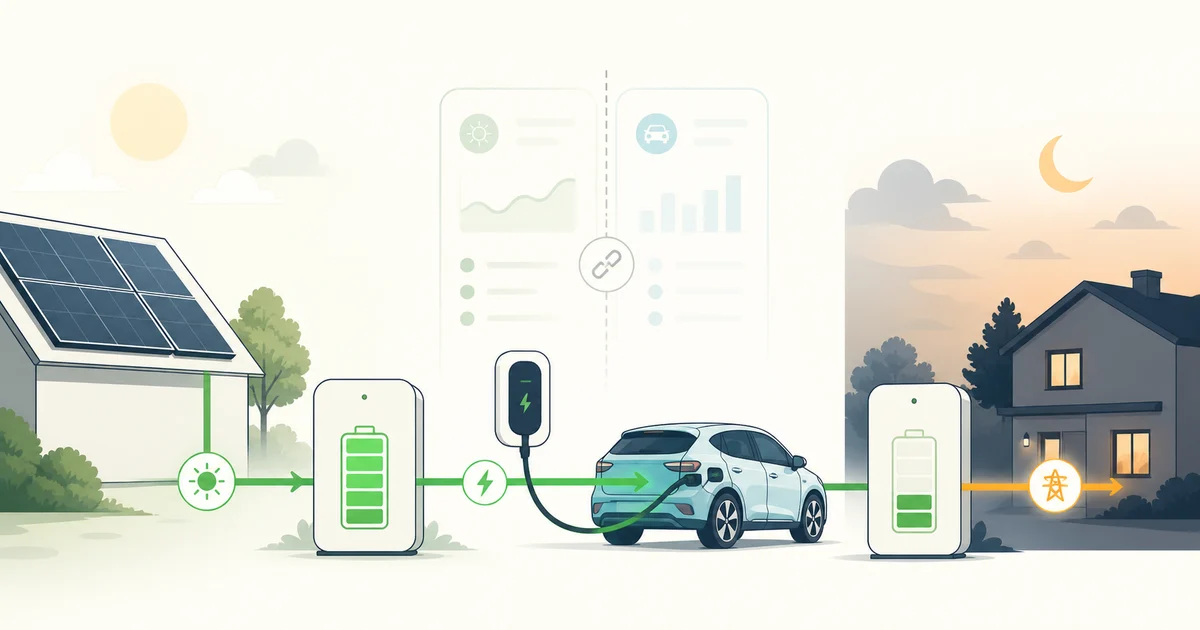
UK households with solar panels, a home battery, and an EV are among the best-equipped to reduce their energy bills. They have generation, storage, and controllable demand all under one roof.
Some are also quietly losing value to conflicts they have never been told about. The amount depends heavily on the battery size, tariff, EV charging pattern, solar output and export rate.
Here is an educational worked example of where that value can go.
A common UK solar battery EV home
A common UK solar, battery, and EV setup looks something like this:
- Solar array: 4–6kW peak capacity
- Battery: 9.5–15kWh usable storage (Solis, GivEnergy, Tesla, or similar)
- EV charger: 7kW tethered or untethered (zappi, Ohme, or similar)
- Tariff: Octopus Go, Intelligent Go, or Flux
As a rough rule of thumb, a 4kW system might generate 16–22kWh on a good summer day, 8–14kWh in spring or autumn, and 2–5kWh in winter.
The battery captures excess solar during the day and supplies the home in the evening when the solar drops off, avoiding more expensive late-day grid imports.
This all works well in isolation. The problem starts when the EV is added.
For the examples below, assume an illustrative home with a 4kW solar array, a 12.5kWh usable battery, a 7kW EV charger, and a peak import rate of 30p/kWh. These are not promised savings or a universal UK average; they are round-number assumptions to show the mechanism.
Scenario 1: daytime Intelligent Octopus Go EV session
It is a Tuesday afternoon in April. Your 4kW solar array has been generating since 08:30. By 13:00, your battery is at 80%. In this worked example, the battery has 12.5kWh of usable capacity, so 80% is about 10kWh stored. It has been in discharge mode since your overnight charging window ended at 05:30.
At 13:15, Octopus Intelligent Go dispatches a charging session. Your zappi starts pulling 7kW. Octopus is offering cheap grid power for this session, but your inverter never receives the dispatch signal. It only sees a 7kW load on the house circuit.
Since your battery is in discharge mode, it follows its configuration: it supplies power to meet that load. The battery begins discharging alongside whatever is coming from the grid.
Over the next 90 minutes, your battery drops from 80% to roughly 20%. The Intelligent Go session charges your car at a cheap rate, but the cheap rate applies to the grid import portion only. In this illustrative scenario, 7–8kWh of solar storage you collected that morning has been consumed by the car rather than being held for the evening peak.
That storage, had it remained until the evening, would have offset 7–8kWh of higher-rate grid imports during peak hours. If your peak import rate were 30p/kWh, that one session would be worth about £2.10–£2.40.
Illustrative loss from one session: around £2.10–£2.40.
At three sessions per week across spring and summer, that worked example could become roughly £25–£30/month in missed solar value for that particular assumption set. A home with fewer daytime sessions, a different tariff spread or a smaller battery would see a different result.
Note: this conflict does not occur during the overnight off-peak window itself. While the battery is charging, for example 00:30 to 05:30 on Octopus Go, it cannot simultaneously discharge, so overnight home loads and EV charging all run from the grid at the cheap rate as intended. The problem is specifically with sessions dispatched after that window closes, when the battery has switched to discharge mode.
Scenario 2: battery empty before the cheap overnight window
Your battery is set to discharge in the evening, which is correct, that is when you want to offset peak imports. By 22:00, your battery is at 15%.
Your Go tariff's cheap window starts at 00:30. The battery is too low to run the house overnight, so the inverter starts importing from the grid at standard rate between 22:00 and 00:30.
Two and a half hours of grid import at a higher daytime rate, averaging 0.8kW of household demand: roughly 2kWh imported before the cheap window opens. At 30p/kWh, that is about 60p.
Illustrative loss per night: around £0.60. If it happened every night, that would be roughly £18/month in this simplified example.
This one is subtle because it looks like normal behaviour on any dashboard. The battery discharged correctly. The import just happened a bit early.
Scenario 3: extra battery cycling from EV demand
Every time your battery discharges and recharges, it uses a small amount of its total cycle budget. Most home batteries are rated for 3,000–6,000 full cycles before capacity degrades to 80%.
If the battery is cycling unnecessarily, supplying EV loads, topping up when it didn't need to, recharging earlier than planned, you are consuming cycle budget on avoidable work.
There is no clean pounds-per-cycle number. Warranty terms, chemistry, depth of discharge, temperature, replacement timing and residual capacity all matter. The safer way to think about it is that avoidable extra cycles use part of a finite cycle budget without creating useful household value.
This is the hardest cost to see. Over a 10-year battery warranty period, repeated unnecessary cycling can contribute to earlier capacity fade, but it should not be treated as a fixed cash loss per cycle.
Why solar EV conflict does not show clearly on dashboards
Your solar inverter dashboard shows generation and consumption. Your EV charger app shows session energy. Your Octopus account shows import and export.
None of these dashboards show:
- Whether the battery was the source of supply during an EV session
- Whether that battery charge came from solar or from overnight cheap import
- Whether the import timing was optimal
- What the battery would have been worth if it had been held until peak demand
The data is siloed. Octopus sees what it imports. The inverter sees what the battery does. The EV charger sees what the car received. No single system has the full picture.
Where solar battery EV value can leak
For a home like the worked example above, uncoordinated operation can create several kinds of avoidable value loss:
| Source | Illustrative impact |
|---|---|
| Missed solar storage (EV conflicts) | A few pounds per affected daytime session in the assumption set above |
| Sub-optimal overnight import timing | Pence to low pounds per affected night, depending on load and tariff spread |
| Excess battery cycling | Extra use of finite cycle budget, not a fixed £/cycle cost |
These are illustrative examples based on one common UK home profile, not a promised monthly saving or a universal household result. Homes with larger batteries, different solar output, different tariff regions, different export rates or fewer EV sessions will land elsewhere.
What whole-home coordination actually changes
Whole-home coordination does not add new hardware. It adds visibility and sequencing.
When a smart charging session is detected: During a smart-charge slot, 1app.energy either holds the battery or charges it, depending on price and your battery target. It decides this for each slot; there is no mode to pick.
Hold: the battery holds its charge instead of supplying the EV load. Solar storage is preserved for the evening, and your car can use the Octopus scheduled charging supply without the battery paying for it.
Charge: the battery holds and, where the tariff window and site conditions make it worthwhile, tops up as well. You end the session with more stored energy than you started with, usable in the evening peak, exportable on a Flux or SEG tariff, or simply reducing how much battery capacity you need to own in the first place.
The result is not a dramatic overnight transformation. It is consistent marginal improvement: the battery is where you expect it, solar storage reaches the evening, and EV sessions use the grid rather than drawing down a battery that had already done its work.
Common questions about solar energy lost to EV charging
Does an EV always waste solar if I have a home battery?
No. The conflict appears when the EV charges while the battery is in discharge mode and the battery supplies the charger load. If the EV charges from surplus solar, or during a protected off-peak window, the result can be sensible.
Is the loss always worth pounds per session?
No. The examples here use round numbers to show the mechanism. The real value depends on the tariff spread, battery state of charge, export rate, solar output and how much of the EV load came from the battery.
Why does my inverter app not show this as a problem?
The inverter can show that the battery discharged. It usually cannot tell whether the cause was an EV smart charging session, a heat pump cycle, a cooker, or another home load. That missing cause is why the issue is easy to miss.
Can a battery setting fix the EV conflict?
Sometimes. A reserve floor or hold schedule can help, but fixed settings do not always follow dynamic smart charging sessions. That is why tariff and EV context matter.
How can 1app.energy help reduce this loss?
Where the devices and control path are supported, verified and customer-enabled, 1app.energy can use tariff and EV context to help keep the battery from serving the wrong load at the wrong time.
Sources and assumptions checked on 17 June 2026
- Octopus Go tariff page, for the fixed overnight window used in the example.
- Intelligent Octopus Go tariff page, for the smart charging context.
- Battery reserve floor checks, for the reserve-setting logic behind protecting evening battery value.
Related reading about solar battery EV conflicts
- Why Octopus can drain a home battery during EV charging
- Octopus Intelligent Go: what really happens to your home battery
Final thought on lost solar value
The useful question is not only how much solar your roof generated. It is whether the right load used that solar at the right time.
Curious what your specific setup might be losing? Read how 1app.energy can help coordinate the system, then start the signup check to choose your inverter first.
Relevant smart controls
These mode pages are the closest product-side follow-on from the issue explained in this article.
Home First
A simpler home-first mode. It runs the home from your own solar and battery first and avoids automatic battery export.
Autopilot
The best starting mode for most homes. Autopilot charges when power is cheap, keeps battery back for the home, and can export spare battery power when prices are high.
Does this sound like your home?
Your setup might already qualify.
Choose your inverter to start. Supported homes create an account straight away; other setups join the compatibility list.