Tesla Powerwall 3P: launch date, specs and UK availability
Tesla launched the three-phase Powerwall 3P in Germany on 23 April 2026. What the 3P actually offers, and the realistic timing for UK availability.
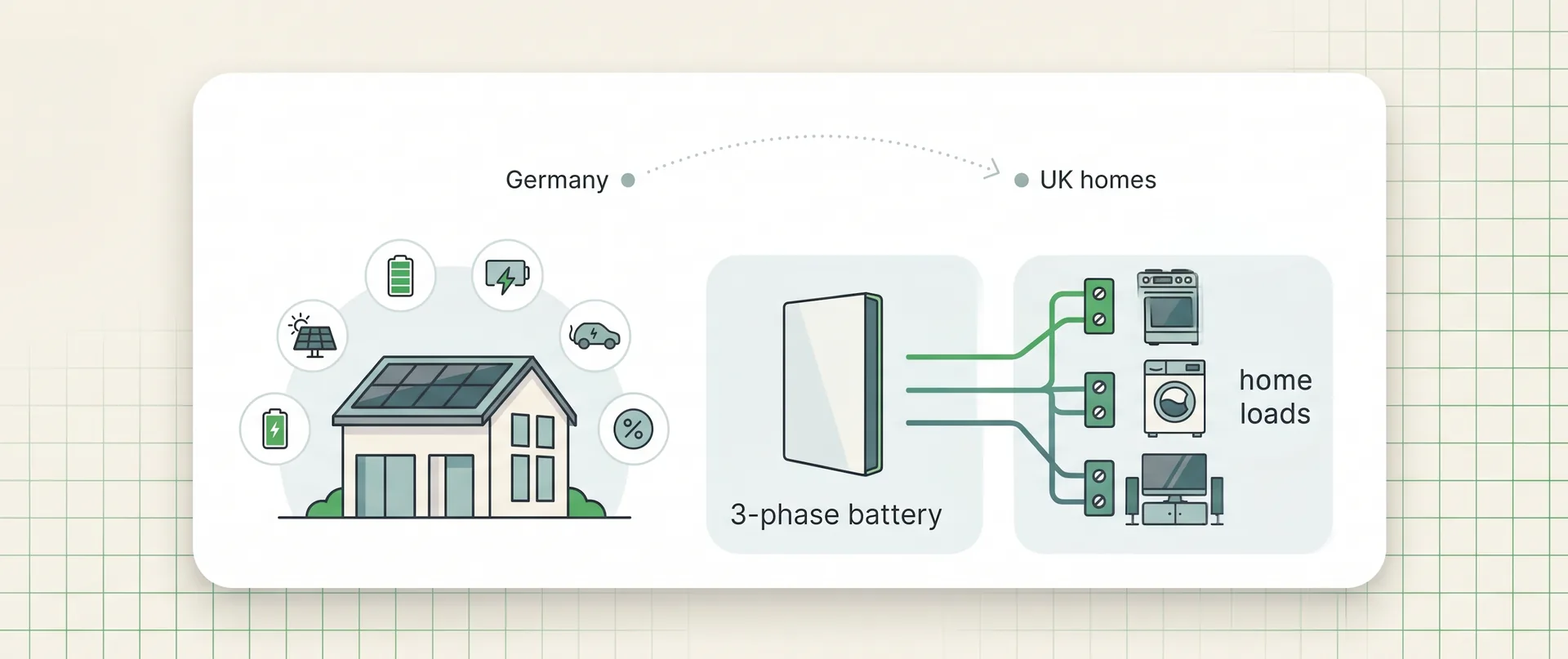
On 23 April 2026, Tesla's Powerwall 3P became available in Germany, with Tesla's German site now listing the new three-phase specification and pv magazine reporting the launch. For most UK homeowners, that might sound like a regional product update. It is more useful than that.
The Powerwall 3P is Tesla's version of Powerwall 3 built around Europe's three-phase electrical reality. Instead of trying to make a single-phase battery fit a larger three-phase home, Tesla has put three-phase output, solar inversion, battery storage, and home energy management into one unit.
That matters because UK homes are changing. Solar is becoming normal. EVs are no longer niche. Heat pumps are moving from "future upgrade" to real installation. Smart tariffs are getting more dynamic. The battery is no longer just a box that stores solar for the evening. It is becoming the part of the home that has to make sense of everything else.
That is close to the problem 1app.energy is built around: not replacing the battery, charger, tariff, or other home equipment, but giving supported homes clearer visibility and tariff-aware battery behaviour where enabled, so one decision does not quietly undermine another.
What is Tesla Powerwall 3P?
Powerwall 3P is the three-phase version of Tesla's current home battery platform. The standard UK Powerwall 3 is a single-phase unit. It can still be installed in many UK homes and remains the relevant product for most single-phase properties.
Powerwall 3P is different because the inverter is designed natively for three-phase homes. According to Tesla's German Powerwall page, the headline specification is:
- 13.5 kWh energy capacity per Powerwall 3P
- Up to 15.4 kW AC power, with a 21 kW one-second backup peak
- Four MPPT solar inputs
- 98.4% solar-to-grid efficiency
- Up to three Powerwall 3 Expansion modules, for 54 kWh total storage
- 1,105 mm x 609 mm x 193 mm enclosure, at 138 kg
- Operation from -20 C to 50 C
- Flood and dust resistance, with flood resistance listed up to 0.6 m
- 10-year warranty
There is an important caveat on the power rating. Tesla's own German footnote says the 15.4 kW AC output is available at 25 C with sufficient solar generation. Without solar, or at higher temperatures, Tesla references up to 11.5 kW AC output. That does not make the product less interesting, but it does mean the "15.4 kW" number should not be read as a guaranteed all-conditions output for every home.
Watch Tesla's Germany launch video
Tesla's Germany launch video is worth watching because it shows the use case Tesla is clearly aiming at: a home with solar, storage, EV charging, and high electrical demand, not just a small battery added to a simple roof array.
Watch on YouTube
Tesla Powerwall 3P Germany launch video
Opens in a new tab so the article does not depend on a third-party video iframe.
The useful takeaway is not the marketing line. It is the direction of travel: home batteries are being designed for bigger loads, more complex roofs, smarter electricity prices, and homes where backup power has to cover more than lights and a fridge.
Why Tesla launched Powerwall 3P in Germany first
Germany is a natural first market for Powerwall 3P. Three-phase 400 V supplies are common in German homes, rooftop solar adoption is high, and many homes are already adding heat pumps and EV chargers. A three-phase battery avoids the awkwardness of trying to balance phases with multiple single-phase units.
There is also a tariff angle. Germany has a growing market for dynamic pricing and home energy management. Tesla's system is not just a battery; it includes a home energy management layer that can use solar production, home consumption, weather data, and electricity prices to decide when to store or discharge energy.
That is the same broad direction the UK is heading in. The UK government has already signalled through its smart appliance standards work that EV chargers, heat pumps, and battery storage systems should become more interoperable across suppliers and tariffs. That is not just a policy detail. It is a sign that home energy is moving away from isolated devices and toward coordinated control.
Single-phase vs three-phase Powerwall for UK homes
Most UK homes still use a single-phase 230 V supply. For those homes, the standard Powerwall 3 remains the product to look at today. Tesla's UK Powerwall page currently lists Powerwall 3 with 13.5 kWh capacity, up to 11.04 kW on-grid and backup power depending on local conditions, three solar inputs with MPPTs, and 97.5% solar-to-grid efficiency.
Three-phase is different. Instead of one live conductor supplying the property, a three-phase supply gives three live conductors. That allows higher total power, better load balancing, and native support for some high-demand equipment.
You are more likely to care about three-phase if you have, or are planning:
- A large detached home or major electrical upgrade
- Multiple EVs
- A high-output EV charger
- A heat pump and battery system
- A large solar array
- A workshop, annex, or other heavy electrical load
The key point is not that every UK home suddenly needs three-phase. Most do not. The point is that the homes that are electrifying fastest are also the homes where the limits of a simple single-phase setup show up first.
What Powerwall 3P means for standard UK single-phase homes
If your home is single-phase, the Germany launch does not mean you should pause everything and wait.
As of 17 June 2026, Tesla's UK reward page is focused on the standard Powerwall 3 and Powerwall 3 Expansion. Those products remain the practical Tesla route for many UK single-phase homes with solar, an EV, or a smart tariff. Powerwall 3 gives you usable storage, backup options, and tariff-aware behaviour through the Tesla app.
The current UK support landscape is also worth separating clearly:
- Domestic battery storage installations can qualify for 0% VAT under HMRC's energy-saving materials rules. The temporary zero rate is currently listed through 31 March 2027.
- Tesla is running its own UK "Next Million Powerwall Program", offering a Virtual Visa Reward Card of £375 per eligible Powerwall 3 or Powerwall 3 Expansion, up to £750 total. Tesla lists the order window as 1 December 2025 to 30 June 2026, with installation and registration required by 31 August 2026.
That second point is a Tesla reward programme, not a government Energy Smart Appliance grant. It is useful, but the eligibility rules matter. The dates and terms are Tesla's own programme details, so check Tesla's current page before relying on them.
What Powerwall 3P means if you have three-phase power
If you already have three-phase power, or you are planning a serious all-electric upgrade, Powerwall 3P is more relevant.
One unit designed for three-phase backup is cleaner than trying to solve the problem with multiple single-phase batteries. It should be especially interesting for homes where the electrical load is no longer occasional. A heat pump, an EV charger, an induction hob, battery charging, and general household demand can overlap in ways that old home energy assumptions did not need to handle.
The UK timing is still not confirmed. As of 17 June 2026, the current UK Tesla reward programme is for Powerwall 3 and Powerwall 3 Expansion, not Powerwall 3P. Powerwall 3P may arrive, and the German launch is a strong signal that Tesla is taking European three-phase homes seriously, but homeowners should not design an installation around an unannounced UK product until Tesla or a Tesla Certified Installer confirms availability.
The practical move is to speak with an installer before you lock in a design. For larger systems, you may also need DNO approval, export-limit planning, and a clear answer on backup circuits versus whole-home backup.
Why Powerwall 3P is also a home-energy coordination problem
The more powerful the battery, the more important the control logic becomes.
A simple solar-and-battery home can often work well with a basic schedule: charge from solar, discharge in the evening, maybe charge from the grid during a cheap overnight window.
But a modern UK home is messier:
- Octopus Intelligent Go may schedule an EV charging session during the day.
- Agile prices may change every half hour.
- A heat pump may run before the home wakes up and again during the evening peak.
- The battery may see a big load and discharge into it, even when cheap grid power is available.
- Solar may be worth storing for the evening, exporting, or using immediately depending on the tariff.
No single device sees the full picture. The EV charger knows about the car. The battery knows about the battery. The heat pump knows about comfort. The tariff provider knows about price. The homeowner is left joining the dots manually.
That is where 1app.energy fits.
1app.energy is not trying to be another battery app. It gives supported homes one clearer place for solar, battery storage, EV charging and tariff visibility, with automation only where the integration is supported and customer-enabled. The goal is to help the battery do the right job for the whole home, not just react blindly to the next load it sees.
For example, if a smart EV session starts while the battery is full, the right answer may be to hold the battery and let cheap grid electricity charge the car, where that behaviour is supported. If another high-demand load is likely during a peak period, the right answer may be to protect a reserve if that context is available. If solar is forecast to be strong later, the right answer may be different again.
Powerwall 3P is interesting hardware. But the homes that need hardware like this also need better coordination.
If you are comparing batteries for an Octopus or Solis home
Search interest in Powerwall 3P often comes from homeowners who are not only choosing a battery. They are trying to decide whether solar, EV charging and a smart tariff can work together without becoming hard to manage.
If that is your situation, use the Tesla news as a prompt to check the whole system:
- Solis IntelliHome and FlexHome batteries: what to check
- Intelligent Octopus Go and home batteries: Charge Cap explained
- Stop Octopus daytime EV charging from draining your home battery
- Solis integration
- Octopus Energy integration
This does not mean 1app.energy supports Tesla Powerwall today. It means the same coordination questions are already active for supported Solis, Octopus and charger homes.
Should UK homeowners wait for Tesla Powerwall 3P?
For most single-phase homes, probably not. If the current Powerwall 3 fits your home, your installer confirms the design, and the numbers work for your tariff, waiting for an unconfirmed UK 3P launch may simply delay a workable installation.
For larger homes, new builds, major renovations, or households moving toward multiple high-draw devices, it is worth asking the three-phase question now. Not because Powerwall 3P is guaranteed to land in the UK on a specific date, but because the electrical design choices you make today can limit what you can install tomorrow.
A good installer conversation should cover:
- Whether your home is single-phase or three-phase today
- Whether three-phase would materially help your planned loads
- How much solar you can actually connect
- Whether you want backup for essential circuits or the whole home
- Which tariff you expect to use
- Which supported data sources and control options are available for your battery, EV charger and other high-demand loads
That last question is often the missing one. It is also the question that determines whether the battery behaves like a useful home asset or just an expensive load follower.
The 1app.energy view on Powerwall 3P
The Powerwall 3P launch is not just "new Tesla battery news". It is part of a wider shift: homes are becoming small energy systems.
That shift is good for homeowners, but only if the devices can work together. A battery with more power can cover more of the home. It can also make bigger mistakes if it discharges at the wrong time, drains before the evening peak, or misses a cheap refill window.
If you are planning solar, battery storage, EV charging, or a heat pump, do not look at the battery in isolation. Look at how the whole home will behave across a real day.
That is the problem 1app.energy is working on for UK homes: giving supported setups a clearer view of tariff, battery, EV charger and solar behaviour, with automation only where integrations are supported and enabled.
Common questions about Tesla Powerwall 3P in the UK
Is Tesla Powerwall 3P available in the UK?
Tesla launched Powerwall 3P in Germany first. As of 17 June 2026, UK homeowners should treat UK Powerwall 3P availability as unconfirmed unless Tesla or a Tesla Certified Installer confirms it for the specific project.
Is Powerwall 3P different from Powerwall 3?
Yes. Powerwall 3P is the three-phase version aimed at homes where three-phase output and larger loads matter. Standard Powerwall 3 remains the relevant Tesla product for many UK single-phase homes.
Should I wait for Powerwall 3P before installing a battery?
Most single-phase UK homes should not delay a workable installation purely for an unconfirmed UK 3P launch. Larger homes, three-phase properties and major electrification projects should ask installers about future three-phase options before committing.
Does the UK Tesla reward programme include Powerwall 3P?
Tesla's UK reward page checked on 17 June 2026 lists Powerwall 3 and Powerwall 3 Expansion. It does not make Powerwall 3P a current UK reward-programme purchase route.
Does 1app.energy support Tesla Powerwall today?
This article does not announce Tesla integration support. 1app.energy focuses on supported homes and should only show or control devices where the integration is supported, verified and customer-enabled.
Sources checked on 17 June 2026
- Tesla UK Powerwall reward programme, for current UK Powerwall 3 and Powerwall 3 Expansion reward terms.
- Tesla Powerwall page, for current Powerwall positioning.
- Tesla Powerwall 3 technical specification, for Powerwall 3 specification context.
- pv magazine report on the German Powerwall 3P launch, for the original Germany launch date.
Related reading about home battery coordination
- Home energy dashboard source of truth: what to check
- Heat pump + battery + EV: why a smart tariff alone is not enough
If you already have a battery and smart tariff, see how 1app.energy connects supported home energy data. If you are choosing equipment now, check which integrations are in the current rollout before you commit to a setup.
Relevant smart controls
These mode pages are the closest product-side follow-on from the issue explained in this article.
Autopilot
The best starting mode for most homes. Autopilot charges when power is cheap, keeps battery back for the home, and can export spare battery power when prices are high.
Home First
A simpler home-first mode. It runs the home from your own solar and battery first and avoids automatic battery export.
Time-based Control
A simple schedule-based mode. Time-based Control charges the battery during your cheaper tariff periods until it reaches the battery target you set.
Does this sound like your home?
Your setup might already qualify.
Tell us which devices and tariff you are on. We review every request and invite in order of fit, not sign-up date.