G98, G99 and G100 explained for UK solar battery homes
A plain-English guide to G98, G99, G100 export limits and DNO forms for UK solar battery homes, plus how 1app.energy helps after installation.
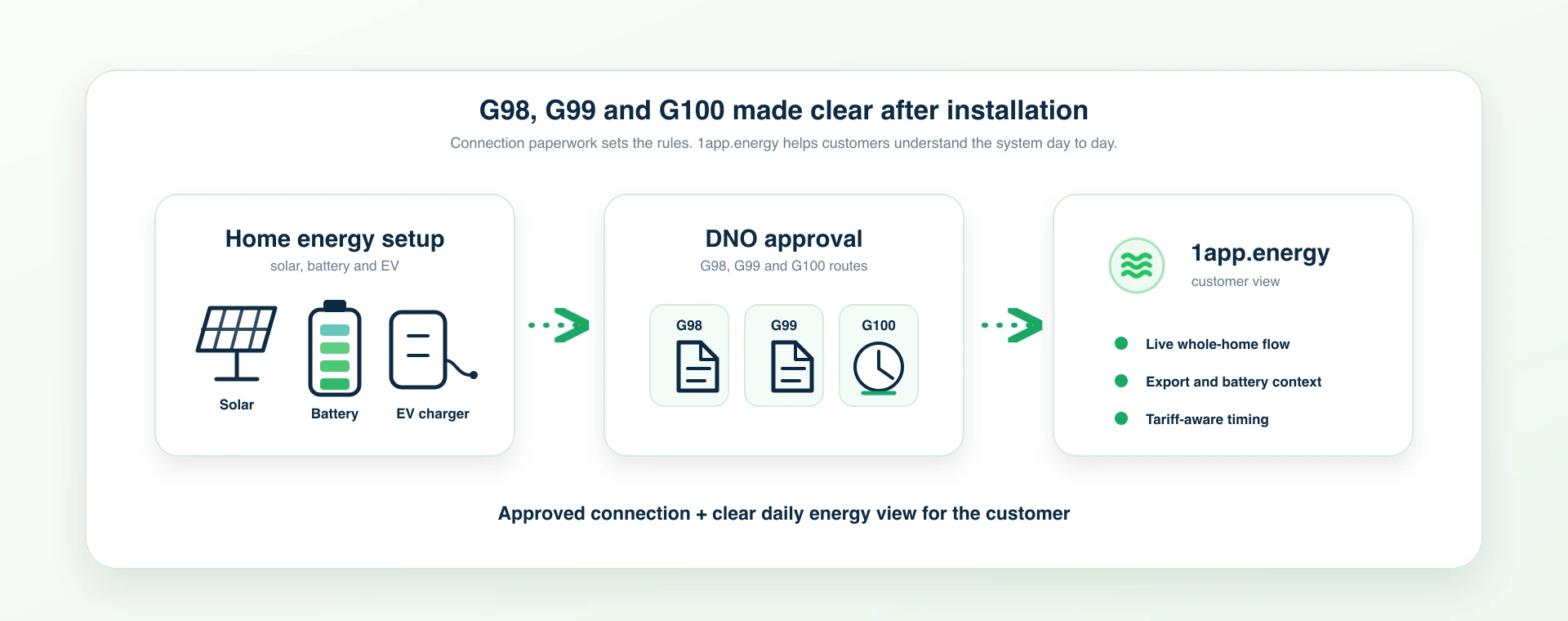
If you are installing solar panels, a hybrid inverter or battery storage in the UK, the system is not only judged by what the hardware can do. It also has to connect safely to the local electricity network.
That is why homeowners and installers often hear terms like G98, G99, G100, Fast Track, export limit, A1-1, A1-2, A3-1 and A3-2.
The forms matter. They tell the Distribution Network Operator, usually called the DNO, what is being installed and whether the network can accept the proposed generation or export.
But once the system is approved and installed, the customer has a different question:
What is my solar, battery, EV charger and tariff actually doing day to day?
That is where a customer app like 1app.energy becomes useful.
This guide explains G98, G99 and G100 in plain English, what the common forms mean, and why clear post-install visibility matters for homes with solar, battery storage, EV charging and time-of-use tariffs.
This article is a customer education guide, not legal, electrical or DNO application advice. Your installer and DNO should always confirm the correct process for your site.
The quick version
For many small domestic solar systems, the process is simpler because the inverter output is within the G98 threshold.
Once the total generation or storage capability is above 16A per phase, commonly explained as 3.68kW per phase, the installation normally moves into G99. National Grid Electricity Distribution describes G99 as applying to generation installations above 16A/3.68kW per phase.
G98 is still a DNO process. It is usually a simpler "fit and notify" route for fully type tested micro-generation, but the DNO still needs the installation information after commissioning.
G99 is the DNO connection process.
G100 is different. G100 is about export or import limitation. It is used when a system needs to make sure it does not export, or import, above an agreed limit.
In simple terms:
- G98 is the simpler route for small, fully type tested micro-generation up to 16A per phase.
- G99 asks whether the system can connect to the network.
- G100 explains how an export or import limit will be controlled.
- Commissioning forms confirm that the approved system has been installed and tested.
- 1app.energy helps the customer understand the live system after installation, where supported.
Where G98 fits in before G99
G98 is the connection route for small, fully type tested micro-generators connected at low voltage.
The key threshold is 16A per phase. In practical domestic language, that is usually described as:
- 3.68kW on a single-phase supply at 230V; or
- 11.04kW on a three-phase supply at 400V.
The important detail is that the threshold is based on the aggregate registered capacity at the premises. ENA guidance also makes clear that micro-generators include electricity storage devices, so batteries and hybrid inverters can affect whether the site still fits G98.
For inverter-connected solar or battery systems, the relevant capacity is normally the inverter's continuous AC rating, not just the solar panel DC size on the roof. That is why a roof may have more panel capacity than the inverter's export capability, and why the inverter/battery arrangement matters.
For a typical single-premises G98 installation, National Grid describes the process as fit and notify:
- the installer fits and commissions the G98-compliant system;
- the installer sends the G98 Installation Document and operation diagram to the DNO;
- the notification should be sent within 28 days of commissioning.
G98 does not mean "no paperwork". It means the system is small enough, and type tested enough, for a simpler notification route.
There is also a separate G98 Multiple Premises route when an installer is connecting multiple G98 installations in the same close geographic region within 28 days. That route is more relevant to installer workflows than a single homeowner, but it is worth knowing because it can change whether work needs DNO agreement before installation.
In simple customer terms:
- a small solar inverter may fit G98;
- adding a battery, second inverter or larger hybrid inverter may push the aggregate capacity above G98;
- if the system exceeds 16A per phase, or does not meet G98 requirements, G99 normally applies;
- if export must be limited, G100 may also be needed.
Why G99 matters for solar and battery homes
A modern home energy setup is often more than a few solar panels.
It may include:
- solar panels;
- a Solis hybrid inverter or another inverter;
- battery storage;
- an EV charger;
- an Octopus tariff or another time-of-use tariff;
- export payments;
- a DNO-approved export limit.
From the network's point of view, the important question is not simply how many panels are on the roof. It is how much power the system can push towards the grid.
That is why inverter capacity, battery storage and export settings matter. A battery can store energy, but a hybrid inverter and battery setup may also be capable of exporting power. The DNO needs to understand the total connected generation and storage arrangement before approving the connection route.
For the customer, this can feel confusing because the paperwork is written for network compliance, not everyday use.
The customer may only care about practical questions:
- Why was I given a 3.68kW, 5kW or 7.36kW export limit?
- Does the export limit stop my battery from powering the house?
- Will I lose solar energy if export is capped?
- Can my EV still charge without draining the home battery?
- Can I still use Octopus smart tariffs or manual tariff periods?
The answer depends on the installed hardware, DNO approval, inverter settings and how the system is managed after installation.
The common G99 application forms
The exact route depends on the installation, the DNO area and whether the system qualifies for Fast Track. Some DNOs now provide online application flows, but the form names are still useful because installers and DNO emails often refer to them.
As a plain-English map:
| Form | When it is normally used |
|---|---|
| G99 A1-1 | When the total installation size is above 3.68kW per phase, falls outside the G99 Fast Track parameters, and is still within the smaller Type A route used for many domestic and small commercial systems. Some DNO communications describe this as below 51kW; National Grid's public guidance describes A1-1 using below 50kW three-phase or 17kW single-phase wording. |
| G99 A1-2 | When the installation falls within the G99 Fast Track parameters. |
| G99 Standard Application | When the installation is larger or more complex, including cases that fall outside the smaller A1-1 and Fast Track routes. Some DNO communications describe this as 51kW or larger. |
G99 A1-1
G99 A1-1 is generally used for smaller Type A applications that do not fall into the Fast Track route.
National Grid's current G99 guidance describes A1-1 as the application form for power generating modules with total aggregate capacity below 50kW three-phase or 17kW single-phase. Some DNO communications may describe similar domestic/small-commercial routes in slightly different terms, so the installer should always follow the current DNO guidance for the site.
For homeowners, the practical meaning is:
The system is above the simple G98 route and needs a G99 application before connection.
G99 A1-2
G99 A1-2 is used for Fast Track applications where the system fits the relevant Small Generation Installation, or SGI, criteria.
Fast Track does not mean "ignore the DNO". It means the installation fits a more streamlined G99 route because the equipment is type tested and the capacity/export limits fit the Fast Track rules.
National Grid describes SGI-2 and SGI-3 as application processes followed by notification within 28 days of commissioning.
G99 Standard Application
Larger or more complex systems use the standard G99 application route.
This is more common for larger commercial systems, larger three-phase systems, or cases where the installation falls outside the smaller A1-1 and Fast Track routes. If your project is domestic but unusually large, three-phase, or has multiple generation sources, your installer should confirm whether standard G99 applies.
Commissioning forms after installation
Approval is not the end of the process.
Once the approved generation has been installed and commissioned, the installer normally has to send the relevant commissioning or notification form back to the DNO.
These are the installer's confirmation that the approved generation equipment has been installed and commissioned. DNO guidance commonly requires the commissioning information to be sent within 28 calendar days of the commissioning tests being carried out on site.
G99 A3-1
G99 A3-1 is used for commissioning where the installation falls outside the Fast Track parameters.
G99 A3-2
G99 A3-2 is used for commissioning where the installation falls within the Fast Track parameters.
National Grid's G99 Fast Track guidance refers to the follow-up notification after commissioning, and its connection procedures show A3-2 for Fast Track SGI-2 and SGI-3 commissioning.
The important customer point is simple:
Your installer should complete the post-install commissioning paperwork, because the DNO needs confirmation that the approved equipment and settings were actually installed.
Where G100 fits in
G100 is about export and import limitation.
National Grid explains export limitation as a way for customers to install more generation or storage while restricting the net export of the connection, rather than waiting for or contributing to upstream network reinforcement.
In practical domestic terms, that might mean:
- the inverter and battery could technically export more;
- the DNO approves the system only if export is capped;
- a G100-compliant export limitation scheme is used to keep export at or below the agreed limit.
This can be a sensible compromise. It may allow the customer to install a larger solar and battery system while respecting what the local network can accept.
But it is important not to confuse export limitation with customer optimisation.
G100 makes sure the system does not export above an agreed limit. It does not, by itself, explain to the customer when solar is being used, when the battery is full, when the EV is charging, or whether the tariff strategy makes sense.
The common G100 forms
The ENA G100 Issue 2 document defines three forms that are often referred to by installers and DNOs.
In practical terms:
| Form | What it is for |
|---|---|
| G100/2 Form A | The application information where export or import needs to be limited. |
| G100/2 Form B | The manufacturer or compliance declaration for the G100/2 device or scheme, including how the device limits export or import. Where the product is already type tested and registered, the installer may only need the manufacturer reference or declaration. |
| G100/2 Form C | The commissioning confirmation after generation equipment has been installed with export limitation applied. This should sit alongside the relevant G99 A3 commissioning form where export limitation is part of the approved installation. |
G100/2 Form A
Form A is the application information for the Customer Export or Import Limitation Scheme.
It explains the limitation scheme, requested maximum export or import limit, equipment details and how the scheme operates. It normally accompanies the relevant generation, storage or significant load application.
G100/2 Form B
Form B is the manufacturer or compliance verification information for the export/import limitation scheme.
If the limitation product is fully type tested and registered with the ENA Type Test Register, the installer may be able to quote the manufacturer reference instead of providing a full Form B each time.
G100/2 Form C
Form C is the installation and commissioning confirmation for the limitation scheme.
It confirms that the export/import limitation scheme has been installed, tested and commissioned. The ENA G100 document says that if the required commissioning checks fail, the limitation scheme should not be put into service.
For a homeowner, the practical summary is:
If your system has an export limit, your installer should make sure the approved export-limiting setup is documented, installed and commissioned correctly.
What Fast Track means
Fast Track is a streamlined G99 route for certain small generation and storage installations.
National Grid describes three Small Generation Installation categories:
- SGI-1: notification-only, where all generation/storage devices are each no more than 16A and the total is also no more than 16A.
- SGI-2: application plus notification, where devices are each no more than 16A and total ratings are no more than 32A, with any G100 scheme limiting export to no more than 16A.
- SGI-3: application plus notification, where devices are each no more than 32A and total ratings are no more than 60A, with any G100 scheme limiting export to no more than 32A.
For SGI-3, DNO wording is often expressed in practical inverter terms:
- one inverter rated at no more than 32A, commonly described as 7.36kW per phase, and fully type tested to G98/G99; or
- two or more inverters where each inverter is no more than 32A / 7.36kW per phase, each is fully type tested, the combined generation capacity is no more than 60A, commonly described as 13.8kW per phase, and a limitation scheme caps export to 32A / 7.36kW per phase or less.
You may also hear installers or DNO emails talk about 5+5 style arrangements. In simple terms, this usually means each generating unit is rated up to 5kW per phase, total installed capacity is 10kW per phase or less, and total export onto the network is limited to 5kW per phase or less.
Treat all of these shorthand labels as prompts to check the exact DNO criteria for the site, not as a substitute for the current application rules.
A real-world example: Solis inverter, battery, EV and export limit
Imagine a home with:
- a Solis hybrid inverter;
- solar panels;
- home battery storage;
- a Zappi or another EV charger;
- Octopus Intelligent Go or another time-of-use tariff;
- a DNO-approved export limit.
The DNO paperwork answers one set of questions:
- What inverter and battery equipment is installed?
- What is the registered capacity?
- Is an export limitation scheme required?
- What maximum export is allowed?
- Has the approved equipment been commissioned?
But the customer still has another set of questions:
- Is the battery charging from solar or the grid?
- Did the EV charger drain the battery during the day?
- Was the battery full before the evening peak?
- Was solar exported because the battery was full?
- Did the tariff strategy help or hurt the customer?
- How much grid import happened during expensive periods?
That is the gap between connection paperwork and everyday customer experience.
Export limits do not remove the need for smart behaviour
An export limit does not automatically make a system worse.
If a home has a battery, an export limit may simply mean the customer needs to use more solar locally, store more at the right time, and avoid unnecessary export peaks.
The best outcome often comes from coordination:
- use solar directly in the home where possible;
- store surplus solar when the battery has space;
- avoid draining the battery into EV charging at the wrong time;
- charge the battery during cheap tariff windows when needed;
- hold or discharge the battery at the right time for the customer's tariff and export value;
- stay within the approved hardware and export settings.
That last point matters. A customer app should not bypass a DNO export limit. The export limit is part of the approved connection setup.
How 1app.energy helps after G98, G99 and G100
1app.energy does not replace the installer, the DNO, G98 notification, G99 approval or a G100-compliant export limitation scheme.
It helps with the part customers actually live with after installation: understanding and managing the system.
For supported Solis-based homes, 1app.energy can bring the key signals into one app:
- live whole-home power flow;
- solar generation context;
- battery charge and discharge behaviour;
- grid import and export;
- EV charging context where supported;
- Octopus dynamic tariff context where supported;
- manual tariff setup for other tariffs;
- daily energy and cost visibility;
- tariff-aware battery behaviour where supported and enabled.
This is useful because a DNO export limit is only one part of the home's energy behaviour.
A customer still needs to know whether the system is using energy sensibly. If the battery is empty by 17:00, if the EV is silently pulling from the battery, or if off-peak charging is not aligned with the tariff, the customer needs visibility and control context.
Why this matters for installers
Installers already deal with the technical forms. The customer usually does not want to learn every DNO process.
What the customer wants is confidence that the system makes sense after installation.
If you install Solis-based solar and battery systems, 1app.energy gives customers a simple post-install app story:
Your G98, G99 or G100 paperwork covers the network connection. 1app.energy helps you understand solar, battery, EV charging and tariff behaviour once the system is running.
That is a clearer customer experience than leaving the homeowner to compare an inverter app, charger app, supplier app and export paperwork on their own.
Common questions about G98, G99, G100 and home batteries
Does G98 mean I do not need to tell the DNO?
No. G98 is usually simpler than G99, but it is still a DNO notification process. For a single-premises G98 installation, the installer normally notifies the DNO within 28 days of commissioning.
Is G98 always enough for a domestic solar and battery system?
No. A small solar-only inverter may fit G98, but adding battery storage or another inverter can change the aggregate registered capacity. If the total capability is above 16A per phase, or the equipment does not meet G98 requirements, the installer should check the G99 route.
Does G99 mean my system has an export limit?
Not always. G99 means the installation needs the relevant generation connection process. The DNO may approve the requested export, approve a lower export, ask for export limitation, or use another connection route depending on the site and local network.
Does G100 mean the system is export limited?
G100 is the standard used for customer export or import limitation schemes. If your DNO approval says export must be limited, the limitation scheme should be designed, documented and commissioned correctly.
Does an export limit stop my battery powering the house?
Usually, an export limit is about how much power can flow back to the network, not how much power the battery can supply to the home internally. The exact behaviour depends on the inverter, battery, wiring, DNO approval and installer configuration.
Can I change my export limit later?
Do not change an export limit casually. If you want a higher export limit or a different inverter/battery setup, speak to your installer and DNO. The approved connection settings matter.
Can 1app.energy keep my system G99 or G100 compliant?
No. Compliance is handled through the approved design, equipment, installer configuration and DNO process. 1app.energy is a customer app that helps with visibility and tariff-aware behaviour where supported. It should work within the approved setup, not replace it.
Why does this matter for Octopus tariffs?
Time-of-use tariffs make timing important. A home may want to charge the battery off-peak, preserve battery energy during EV charging, and avoid expensive grid import during peak periods. G99/G100 defines the connection and export constraints; tariff-aware software helps the customer understand and manage daily behaviour within those constraints.
Final thought
G98, G99 and G100 are important because they help protect the electricity network and define how a solar, battery or generation system connects.
But customers do not live inside a form. They live with the system.
After the installation is approved and commissioned, the customer still needs one clear place to understand solar generation, battery behaviour, EV charging, grid import/export and tariff periods.
That is what 1app.energy is built to help with for supported homes.
One app for solar, battery, EV and tariff.
Sources checked on 6 May 2026: National Grid G98 guidance, National Grid G98 connection procedures, National Grid G99 guidance, National Grid G99 Fast Track guidance, National Grid export limitation guidance, ENA Distributed Generation Guide, and ENA Engineering Recommendation G100 Issue 2.
If you have a supported Solis-based renewable system, visit 1app.energy to start early-access onboarding.
Does this sound like your home?
Your setup might already qualify.
Tell us which devices and tariff you are on. We review every request and invite in order of fit — not sign-up date.